How Satellites Detect a Weak Smartphone Signal
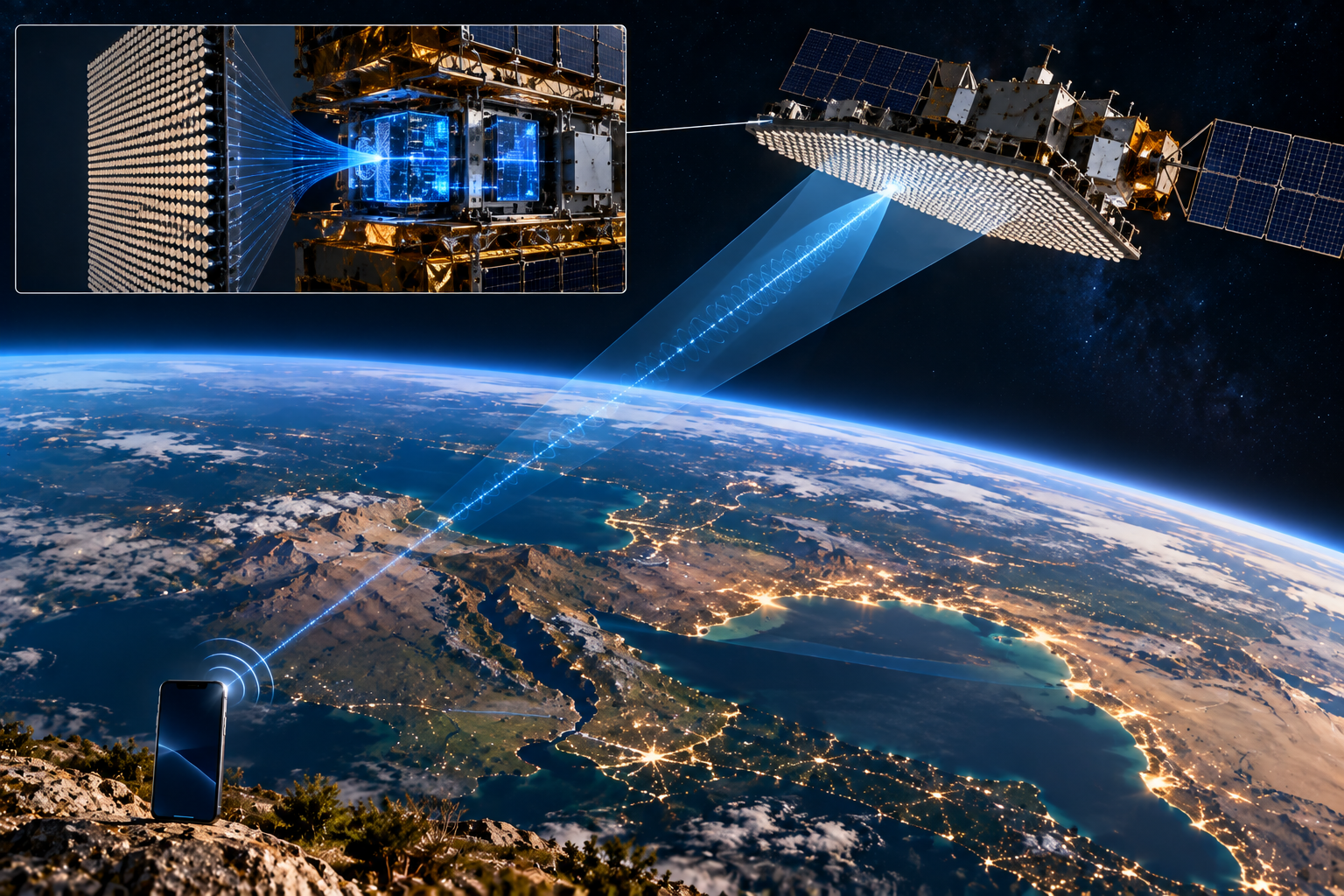
A satellite transmitting toward Earth can carry solar arrays, powerful electronics and a large antenna system. Your smartphone has none of those advantages. It runs from a small battery, hides its antennas inside a thin case and normally communicates with cell towers located relatively close to the user. Yet direct-to-device satellite networks are being engineered to detect that phone from hundreds of kilometers above Earth.
The surprising part is the uplink. The satellite does not somehow make the smartphone transmit like a powerful ground station. Instead, engineers build the complete radio link around the weak transmitter already in your hand. Large orbital antennas, focused beams, low Earth orbit, sensitive receivers, signal processing and precise compensation for satellite motion all contribute to making that weak signal usable.
A weak signal is not automatically an undetectable signal. What matters is whether the wanted transmission arrives at the satellite with enough signal quality relative to noise and interference for the receiver to acquire, synchronize and decode it.
- Why a Smartphone Signal Is So Weak in Space
- What Happens to the Signal on the Way Up
- Why Low Earth Orbit Helps
- The Satellite Uses a Much Larger Antenna
- How Beamforming Helps Detect the Phone
- The Battle Between Signal and Noise
- What the Satellite Receiver Actually Detects
- Why Doppler Makes the Uplink Harder
- Timing Is Another Hidden Problem
- Why Frequency Choice Matters
- What Happens After the Signal Is Detected
- Why the Connection Still Has Limits
- Reality Check
- Final Verdict
- FAQ
Why a Smartphone Signal Is So Weak in Space
A normal smartphone was designed around terrestrial cellular networks.
Its radio transmitter must operate within strict power, thermal, battery and regulatory constraints. Its antennas must fit inside a compact device alongside cameras, batteries, processors and several other radio systems.
That is completely different from a traditional satellite earth station with a directional dish and dedicated transmitter.
When a phone sends a signal toward a terrestrial tower, the network is usually designed around relatively short terrestrial distances. Direct-to-device communication stretches that concept dramatically.
The phone may now be transmitting toward a spacecraft hundreds of kilometers away.
The challenge is therefore not to make the smartphone behave like a satellite terminal with a large directional antenna. The network must detect the phone despite those limitations.
What Happens to the Signal on the Way Up
Radio energy spreads as it travels.
As the distance between transmitter and receiver increases, the receiving antenna intercepts only a fraction of the transmitted energy.
This effect is described in a link budget as free-space path loss.
It is one of the fundamental reasons satellite communication is difficult.
Path loss depends strongly on distance and frequency. Moving a receiver much farther away does not merely make the signal slightly weaker. The additional propagation distance can create a substantial RF penalty.
The uplink therefore begins with an uncomfortable combination:
Small handset antenna + limited handset power + long radio path = extremely demanding satellite receiver.
But path loss alone does not decide whether the link works.
The complete link budget also includes antenna gain, receiver sensitivity, noise, interference, bandwidth, waveform characteristics and coding.
Why Low Earth Orbit Helps
Distance is one reason many direct-to-device broadband systems use low Earth orbit.
A geostationary satellite operates approximately 35,786 kilometers above Earth’s equator. A LEO direct-to-device satellite can operate hundreds rather than tens of thousands of kilometers above the surface.
That shorter path is extremely valuable to the link budget.
It does not eliminate free-space loss, but it makes direct communication with low-power handheld devices considerably more practical.
There is a tradeoff.
A geostationary satellite appears nearly fixed in the sky to a ground observer. A LEO satellite moves rapidly relative to the user.
The network therefore gains a shorter RF path but inherits major challenges involving Doppler, timing, moving coverage beams, satellite tracking and handover.
This is a recurring theme in satellite engineering: improving one part of the system often creates another problem that must be solved elsewhere.
The Satellite Uses a Much Larger Antenna
The smartphone cannot carry a giant antenna, but the satellite can carry something much larger.
This is one of the most important engineering techniques behind direct-to-device broadband.
A large receiving aperture provides antenna gain. That gain helps the satellite collect more of the weak radio energy arriving from the handset.
AST SpaceMobile provides an unusually clear example of this architecture. Its BlueBird 1-5 satellites use phased-array antennas measuring 693 square feet, while its next-generation BlueBird satellites use arrays of roughly 2,400 square feet. The company specifically links these large arrays to the low power and small antenna size of standard mobile phones. :chatgpt-content-reference{index=”0″}
This reverses the traditional satellite-phone approach.
Instead of requiring the consumer to carry a large specialized antenna, much of the antenna gain is placed on the spacecraft.
For a deeper explanation of that design shift, see Why Satellite Phones Need Huge Antennas but Your Smartphone Doesn’t.
How Beamforming Helps Detect the Phone
A large antenna becomes even more useful when it is a phased array.
A phased array contains many antenna elements that can operate together with carefully controlled phase relationships.
The system can electronically form and steer beams without mechanically pointing a traditional dish toward every individual coverage area.
For direct-to-device networks, this allows the satellite to concentrate RF performance into geographic cells rather than treating an enormous area of Earth as one undivided coverage zone.
AST describes its arrays as creating highly focused beams while supporting many coverage cells. :chatgpt-content-reference{index=”1″}
This matters for both sides of the link.
On the downlink, a focused beam helps deliver useful signal toward phones on the ground.
On the uplink, antenna gain and spatial selectivity help the satellite receive the phone’s weak transmission while managing unwanted energy and interference.
The Battle Between Signal and Noise
A satellite does not need the smartphone signal to arrive “strong” in an everyday sense.
It needs the wanted signal to be sufficiently distinguishable from noise and interference for the radio system to recover the information.
This makes receiver noise performance important.
Every receiving system contains thermal noise. Electronics introduce additional noise, and other transmitters can contribute interference.
The satellite’s RF front end, antenna gain, bandwidth and signal processing therefore determine how effectively the wanted signal can be extracted.
Digital communication also benefits from coding and error-correction techniques.
The receiver does not need every transmitted bit to arrive perfectly. Proper coding can allow the system to recover information despite some errors.
But error correction is not unlimited.
Once the signal quality falls below the practical threshold required by the waveform and coding scheme, reliable decoding becomes impossible.
| Factor | Effect on Smartphone-to-Satellite Uplink |
|---|---|
| Shorter orbital distance | Reduces propagation loss compared with much higher orbits |
| Larger satellite antenna | Provides more receive gain |
| Focused beam | Concentrates antenna performance into a geographic area |
| Low receiver noise | Helps preserve weak-signal detectability |
| Suitable coding | Allows recovery despite some transmission errors |
| Interference control | Protects the wanted cellular signal from competing energy |
| Doppler compensation | Helps keep the rapidly shifting signal within radio tolerances |
What the Satellite Receiver Actually Detects
The satellite does not simply listen for a voice waveform coming directly from the phone.
The handset transmits a structured cellular radio signal according to the network technology being used.
The receiving system must first detect and acquire that transmission, establish synchronization and then demodulate the encoded information.
This is particularly important when a device initially attempts to access the network.
In cellular systems, random-access procedures help establish initial uplink synchronization between user equipment and the network.
Ericsson notes that satellite distance and motion create special difficulties for these procedures because excessive residual delay or Doppler can distort the access signal enough to cause detection failures. :chatgpt-content-reference{index=”2″}
So “detecting a smartphone” actually involves several RF and protocol layers working together.
The satellite network must not only hear energy. It must recognize the correct transmission and recover it within the timing and frequency tolerances required by the radio system.
Why Doppler Makes the Uplink Harder
A LEO satellite can travel at several kilometers per second relative to Earth.
That creates Doppler shift.
The basic principle is similar to the changing pitch of a siren as a vehicle approaches and then moves away, except here the effect appears as a shift in radio frequency.
AST says its satellites travel at around 17,000 mph and describes gateway technology that compensates for Doppler and delay. :chatgpt-content-reference{index=”3″}
For a terrestrial mobile phone, this is a major change in operating environment.
Traditional cellular networks were designed around base stations that do not orbit the planet at enormous speed.
If the frequency shift is not compensated sufficiently, the receiver can have difficulty maintaining synchronization with the handset signal.
The challenge also changes as the satellite moves across the sky.
The Doppler relationship at the beginning of a pass is not identical to the relationship later in the pass.
Timing Is Another Hidden Problem
Distance introduces propagation delay as well as signal loss.
Radio waves travel extremely quickly, but not instantaneously.
Terrestrial cellular standards were designed with particular timing assumptions. Put the radio access node in orbit and those assumptions need careful handling.
There are different engineering approaches.
Some direct-to-device systems aim to support existing terrestrial cellular devices while the network compensates for satellite effects.
In standardized 3GPP NR-NTN, newer compatible user equipment can participate directly in compensation. Ericsson explains that Release 17 NTN devices can use their position together with satellite ephemeris information to calculate timing and frequency corrections for uplink transmission. :chatgpt-content-reference{index=”4″}
This distinction is important.
There is no single technical method behind every service marketed as satellite-to-phone or direct-to-device.
Why Frequency Choice Matters
Frequency influences propagation loss, antenna design, available bandwidth and the behaviour of signals around obstacles.
It also determines whether an ordinary smartphone has compatible radio hardware.
This is why spectrum is central to direct-to-device engineering rather than just a regulatory detail.
Some systems use frequencies associated with mobile network operators so existing cellular devices can communicate using supported bands. Standardized NTN systems can follow a different spectrum path.
Ericsson identifies both unmodified terrestrial-cellular approaches and 3GPP NTN as active D2D architectures, each with different compatibility and engineering tradeoffs. :chatgpt-content-reference{index=”5″}
Lower frequencies can offer useful propagation characteristics, but spectrum availability, interference protection, bandwidth and licensing must all be considered.
A satellite cannot simply transmit on whatever cellular frequency provides the easiest link.
What Happens After the Signal Is Detected
Receiving the smartphone uplink is only the beginning.
The satellite service still needs to connect that transmission to the telecommunications network.
One architecture uses ground gateways.
AST describes a path where the smartphone signal reaches the satellite, is relayed to a gateway, undergoes compensation for satellite-related effects and is then routed into a partner mobile operator’s network. :chatgpt-content-reference{index=”6″}
Smartphone → LEO Satellite → Ground Gateway → Mobile Operator Network → Destination
This shows why direct-to-device is more accurately viewed as an extension of telecommunications infrastructure rather than a phone communicating independently with a spacecraft.
The satellite provides the missing radio-access layer where terrestrial towers cannot provide coverage.
Why the Connection Still Has Limits
A huge satellite antenna does not create unlimited coverage or capacity.
Every beam has finite spectrum and power. Every coverage cell can support only a finite amount of traffic. Interference must be controlled, and the satellite must serve many users across a large geographic area.
The handset’s environment matters too.
Buildings, vehicles, terrain and other obstructions can consume link margin. Device orientation and the available satellite geometry can also affect performance.
There is therefore an important difference between demonstrating that an ordinary phone can establish a satellite link and guaranteeing terrestrial-like broadband performance in every location.
Capacity is another challenge.
A terrestrial mobile operator can deploy many base stations and divide a city into numerous small cells. A satellite covers much larger areas, so spatial reuse, beam design and spectrum management become critical.
Modern phased arrays can create many cells, but the RF resources remain finite.
Reality Check
A satellite does not detect a smartphone because the phone suddenly becomes a powerful satellite transmitter.
The handset remains a small, power-limited radio device. The engineering achievement is building a satellite network capable of closing the link anyway.
That can involve a shorter LEO path, enormous receive arrays, focused beams, carefully designed receiver electronics, interference management, coding, Doppler correction and timing compensation.
AST SpaceMobile provides one real-world implementation using very large phased arrays specifically intended to capture weak signals from standard phones, while 3GPP NTN provides another important technical path in which compatible devices and networks incorporate satellite-specific timing and Doppler mechanisms. :chatgpt-content-reference{index=”7″}
These approaches should not be treated as technically identical simply because both can be described as direct-to-device satellite communication.
Final Verdict
The most impressive part of satellite-to-phone technology may not be sending a signal from space to your phone. It is hearing your phone transmit back.
A smartphone starts with several disadvantages: limited power, a tiny internal antenna and a radio system originally built around terrestrial cellular networks.
Direct-to-device networks compensate at the system level.
LEO reduces the distance. Large phased arrays increase satellite antenna gain. Beamforming concentrates performance into coverage cells. Sensitive receivers search for usable signals near the noise floor. Coding helps recover imperfect transmissions. Timing and Doppler compensation keep the moving satellite and terrestrial-style handset synchronized.
Once the signal is acquired, gateways and mobile operator infrastructure can carry the connection into the wider network.
The weak smartphone signal never stops being weak. The breakthrough is that the satellite network has become sophisticated enough to detect, recover and use it.
Frequently Asked Questions
| Question | Answer |
|---|---|
| How can a satellite detect a smartphone hundreds of kilometers away? | The complete link can combine a relatively short LEO path, high satellite antenna gain, focused beams, sensitive receiver electronics, signal processing and error correction. |
| Does the smartphone transmit more power in satellite mode? | The exact behavior depends on the radio technology and network, but D2D does not rely on turning an ordinary phone into a high-power satellite earth station. The network is engineered around handset power limitations. |
| Why are direct-to-phone satellites using huge antennas? | A large effective antenna aperture provides gain that helps the spacecraft receive weak handset uplinks and form focused coverage beams. |
| Why is LEO useful for smartphone satellite connections? | LEO places the satellite hundreds rather than tens of thousands of kilometers from the user, helping reduce propagation loss compared with GEO links. |
| What is beamforming? | Beamforming coordinates many antenna elements so the array can concentrate radio performance toward selected geographic areas rather than radiating or receiving equally in every direction. |
| What is Doppler shift in satellite-to-phone communication? | Rapid relative movement between a LEO satellite and the phone changes the apparent received frequency. The network must compensate sufficiently to maintain synchronization. |
| Why does timing matter? | The satellite path introduces much greater propagation delay than a normal terrestrial cell. Cellular synchronization and access procedures must account for that difference. |
| Is 5G NTN the only way to connect phones to satellites? | No. Current D2D development includes approaches using existing terrestrial cellular interfaces as well as standardized 3GPP NTN capabilities designed specifically for non-terrestrial networks. |
| Does the satellite connect directly to the internet? | Architecture varies. Some systems relay smartphone traffic through terrestrial gateways and partner mobile operator networks before it reaches its final destination. |
| Can a weak phone signal always be recovered? | No. Every radio link has a practical threshold. Excessive path loss, obstruction, noise, interference or insufficient link margin can prevent successful acquisition and decoding. |