Why Your Dish Finds Hot Bird but Misses Astra
Estimated Reading Time: 8 minutes
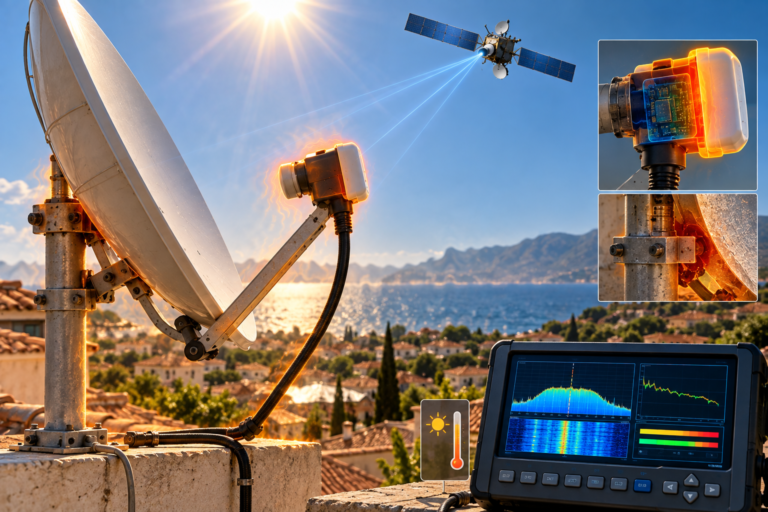
Your satellite dish finds Hot Bird 13E with a strong signal, the receiver scans channels normally, and the LNB clearly works. But when you try Astra 19.2E, the receiver shows no quality or refuses to lock a known transponder. This can make Astra look weak or unavailable when the real problem is often much simpler.
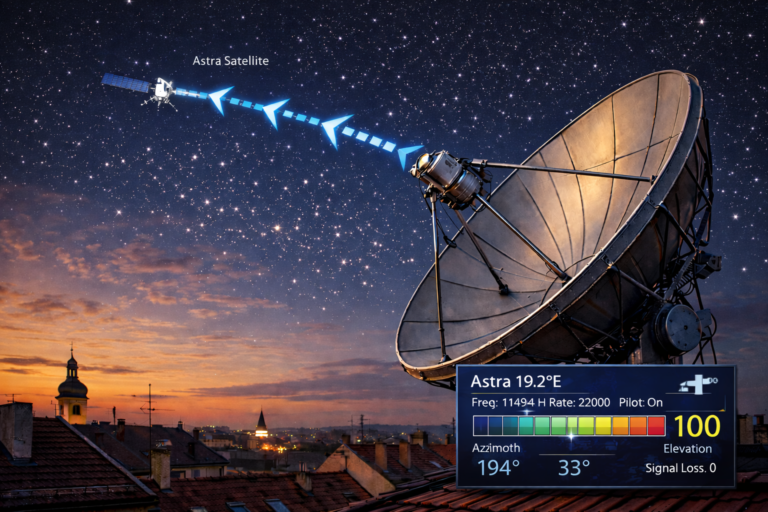
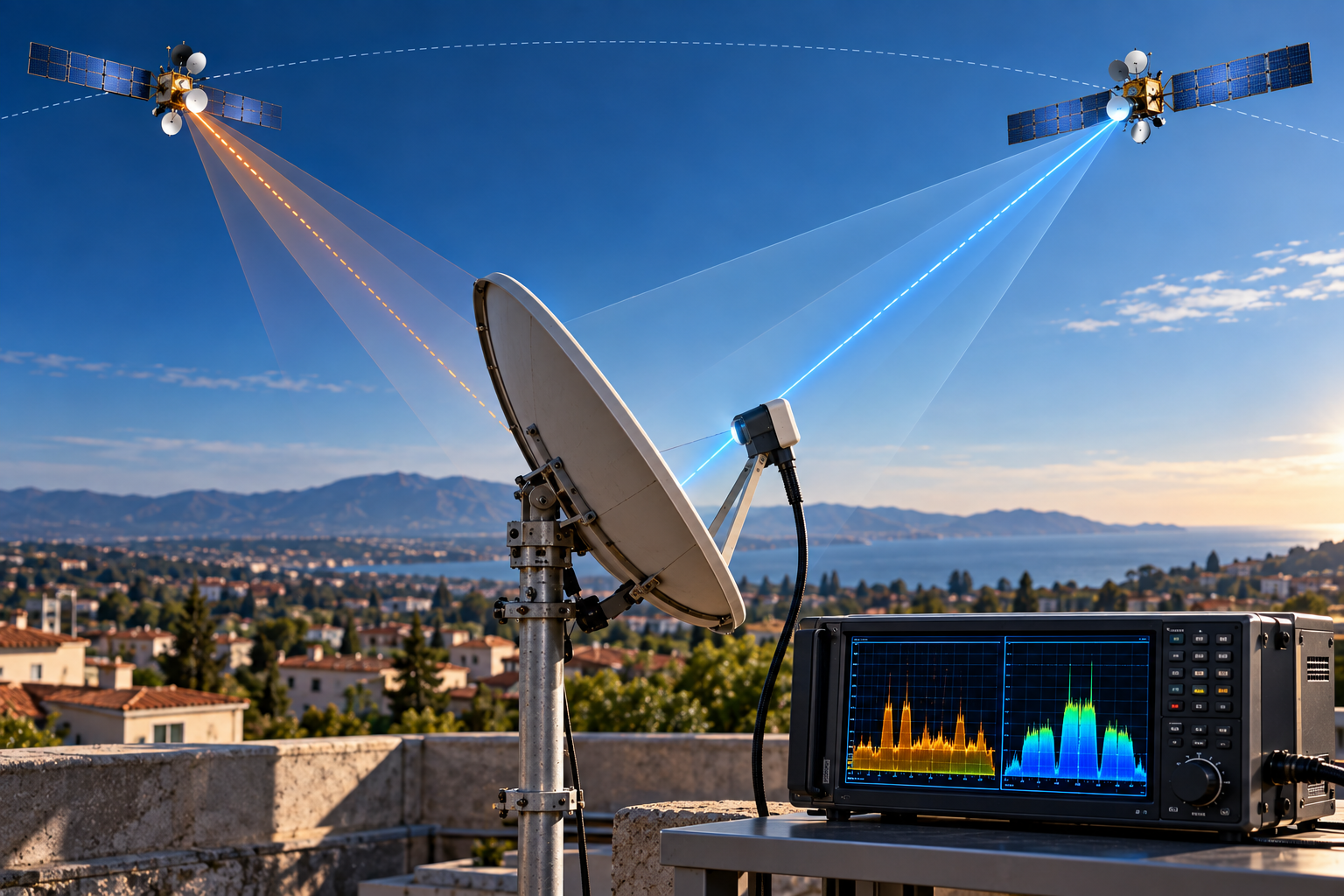
Hot Bird 13E and Astra 19.2E are different geostationary orbital positions. Receiving one successfully does not mean the dish is automatically aimed at the other. Dish direction, elevation, LNB geometry, receiver settings and, in multi-satellite installations, DiSEqC configuration all determine whether Astra can be found.
Hot Bird is positioned at approximately 13°E orbital longitude while Astra’s major European television neighbourhood is at 19.2°E. The difference is 6.2° in orbital longitude, but that does not mean you should simply rotate the physical dish exactly 6.2° using a compass. The azimuth and elevation seen from your installation depend on your geographic location and antenna geometry.
- Hot Bird and Astra Are Different Orbital Positions
- Why 6.2° Does Not Mean a 6.2° Dish Turn
- You May Still Be Pointing at Hot Bird
- Use a Known Astra Transponder to Identify the Satellite
- Why Signal Strength Can Fool You
- Which Direction Should the Dish Move?
- Do Not Adjust Azimuth Alone
- Why LNB Skew Changes Too
- The Problem Is Different With a Monoblock LNB
- Why DiSEqC Can Make Astra Look Missing
- Check Receiver and LNB Settings
- Why Hot Bird May Work With More Margin
- How to Find Astra Without Guessing
- Reality Check
- Final Verdict
- FAQ
Hot Bird and Astra Are Different Orbital Positions
Hot Bird 13E and Astra 19.2E may both serve large parts of Europe, but your antenna does not receive them as one combined satellite position.
A fixed single-LNB dish normally points its main beam toward one orbital neighbourhood.
The reflector concentrates energy arriving from that direction onto the LNB feed. Move sufficiently away from the antenna’s main beam and reception falls rapidly.
Therefore, a dish correctly peaked on Hot Bird can have excellent quality while Astra remains outside the antenna’s strongest reception direction.
This is not evidence that the dish, cable or receiver is broken.
In fact, receiving Hot Bird reliably already proves several useful things: the receiver can communicate with the LNB, at least part of the coaxial path is functional, the antenna can receive Ku-band satellite signals, and the receiver can demodulate compatible carriers.
What it does not prove is that the reflector is aimed at 19.2E.
Why 6.2° Does Not Mean a 6.2° Dish Turn
This is one of the easiest mistakes to make during manual alignment.
The orbital longitudes 13°E and 19.2°E describe positions along the geostationary orbital arc.
They are not direct instructions for how far to rotate the dish mount on your wall.
Your actual pointing angles are calculated from two positions: the satellite’s orbital longitude and your installation’s latitude and longitude.
From the ground, each satellite therefore has a particular azimuth and elevation.
The azimuth difference between Hot Bird and Astra as seen from one European location will not simply equal 6.2° in every case. Elevation also changes.
Orbital separation is not the same as physical dish rotation. Use local pointing data for the installation location rather than treating 13°E and 19.2°E as compass bearings.
This becomes even more important when the antenna mount is not perfectly vertical, because azimuth and elevation adjustments can then interact mechanically.
You May Still Be Pointing at Hot Bird
A satellite finder can make this problem surprisingly confusing.
Many simple meters react to RF energy. They do not necessarily tell you which orbital position is producing that energy.
You can move the dish, hear the meter peak and assume you have found Astra when you have actually reacquired Hot Bird or another nearby orbital position.
Receiver signal-strength bars can create the same problem.
A high strength reading does not identify a satellite.
The correct way to confirm an orbital position is to lock a known active carrier belonging to that position and verify the services or network information received from it.
This is why experienced installers do not identify Astra simply because “the signal became strong.”
Use a Known Astra Transponder to Identify the Satellite
Before moving the dish, the receiver should be configured with a valid Astra 19.2E carrier.
The important parameters normally include frequency, polarization and symbol rate, together with appropriate DVB reception settings.
These parameters should be verified from a current reliable source because satellite service assignments can change.
Once the receiver is monitoring a confirmed Astra carrier, dish movement becomes meaningful.
You are no longer looking for arbitrary Ku-band energy. You are looking specifically for a carrier expected at 19.2E.
This also prevents an old receiver database from creating false confidence.
Stored channel names do not prove that the receiver currently has the satellite. A channel list can remain in memory long after the dish has been moved.
Why Signal Strength Can Fool You
Suppose the receiver shows 80% strength but 0% quality while you are trying to find Astra.
That does not necessarily mean Astra is reaching the receiver at 80%.
Consumer strength meters are not standardized RF instruments. Depending on receiver design, the reading can respond to broadband RF energy reaching the tuner even when the selected digital carrier cannot be demodulated.
Quality is much more useful during alignment because it is associated more closely with successful carrier recovery.
Professional alignment goes further by using measurements such as MER and BER.
Strength without quality: RF energy may be present, but the selected carrier is not being decoded.
Stable quality: the receiver has acquired a usable digital carrier.
This is why a dish can show apparently impressive signal strength while pointing at the wrong orbital position.
Which Direction Should the Dish Move?
The correct movement depends on the installation location.
Astra 19.2E lies farther east in orbital longitude than Hot Bird 13E, but translating that fact into physical antenna movement should be done using the local azimuth and elevation values.
There is another complication: installers often stand in front of the dish while adjusting it.
That can make left and right descriptions ambiguous because the direction depends on whether you are viewing the reflector from the front or from behind.
For that reason, instructions such as “move the dish a little left” are less reliable than actual azimuth values calculated for the site.
The practical method is to determine the required local pointing angles, loosen the mount only enough for controlled movement, and make very small adjustments while monitoring a known Astra carrier.
Large sweeps can easily skip the narrow peak of a correctly sized dish.
Do Not Adjust Azimuth Alone
Moving from Hot Bird to Astra is not purely a horizontal adjustment.
The required elevation also changes.
The amount depends on your location.
If you rotate the dish horizontally but leave elevation significantly wrong, the antenna’s main beam may pass above or below the required direction.
You can then move through the correct azimuth without ever obtaining a reliable lock.
A useful alignment process alternates small azimuth and elevation adjustments while monitoring digital quality.
Once the carrier is found, both axes should be fine-peaked rather than stopping at the first lock.
This matters because the first successful lock may occur near the edge of the antenna beam where little weather margin remains.
Why LNB Skew Changes Too
LNB skew describes the rotational orientation of the LNB relative to the incoming signal’s polarization.
The optimum skew depends on the geometry between the installation and the satellite orbital position.
Changing from 13E to 19.2E therefore changes the ideal polarization orientation slightly.
A system may still work with imperfect skew, especially when signals are strong, but incorrect orientation can reduce polarization isolation and lower MER.
This can become especially noticeable on lower-margin carriers.
After Astra is acquired and the dish is peaked, fine adjustment of LNB skew can therefore recover additional quality.
Do not rotate the LNB randomly. Use the expected local orientation as a starting point and optimize using quality measurements.
The Problem Is Different With a Monoblock LNB
If the installation uses a monoblock LNB designed to receive Astra 19.2E and Hot Bird 13E from one reflector, the dish should not normally be moved back and forth every time you change satellites.
The system uses two feed positions separated physically at the focal area of the dish.
One feed receives one orbital position while the second feed is offset to receive the other.
This changes the diagnosis completely.
If Hot Bird works but Astra does not on a monoblock installation, possible causes include incorrect monoblock orientation, unsuitable feed spacing for the dish geometry, incorrect DiSEqC port assignment, insufficient dish alignment margin or a fault affecting one side of the monoblock.
The reflector itself also matters. A monoblock designed around a common dish geometry may not produce equally good results on every reflector size and focal ratio.
| Installation | Hot Bird Works, Astra Does Not |
|---|---|
| Single LNB fixed dish | Dish may simply still be pointed at Hot Bird |
| Two separate LNBs | Check secondary feed position, skew and switching |
| Monoblock LNB | Check orientation, feed geometry and DiSEqC assignment |
| Motorized dish | Check motor position, reference alignment and stored position |
Why DiSEqC Can Make Astra Look Missing
Multi-satellite reception often uses DiSEqC switching.
The receiver sends control commands through the coaxial cable to select the required LNB input or feed.
Imagine Hot Bird is connected to Port A and Astra to Port B.
If the receiver database expects Astra on Port A, selecting an Astra channel can leave the system physically connected to the Hot Bird feed.
The receiver then reports no quality on the requested Astra carrier even though both LNBs and the dish may be working perfectly.
This is one of the first settings worth checking when one satellite works normally and another is completely absent from a multifeed system.
Do not assume every monoblock uses the same port order in every installation. Verify the actual device configuration.
Check Receiver and LNB Settings
Before changing the dish, verify the receiver configuration.
A standard European universal Ku-band LNB installation requires the receiver to use the appropriate local oscillator settings and control signals.
The receiver also needs correct DiSEqC configuration if multiple feeds are present.
Incorrect frequency data can create another false failure.
If the transponder stored in the receiver is obsolete or incorrectly entered, the dish can be perfectly aligned while the quality meter remains at zero.
A scan is useful after correct reception has been established, but repeatedly rescanning while the antenna is pointed at the wrong position will not solve the alignment problem.
A receiver scan searches the signal reaching the tuner. It cannot electronically redirect a fixed dish from Hot Bird 13E to Astra 19.2E.
Why Hot Bird May Work With More Margin
There is another possibility: the antenna may be positioned close enough to Astra to receive some energy, but not well enough for reliable carrier decoding.
Satellite reception depends on link margin.
Dish size, pointing accuracy, LNB performance, cable loss, local footprint conditions and carrier parameters all contribute to whether the receiver has enough quality above its decoding threshold.
A strong Hot Bird carrier can remain stable while the selected Astra carrier fails.
That does not prove that Hot Bird is universally “stronger than Astra.”
Different carriers and locations can produce different results.
Astra 19.2E itself is an orbital neighbourhood rather than one universal RF source with identical performance across every transponder.
This is particularly important near footprint edges, where small differences in antenna gain and alignment margin become more visible.
For a deeper explanation, see Why Astra Signal Changes Across Europe.
How to Find Astra Without Guessing
The fastest approach is systematic rather than random.
1. Confirm that the satellite currently received is actually Hot Bird 13E.
2. Determine whether the system uses one LNB, multiple LNBs, a monoblock or a motor.
3. Obtain the correct local azimuth and elevation for Astra 19.2E.
4. Enter a currently valid Astra carrier into the receiver or professional meter.
5. Verify universal-LNB and DiSEqC settings before moving hardware.
6. If using a single fixed LNB, make small controlled azimuth and elevation adjustments toward Astra.
7. Watch digital quality rather than relying only on strength.
8. Once the carrier locks, fine-peak azimuth and elevation.
9. Optimize LNB skew.
10. Test several Astra transponders rather than stopping after the strongest one works.
The final step matters.
A dish can acquire one strong Astra carrier while still being slightly off peak. Testing carriers across different frequencies and polarizations provides a better indication of the installation’s overall margin.
If Astra is found but only certain transponders fail, the problem has changed. At that point, investigate polarization, band switching, LNB behaviour, cabling and carrier-specific margin rather than continuing to move the entire dish.
Reality Check
If Hot Bird works and Astra does not, do not immediately buy a larger dish or a more powerful LNB.
A completely missing Astra signal is often an alignment, identification, switching or receiver-configuration problem rather than proof that the antenna is too small.
Likewise, the 6.2° orbital separation between Hot Bird 13E and Astra 19.2E should not be translated directly into a 6.2° physical movement of the dish. Ground pointing geometry depends on the installation location.
In a monoblock or multi-LNB system, moving the whole dish may even make a switching or feed-position problem worse. Identify the type of installation before making mechanical changes.
Final Verdict
If your dish finds Hot Bird but misses Astra, the working Hot Bird signal is actually useful diagnostic evidence.
It tells you that significant parts of the satellite reception chain are already functioning. The next task is not to replace everything. It is to determine why the antenna system is not presenting the correct Astra 19.2E carrier to the receiver with sufficient quality.
With a single-LNB dish, the most likely starting point is pointing geometry: Astra and Hot Bird occupy different orbital positions and require different local azimuth, elevation and skew values.
With a monoblock or multi-LNB system, the investigation expands to feed position and DiSEqC switching. With a motorized dish, motor position and reference alignment become important.
Use a verified Astra transponder to identify the satellite, monitor quality rather than arbitrary strength, move the antenna in controlled steps and fine-peak the system after the first lock.
The important lesson is simple: finding Hot Bird proves that you can receive a satellite. It does not prove that the dish is looking at Astra.
Frequently Asked Questions
| Question | Answer |
|---|---|
| Why can I receive Hot Bird 13E but not Astra 19.2E? | The dish may still be aligned with Hot Bird, or a multi-LNB system may have incorrect feed positioning or DiSEqC configuration. Receiver settings should also be checked before replacing hardware. |
| How far apart are Hot Bird 13E and Astra 19.2E? | Their nominal orbital longitudes differ by 6.2 degrees. This is orbital separation, not a universal instruction to rotate every physical dish exactly 6.2 degrees. |
| Do I only need to move the dish sideways from Hot Bird to Astra? | No. Both azimuth and elevation can change between orbital positions, and LNB skew should also be checked after Astra is acquired. |
| Why do I have signal strength but no Astra quality? | The tuner may be receiving RF energy without locking the selected Astra carrier. The dish may be on another satellite, the transponder data may be wrong, or signal quality may be below the decoding threshold. |
| Can I receive Astra 19.2E and Hot Bird 13E on one dish? | Often yes, depending on dish geometry, location and installation design. Multi-LNB brackets and suitable monoblock LNBs are commonly used for these two orbital positions. |
| Why does my monoblock receive Hot Bird but not Astra? | Possible causes include incorrect monoblock orientation, DiSEqC port assignment, feed geometry, poor dish alignment or a fault affecting one feed path. |
| Should I rescan the receiver to find Astra? | A scan is useful only when Astra is actually reaching the tuner. Rescanning cannot redirect a fixed dish from Hot Bird to Astra. |
| Does a bigger dish make Astra easier to find? | A larger dish can provide more antenna gain, but it also has a narrower beam and can require more precise alignment. A larger reflector does not correct pointing at the wrong satellite. |
| Can incorrect LNB skew stop Astra reception? | Severely incorrect skew can reduce polarization performance and margin, but complete absence of Astra should also prompt checks of dish direction, elevation, switching and receiver configuration. |
| How do I know I have actually found Astra 19.2E? | Lock a currently valid Astra carrier and verify the services or network information received from it. A generic signal-strength peak alone does not identify the orbital position. |