Why Hot Bird Quality Changes During the Day
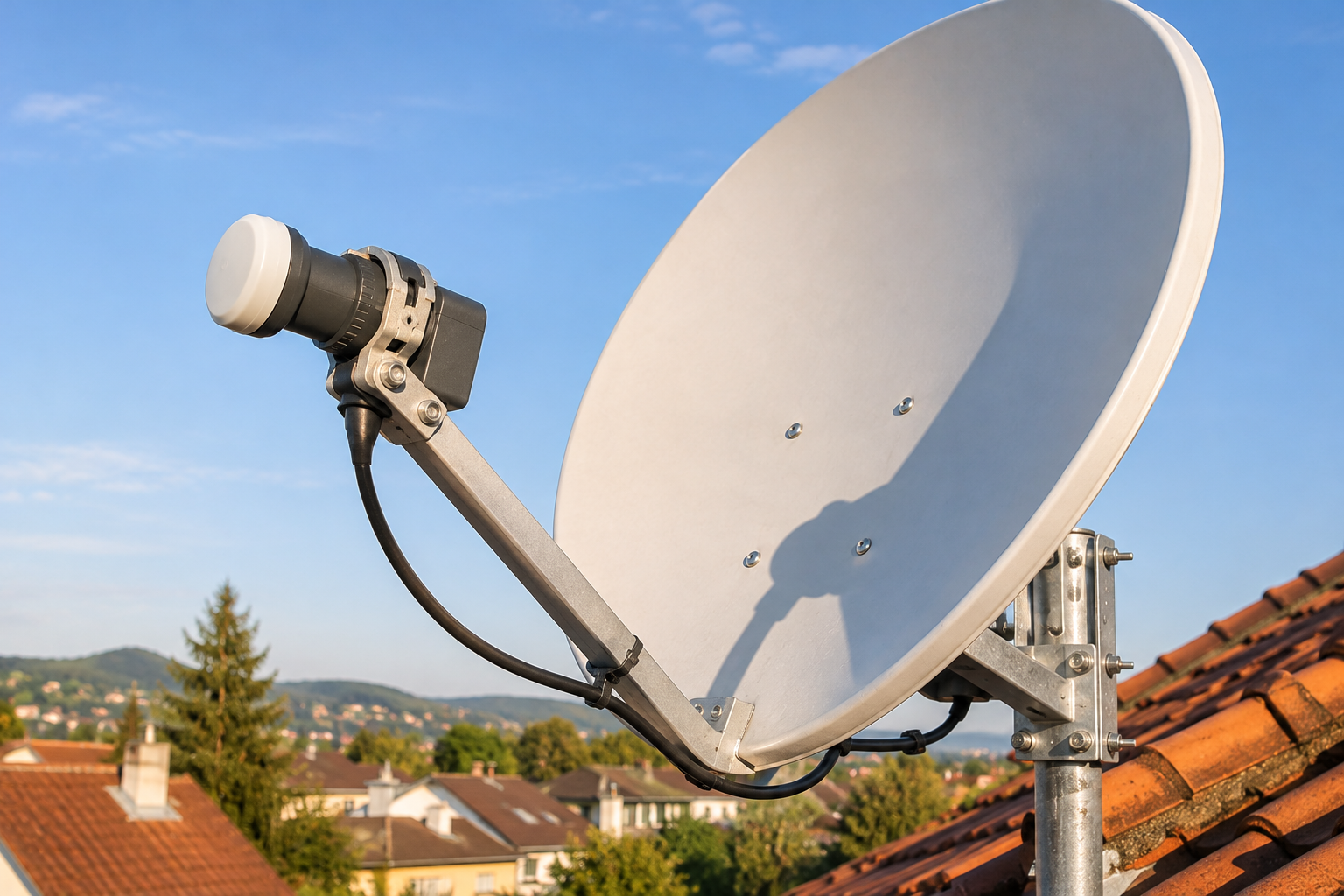
Your Hot Bird 13°E reception is nearly perfect in the morning. By early afternoon, the same transponder begins losing quality, and some channels start freezing. Later that evening, everything returns to normal without anyone touching the dish or changing the receiver settings. If the satellite stays at the same orbital position, why does reception seem to follow the time of day?
A repeating daily pattern often suggests a changing condition somewhere along the receiving system or propagation path. LNB temperature, small mechanical movements, local electrical interference, and atmospheric effects can all influence reception under particular circumstances. But the time of day alone does not identify the cause. The most useful approach is to measure what changes, determine whether the pattern is repeatable, and separate equipment behavior from genuine propagation effects.
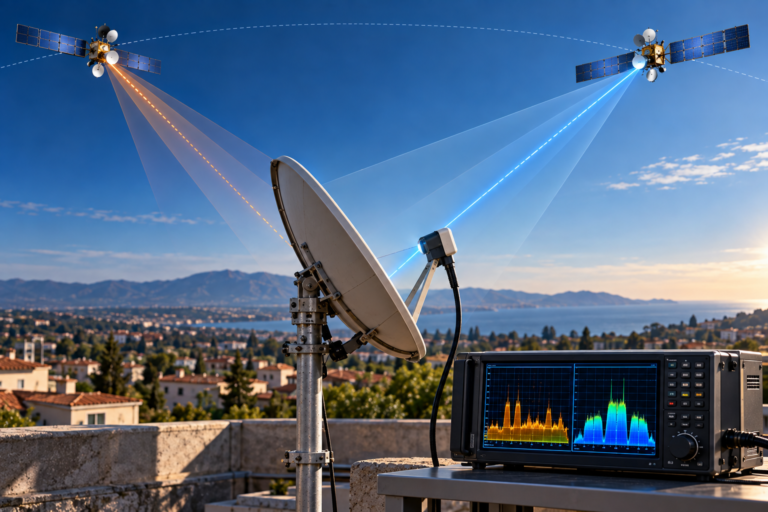
Hot Bird 13°E is served by Eutelsat’s HOTBIRD 13F and 13G satellites. A properly functioning geostationary satellite does not normally follow a daily household reception schedule. When signal quality changes at particular times, investigate the local RF installation, environmental conditions, interference, and actual carrier margins before assuming that the satellite itself is reducing transmission power.
Why Hot Bird Reception Can Follow a Daily Pattern
When a satellite receiver consistently shows different quality readings at different times, the first question should be whether the change is genuinely time-related or merely coincidental.
A single afternoon signal failure does not establish a daily pattern.
However, repeated changes under similar conditions can provide useful diagnostic information.
Several environmental variables change throughout the day, including outdoor temperature, direct sunlight, wind conditions, humidity, and the operating schedules of nearby electrical equipment.
Any of these may influence a vulnerable receiving installation.
Correlation Is Not the Same as Cause
Suppose reception becomes worse every afternoon.
It would be tempting to conclude that direct sunlight is damaging the LNB’s performance.
Yet the same period might coincide with a nearby electrical device operating, stronger wind conditions, or changing atmospheric turbulence.
Without additional observations, the timing alone cannot distinguish these possibilities.
Why Measurements Matter More Than Receiver Percentages
Consumer satellite receivers often display signal strength and quality as percentages.
These indicators can help identify changes on the same receiver, but they are not standardized engineering measurements.
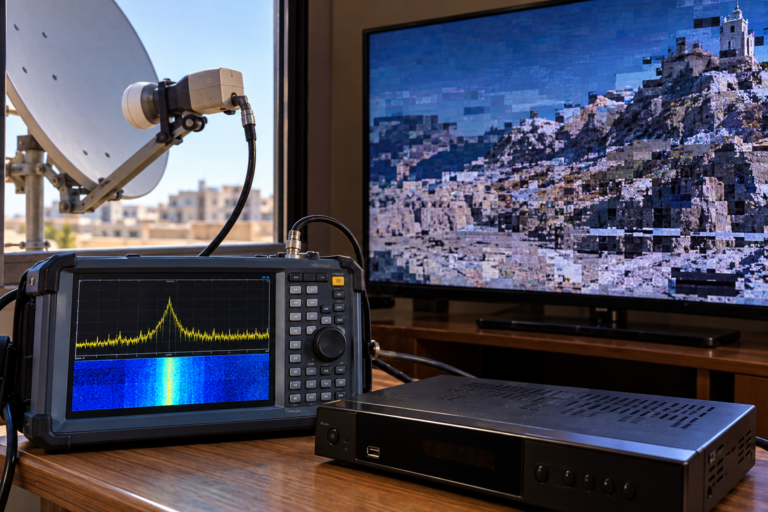
Where possible, use an analyzer capable of reporting carrier-to-noise ratio, modulation error ratio, lock status, and relevant error measurements.
Record the same transponders with the same equipment under comparable conditions.
How LNB Temperature Can Influence Hot Bird Reception
The low-noise block downconverter, or LNB, is exposed to outdoor environmental conditions.
Its internal electronic components operate across a specified temperature range, but their characteristics are not perfectly constant.
Temperature can influence gain, noise performance, oscillator behavior, and other electrical characteristics.
The significance depends on the LNB design, condition, and the available reception margin.
Why Direct Sunlight Can Matter
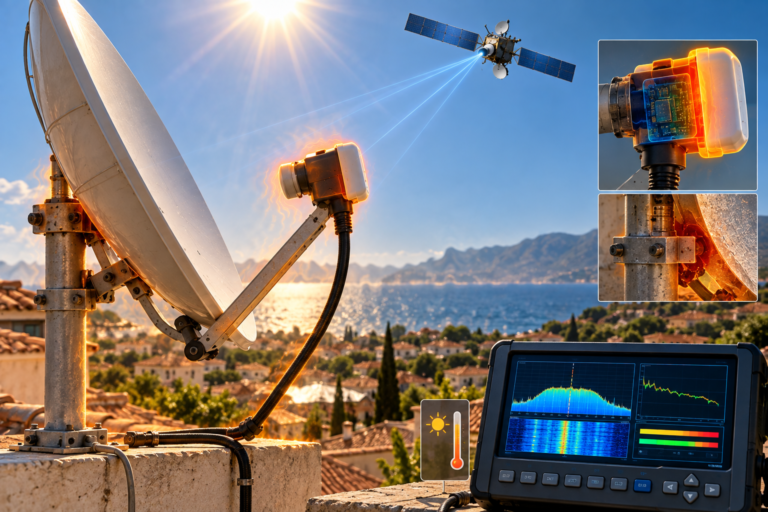
An LNB exposed to sunlight may become warmer than the surrounding air.
The housing material, color, ventilation, and mounting position can affect its operating temperature.
If an aging or defective unit becomes unstable as it warms, reception may deteriorate during hotter parts of the day.
However, a properly functioning LNB should operate within its manufacturer’s specified environmental limits.
Direct sunlight alone is not proof that the LNB is faulty.
Gain and Noise Performance Can Change
An LNB’s low-noise amplification stages contribute to overall receiving-system performance.
Their electrical behavior can vary with temperature, although the magnitude and practical consequences depend on the design.
A system with comfortable reception margin may show little noticeable effect.
A marginal installation may reveal comparatively small changes through reduced carrier quality or intermittent locking.
This is why a suspected temperature problem should be evaluated across multiple transponders rather than judged from one channel.
Local Oscillator Drift: When Frequency Stability Becomes Important
A conventional universal Ku-band LNB converts satellite downlink frequencies into lower intermediate frequencies using internal local oscillators.
Common nominal oscillator settings are 9,750 MHz and 10,600 MHz.
The receiver calculates the expected intermediate frequency based on the configured oscillator and selected satellite carrier.
Frequency Offset Versus Temperature Drift
Frequency offset describes the difference between the actual converted carrier frequency and its expected value at a particular moment.
Frequency drift describes a change in that frequency over time.
If the LNB oscillator changes with temperature, the converted signal may move relative to the receiver’s expected tuning position.
Receivers can accommodate frequency errors within their supported acquisition and tracking ranges, but those capabilities vary.
How Oscillator Drift May Appear on a Receiver
Potential symptoms include slower carrier acquisition, intermittent lock failures, or a loss of lock under particular operating conditions.
These symptoms are not exclusive to oscillator problems.
Incorrect transponder parameters, receiver limitations, and insufficient carrier quality can create similar behavior.
A professional analyzer capable of observing the carrier’s frequency offset over time can provide stronger evidence than a changing quality percentage.
Oscillator drift is primarily a frequency-stability issue. Reduced MER or C/N may occur because of other temperature-sensitive impairments, but a change in oscillator frequency does not automatically mean that RF signal power has decreased.
Can Heat Change the Alignment of a Satellite Dish?
Metal structures expand and contract as their temperature changes.
Satellite dishes, mounting brackets, feed arms, and supporting structures are not exempt from this behavior.
Under normal conditions, properly designed installations accommodate expected temperature changes without significant reception problems.
However, a mechanically unstable installation may respond differently.
Why a Marginal Dish Can Be Sensitive
Imagine a dish that is already slightly misaligned.
A small movement caused by mechanical stress or a temperature-related change in its mounting structure could reduce the available antenna gain further.
Carriers with sufficient reception margin may remain stable, while marginal carriers become unreliable.
The result may appear to follow the temperature cycle of the day.
How to Recognize a Mechanical Problem
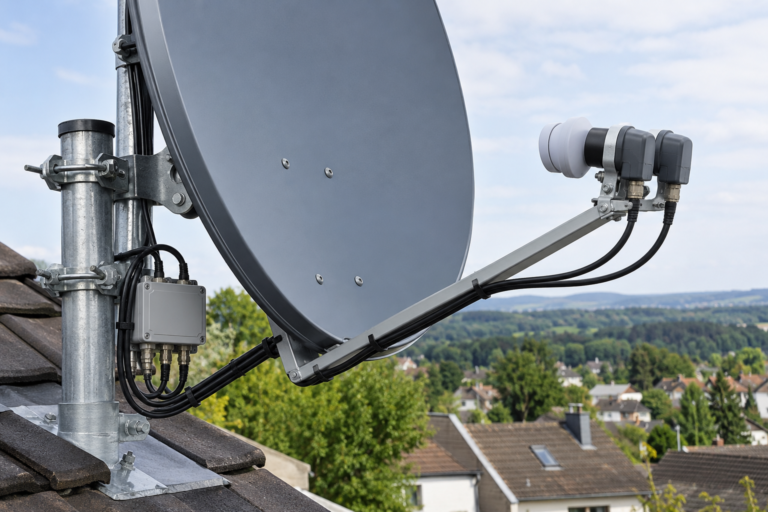
Inspect the mounting system for loose clamps, a flexible mast, damaged feed supports, and other visible defects.
Check whether quality changes correlate more closely with wind or mechanical movement than with temperature.
A controlled alignment check can help establish whether the dish has been operating away from its best pointing position.
Do not loosen or reposition rooftop equipment without suitable access and safety precautions.
Atmospheric Effects Can Change Reception Without Rain
Rain fade is not the only atmospheric phenomenon relevant to satellite propagation.
Even in clear weather, the atmosphere can introduce variations in received signal conditions.
Their significance depends on frequency, receiving location, satellite elevation angle, antenna characteristics, and the state of the atmosphere.
Tropospheric Scintillation
Tropospheric scintillation involves fluctuations in received signal amplitude or phase associated with variations in atmospheric refractive index.
These variations can arise from turbulent atmospheric conditions and changing water-vapor distributions.
Recommendation ITU-R P.618 includes methods for evaluating scintillation effects on Earth-space paths.
The actual impact varies by installation and should not be assumed to explain every daytime signal fluctuation.
Why Clear Skies Do Not Guarantee Identical RF Conditions
Clear skies do not mean that atmospheric temperature, humidity, and refractive conditions remain constant.
These variables can change throughout the day.
However, for many properly designed household satellite installations, ordinary clear-weather variations may be too small to cause noticeable reception failures.
If channels regularly disappear, investigate local equipment and available reception margin rather than immediately attributing the problem to the atmosphere.
Rain-Related Changes Are a Separate Diagnostic Problem
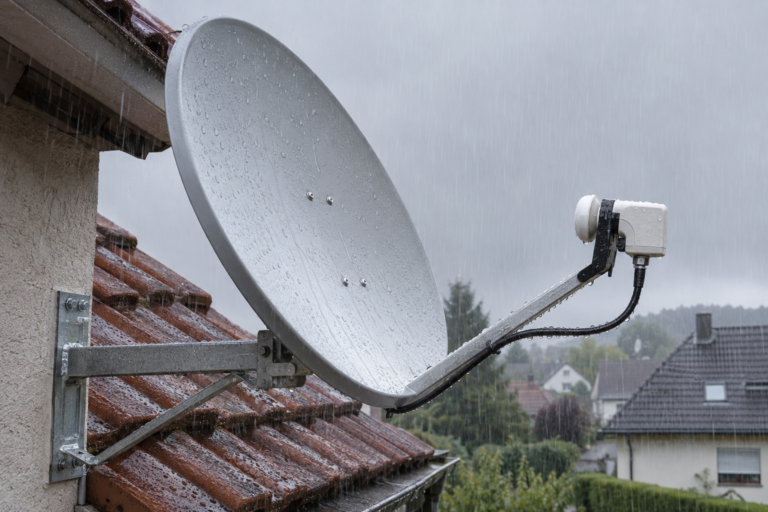
If reception deteriorates specifically during rainfall, precipitation attenuation and outdoor water ingress deserve attention.
Our related guide, Why Hot Bird Works in Rain but One Carrier Fails, examines why a marginal carrier can fail during rain while others continue working, and how to distinguish atmospheric attenuation from outdoor hardware faults.
A repeatable clear-weather afternoon problem should be investigated differently from an outage that occurs only during storms.
Electrical Interference That Appears at Particular Times
Some reception problems follow the operating schedule of nearby electrical equipment rather than the temperature of the satellite system.
Devices such as poorly shielded power electronics, switching equipment, or malfunctioning electrical installations can generate unwanted electromagnetic emissions.
Whether those emissions affect satellite reception depends on their frequency characteristics and how they couple into the RF system.
Why a Problem May Start at the Same Hour
Equipment controlled by timers, occupancy patterns, or operating schedules may become active at predictable times.
If it produces interference that reaches the satellite receiving path, the resulting impairment may look like a daily reception problem.
However, time correlation alone does not establish that a particular appliance is responsible.
What a Spectrum Analyzer Can Reveal
A suitable analyzer can help identify changes in the RF spectrum, elevated noise, or unwanted signals that appear during the affected period.
Comparing spectrum measurements before and during the problem can help distinguish an interference event from a general loss of antenna gain.
Professional assessment may also be necessary to identify the source and determine whether shielding or equipment repair is appropriate.
Solar Interference Is a Seasonal Exception
Satellite operators also recognize a phenomenon known as solar interference or a sun outage.
It occurs when the Sun appears close to the line of sight between a receiving Earth station and a geostationary satellite.
Solar radio noise can then reduce the usable carrier-to-noise conditions.
Why Solar Outages Are Not an Everyday Explanation
Solar interference occurs during limited periods around the equinox seasons, rather than throughout the year.
For an affected receiving station, interference may recur at approximately predictable times over a small number of consecutive days.
The exact dates, times, and durations depend on the receiving location and antenna characteristics.
Therefore, a problem that repeats throughout the summer or winter is not adequately explained by seasonal solar interference alone.
How to Distinguish Solar Interference
Compare the dates and times of the observed interruptions with appropriate satellite sun-interference predictions for the receiving location.
Do not assume that all daytime signal loss is caused by the Sun merely because the antenna is exposed to sunlight.
Heating of the LNB and solar radio interference are physically different phenomena.
Why Only Some Hot Bird Transponders Change Quality
Not every transponder has identical received power, transmission parameters, or operating margin.
Some carriers may be comfortably above the conditions required for reliable decoding, while others operate closer to their thresholds.
A small deterioration in system performance may therefore become visible only on the more marginal carriers.
The Importance of Reception Margin
Digital reception depends on maintaining sufficient quality for the particular modulation and coding configuration.
When a carrier approaches its operating threshold, minor changes in noise, interference, or antenna gain may cause errors and eventually loss of lock.
Another carrier with more margin can remain stable under the same conditions.
This does not prove that the affected carrier is transmitted at lower power.
Why Frequency Patterns Matter
If the affected transponders occupy a similar part of the satellite IF spectrum, investigate frequency-dependent receiver, LNB, or cable behavior.
If the problem instead affects all horizontal or vertical carriers, examine the appropriate polarization-selection and distribution mechanisms.
If every carrier deteriorates together, broader antenna, environmental, or power-supply issues may deserve attention.
The pattern helps narrow the diagnosis before any hardware is replaced.
A Practical 24-Hour Hot Bird Signal Measurement Plan
A useful investigation compares the same transponders at several times rather than relying on one isolated reading.
Step 1: Select Verified Reference Carriers
Choose several currently active Hot Bird transponders with known parameters.
Where practical, include different frequency ranges and both polarizations.
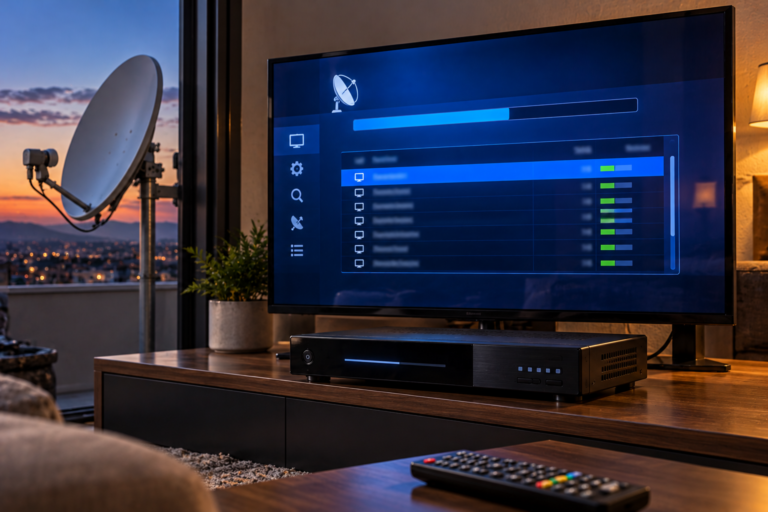
Confirm the receiver is connected to the intended satellite.
Step 2: Record a Baseline
Measure the selected carriers during a period when reception is normally stable.
Record lock status, C/N, MER, and applicable error measurements where suitable equipment is available.
Also record ambient conditions and whether the LNB is exposed to direct sunlight.
Step 3: Repeat at Consistent Intervals
Repeat the measurements during the morning, afternoon, evening, and nighttime.
Use the same receiver or analyzer, connection path, and transmission parameters throughout the comparison.
Avoid changing antenna alignment during the observation period.
Step 4: Compare Temperature and Signal Behavior
Look for a repeatable relationship between changing environmental conditions and carrier performance.
If the receiver supports reliable frequency-offset measurements, record those as well.
A frequency offset changing with temperature may point toward oscillator behavior, while a broader reduction in carrier quality could have several possible explanations.
Step 5: Repeat Over Multiple Days
One day of observations may be influenced by unusual weather or temporary interference.
Measurements collected over several comparable days provide stronger evidence of a genuine pattern.
| Observation Period | What to Record | Diagnostic Purpose |
|---|---|---|
| Morning | MER, C/N, lock status, ambient conditions | Establish a stable reference |
| Afternoon | Same carriers and equipment measurements | Test suspected daytime deterioration |
| Evening | Carrier quality and recovery behavior | Check whether changes reverse |
| Night | Final readings and environmental conditions | Compare the full daily pattern |
The table is a measurement plan, not an expected Hot Bird quality forecast. There is no universal daily schedule requiring signal quality to rise or fall at these times.
What Different Daily Reception Patterns Reveal
| Observed Pattern | Possible Explanation | First Useful Check |
|---|---|---|
| Quality falls as equipment warms and recovers after cooling | Temperature-sensitive LNB or mechanical behavior | Compare frequency offset, carrier quality and mounting stability |
| Carrier frequency changes measurably through the day | Possible local oscillator drift | Verify with a suitable frequency-capable analyzer |
| Reception changes with wind and temperature | Mounting movement or alignment sensitivity | Inspect mast and brackets safely |
| Interference appears at a repeatable hour | Possible nearby scheduled electrical equipment | Compare spectrum measurements across affected periods |
| Short outages occur around equinox seasons | Possible solar interference | Check location-specific sun-outage predictions |
| Only marginal carriers become unstable | Insufficient reception margin | Compare carrier quality against transmission requirements |
| Quality changes mainly during rainfall | Rain attenuation or outdoor water ingress | Compare clear-sky and rain-period measurements |
| Only one receiver shows the daily problem | Local tuner, cable, connection, or power problem | Compare an equivalent known-good receiver path |
These patterns suggest useful investigations but do not establish a diagnosis without repeatable measurements.
How to Improve Hot Bird Reception Stability
Corrective action should address the cause demonstrated by the measurements.
Check Antenna Alignment and Mechanical Stability
If the existing installation is marginal, accurate pointing and secure mounting may recover useful reception margin.
Evaluate representative carriers rather than maximizing an arbitrary receiver strength percentage.
Inspect the LNB and Its Operating Conditions
Verify that the LNB is compatible with the receiver and operates within the manufacturer’s specified environmental conditions.
If controlled tests indicate temperature-dependent instability, replacement with a suitable quality unit may be justified.
Do not assume that an advertised lower noise figure guarantees better installed performance.
Check Cabling and Distribution Components
Inspect outdoor-rated cable, F-connectors, switches, and any powered distribution equipment.
Excessive loss, poor connections, or faulty power delivery can reduce available margin or disrupt LNB operation.
Disconnect relevant equipment from power before changing coaxial connections.
Investigate Confirmed Interference
If repeatable spectrum measurements indicate interference, identify its source using appropriate test procedures.
Repairing defective shielding or equipment is preferable to blindly increasing signal amplification.
Consider Antenna Gain Only When Necessary
A suitable larger reflector may improve reception when inadequate carrier-to-noise margin is the established limitation.
However, it will not correct oscillator drift, wrong tuner settings, defective connections, or incompatible hardware.
Confirm a repeatable pattern → Measure the same carriers → Compare temperature and weather → Check frequency stability → Inspect mounting and connections → Investigate interference → Correct the verified cause.
This approach avoids replacing the LNB or enlarging the dish without evidence that either change will solve the problem.
Reality Check: Hot Bird Does Not Have a Universal Daytime Weakness
There is no general rule that Hot Bird 13°E must provide weaker reception in the afternoon or stronger reception at night.
Daily quality variations may be associated with local equipment temperature, mechanical behavior, interference, or atmospheric conditions, but their importance depends on the actual installation.
Seasonal solar interference is a separate, predictable event occurring around limited periods of the year.
If reception repeatedly changes with the time of day, treat the timing as diagnostic evidence, not as proof of a particular fault.
Final Verdict
Hot Bird 13°E signal quality can change during the day when conditions affecting the receiving system or propagation path vary over time.
LNB temperature sensitivity, oscillator drift, mechanical movement, local electrical interference, and atmospheric scintillation are possible explanations under appropriate conditions.
However, no single cause should be assumed from the time of day alone.
The most reliable diagnosis comes from repeated measurements of verified transponders, including carrier quality, lock behavior, relevant frequency offsets, and environmental conditions.
Once a repeatable relationship is established, corrective action can target the actual limitation instead of relying on unnecessary scans or component replacements.
Frequently Asked Questions
Why is my Hot Bird signal weaker in the afternoon?
Possible causes include temperature-sensitive equipment, mechanical movement, environmental interference, or changes in propagation conditions. The timing alone cannot identify the cause, so compare repeatable measurements across several days.
Can sunlight affect an LNB?
Direct sunlight can raise LNB temperature, potentially influencing electrical performance. A properly functioning unit should operate within its specified temperature range, and sunlight alone does not establish a hardware defect.
Why does Hot Bird reception improve at night?
Evening recovery may coincide with cooling equipment, changing interference conditions, or other environmental differences. A repeatable measurement record is needed to determine the likely explanation.
Can LNB oscillator drift cause channels to disappear?
Yes. Excessive frequency offset or instability can prevent a receiver from acquiring or maintaining a carrier. The effect depends on the receiver’s tracking capabilities and should be confirmed through suitable measurements.
Does atmospheric humidity weaken satellite signals?
Atmospheric water vapor and refractive-index variations can contribute to propagation effects, including scintillation. The significance depends on frequency, location, elevation angle, and atmospheric conditions. Ordinary humidity changes do not automatically cause household satellite outages.
Can solar interference affect Hot Bird 13E?
Yes. Around equinox seasons, the Sun can appear near the satellite line of sight and introduce additional radio noise. Such events are seasonal and location-dependent, not a permanent daily reception problem.
Should I replace the LNB if Hot Bird quality changes during the day?
Not before checking carrier measurements, frequency stability, mounting condition, cabling, and possible interference. Replace the LNB when controlled tests support a hardware problem.
Will a larger dish prevent daily signal fluctuations?
A larger, correctly installed antenna can improve reception margin when insufficient gain is the limitation. It cannot directly repair an unstable oscillator, defective electrical components, or incorrect receiver settings.