Why Astra 19.2E Is Strong but Channels Still Freeze
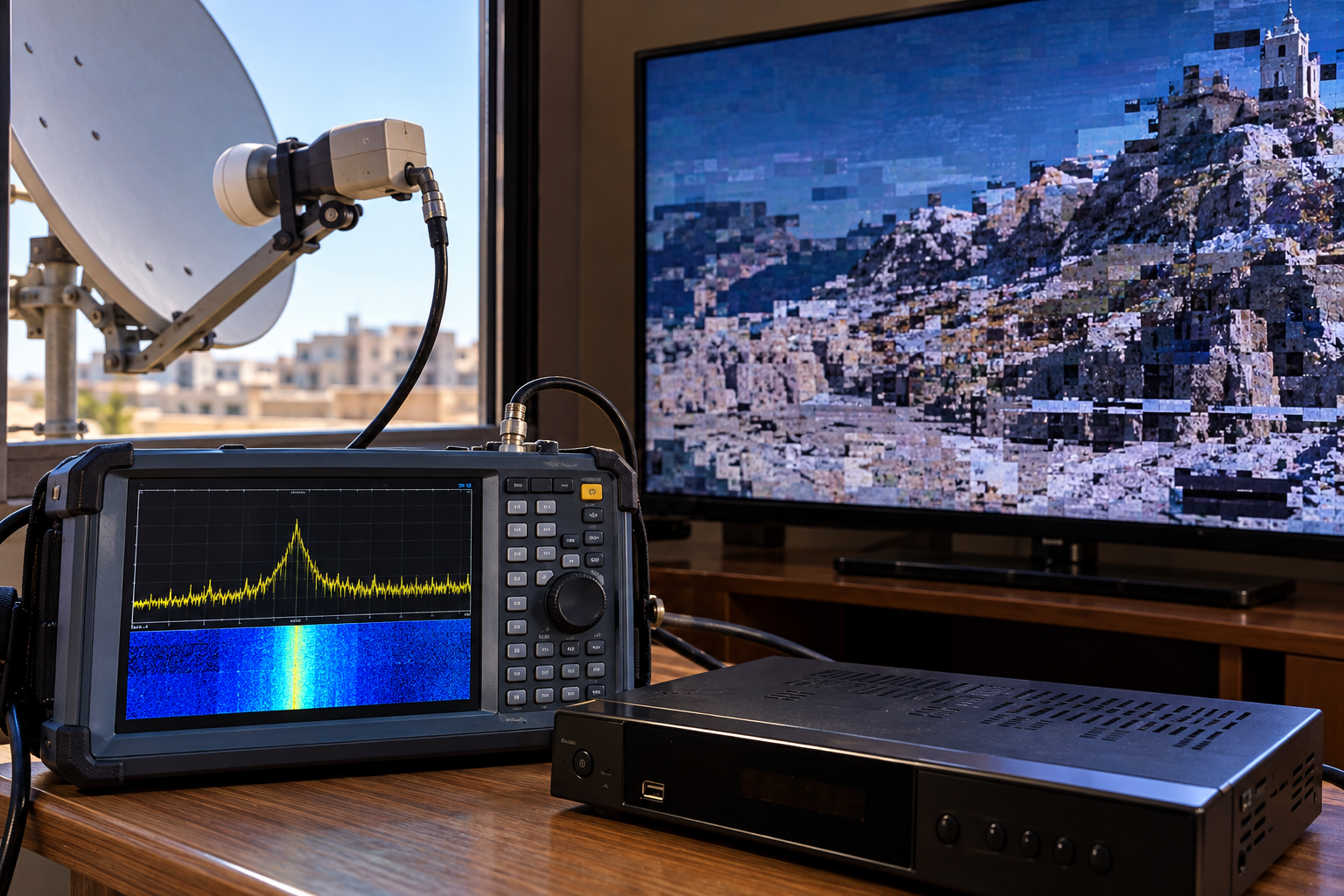
Your receiver shows 90% signal strength on Astra 19.2E. The channel opens immediately, the signal bars remain high, and everything appears normal. Then the picture freezes for two seconds, breaks into digital blocks, or stops completely. A moment later, playback resumes, even though the receiver still reports a strong signal.
This is one of the most misleading problems in digital satellite reception. The receiver may be receiving plenty of radio-frequency power, but that does not mean the transmitted information is arriving cleanly. Astra channels can freeze because of modulation errors, insufficient decoding margin, interference, damaged connections or faults inside the receiver itself. The important distinction is between receiving a strong carrier and successfully recovering the video carried by that signal.
A strong signal-strength reading does not guarantee stable DVB-S or DVB-S2 reception. The receiver must acquire the carrier, demodulate the signal, correct transmission errors, recover the transport stream and decode the video. A problem at any of these stages can interrupt the picture. The correct diagnosis begins by identifying which stage is failing.
- Why 90% Signal Strength Can Be Misleading
- What Happens Between the Satellite and Your Television?
- Why MER Matters More Than a Strong Signal Bar
- How Bit Errors Cause Freezing and Pixelation
- Why DVB-S2 Error Correction Has Limits
- Why Some Astra Transponders Freeze Before Others
- How Interference Damages a Strong Signal
- Can an LNB Cause Freezing Without Losing Signal Strength?
- Why Coaxial Cable Faults Matter
- When the Problem Is Not the Satellite Signal
- What the Freezing Pattern Reveals
- How to Diagnose Astra Freezing Step by Step
- Which Repairs Actually Help?
- Reality Check
- Final Verdict
- Frequently Asked Questions
Why 90% Signal Strength Can Be Misleading
The first mistake is assuming that the receiver’s signal-strength percentage measures how reliably a channel can be decoded.
On many consumer satellite receivers, the strength indicator is derived from tuner measurements or automatic gain control behavior. It may indicate the general level of RF energy entering the tuner rather than the quality of the wanted satellite carrier.
These percentages are not standardized across receiver manufacturers.
A reading of 90% on one receiver cannot automatically be compared with 90% on another.
More importantly, a high reading can coexist with poor modulation quality.
Imagine a receiver receiving a strong carrier that contains substantial phase noise or interference. The RF power may be high, but the demodulator still has difficulty distinguishing the transmitted symbols accurately.
The result can be a strong signal bar accompanied by intermittent picture freezing.
That is why professional satellite measurements focus on parameters such as modulation error ratio, carrier-to-noise ratio and bit error performance.
For a broader explanation, see Why Signal Quality Matters More Than Signal Strength.
What Happens Between the Satellite and Your Television?
To understand why channels freeze, it helps to follow the complete reception chain.
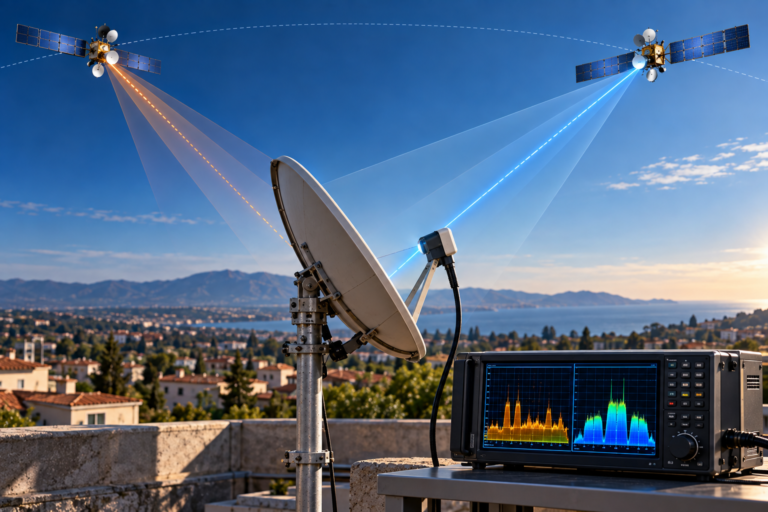
The Astra satellite transmits a digitally modulated radio signal. Your dish collects a small portion of that energy and focuses it toward the LNB.
The LNB amplifies the signal and converts it to an intermediate frequency.
The signal then travels through coaxial cable to the receiver, where the tuner selects the desired carrier.
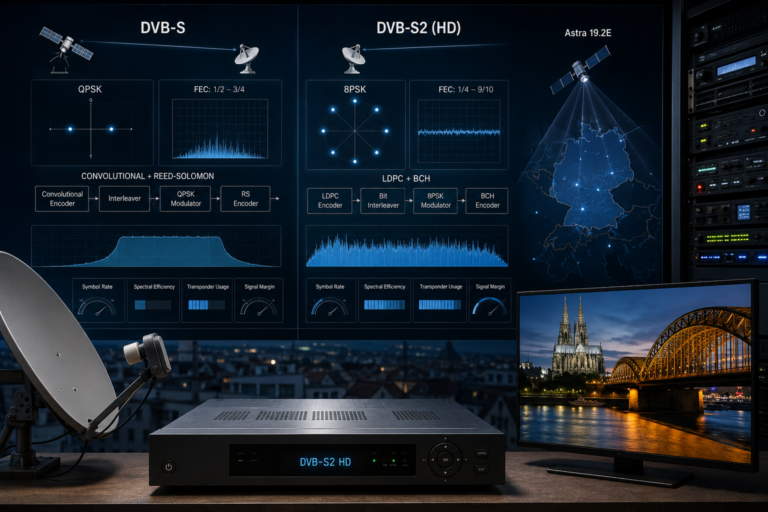
Next, the demodulator attempts to recover the transmitted symbols and reconstruct the data stream. Forward error correction is used to repair errors introduced during transmission.
Finally, the receiver processes the recovered television service and decodes its compressed video and audio.
Satellite transmission → Dish and LNB → Coaxial cable → Tuner → Demodulator → Error correction → Transport stream → Video decoder → Television picture
Freezing can originate at different points along this chain.
If the RF signal becomes too impaired, the demodulator may produce uncorrectable errors.
If the transport stream is valid but the receiver’s video decoder is unstable, the picture may still freeze.
These two failures can look similar on the television screen, but they require different solutions.
Why MER Matters More Than a Strong Signal Bar
Modulation error ratio, or MER, is one of the most useful measurements for diagnosing digital satellite reception.
MER describes how accurately the received modulation symbols correspond to their ideal positions in the signal constellation.
In a clean signal, the received symbols cluster closely around their intended constellation points.
Noise, interference, phase instability and other impairments spread those symbols away from their ideal positions.
As modulation quality deteriorates, MER decreases.
A receiver can therefore report high RF power while the MER is too low to provide reliable decoding margin.
MER is normally expressed in decibels.
Higher MER generally indicates better modulation quality, although the amount required depends on the modulation and coding configuration.
There is no single MER value that guarantees reliable reception for every Astra transponder.
The useful question is how much margin remains above the threshold required by the particular carrier.
Important: MER is not the same as signal strength. Increasing RF power does not necessarily improve MER if the underlying problem is interference, oscillator instability or another form of signal distortion.
How Bit Errors Cause Freezing and Pixelation
Digital satellite signals carry information as encoded bits.
During reception, noise and distortion can cause the demodulator to interpret some transmitted symbols incorrectly.
That produces bit errors.
Bit error rate, or BER, describes the proportion of bits received incorrectly at a particular stage of the decoding process.
However, not every BER reading means the same thing.
A pre-FEC measurement describes errors before the relevant error-correction stages.
A post-FEC measurement describes errors remaining after correction.
Some receivers display intermediate BER measurements instead, so the measurement point matters.
A satellite signal can contain correctable raw errors while the final transport stream remains intact.
That is normal digital communication behavior.
The problem begins when the error-correction system cannot recover all the required information.
Uncorrected errors can damage transport packets or compressed video data.
Depending on the affected information and decoder behavior, the viewer may see macroblocking, missing picture regions, frozen frames or a temporary black screen.
For more technical background, see What BER Really Means on a Satellite Receiver.
Why DVB-S2 Error Correction Has Limits
DVB-S2 uses powerful forward error correction to make satellite communication more reliable.
Its coding architecture combines low-density parity-check coding, commonly called LDPC, with an outer BCH code.
These mechanisms allow the receiver to recover information even when the received symbols contain errors.
But error correction cannot repair unlimited damage.
Each modulation and coding configuration has a minimum signal-quality requirement for reliable operation under specified conditions.
When the received signal approaches that threshold, error correction may still succeed most of the time.
A relatively small additional impairment can then cause decoding performance to deteriorate rapidly.
This is commonly described as the digital cliff.
Unlike analog television, where the picture often becomes progressively noisier, digital reception can appear almost perfect until the decoder reaches its limit.
That explains a common Astra complaint: the picture looks excellent for several minutes, then suddenly freezes without any obvious gradual warning.
Why Some Astra Transponders Freeze Before Others
Not all Astra 19.2E transponders use identical transmission parameters.
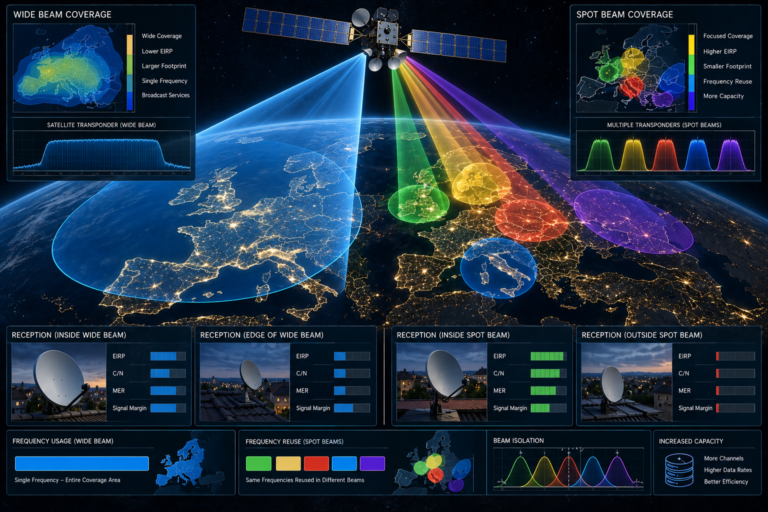
Different carriers can use different symbol rates, modulation formats, coding rates and satellite beams.
These characteristics influence the amount of signal quality required for stable decoding.
For example, DVB-S2 commonly uses QPSK and 8PSK modulation in broadcast applications.
At comparable coding conditions, 8PSK generally requires a cleaner signal than QPSK because its constellation contains more closely spaced symbol states.
But modulation alone does not determine the complete threshold. Coding rate, waveform configuration and receiver performance also matter.
| Technical Factor | Effect on Reception |
|---|---|
| Modulation format | Changes how closely signal constellation points are spaced |
| FEC coding rate | Affects error-correction redundancy and required signal quality |
| Satellite beam and EIRP | Influence available received carrier power at the installation |
| Dish alignment | Determines how efficiently the antenna receives the desired signal |
| Interference and noise | Reduce usable carrier quality and decoding margin |
| Receiver demodulator | Influences acquisition, tracking and error performance |
This is why one group of Astra channels can freeze while another group remains stable.
It is also why a receiver’s overall signal-strength display is insufficient for diagnosing individual transponder problems.
How Interference Damages a Strong Signal
Interference can reduce signal quality without causing a dramatic drop in the receiver’s reported RF power.
In some cases, the interfering energy can even contribute to a higher overall power reading.
Potential sources include unwanted RF signals entering poorly shielded coaxial cable, defective electrical equipment and interference from nearby radio systems.
Cross-polarization interference is another possibility.
Satellite systems reuse frequencies using different polarization states. If the LNB skew is poorly adjusted, the receiving system may have insufficient isolation between horizontal and vertical signals.
That can allow energy from an unwanted polarization to degrade the wanted carrier.
Local oscillator phase noise can also impair demodulation, especially when an LNB is defective or unstable.
These impairments are not equivalent to a simple lack of signal power.
That distinction explains why installing an amplifier is often the wrong response.
An amplifier may increase the level of both the desired signal and unwanted noise or interference. It cannot reconstruct modulation information already damaged before amplification.
Can an LNB Cause Freezing Without Losing Signal Strength?
Yes.
An LNB can deliver substantial output power while producing a signal with inadequate modulation quality.
Several LNB-related faults can contribute to this behavior.
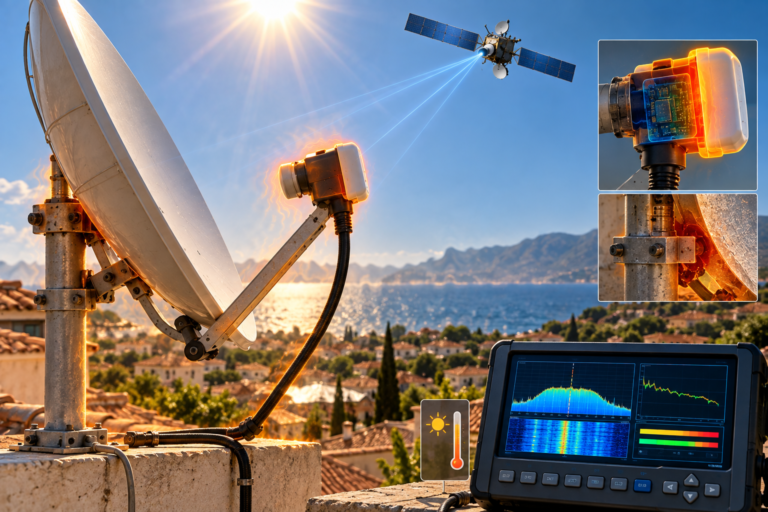
Aging electronic components may introduce excess noise. Oscillator instability can make carrier tracking more difficult. Internal switching problems may intermittently affect particular frequency bands or polarizations.
Temperature can make an existing fault more noticeable.
For example, a defective LNB may perform acceptably during cooler hours but become unstable after prolonged exposure to sunlight.
The receiver may continue displaying a high strength percentage even as MER deteriorates.
That is why a known-good LNB comparison can be useful after other installation problems have been excluded.
However, replacing the LNB without testing the signal path can waste money if the actual fault lies in the coaxial cable, dish alignment or receiver.
Why Coaxial Cable Faults Matter
Coaxial cable problems do not always produce a complete loss of signal.
Damaged shielding can allow unwanted interference to enter the receiving system.
Corroded F-connectors can introduce unstable electrical contact. Moisture inside a cable can increase attenuation and change its RF characteristics.
Sharp bends, crushed sections and poor-quality connectors can also degrade transmission.
Some faults affect particular parts of the intermediate-frequency range more strongly than others.
As a result, one Astra transponder may freeze while another remains usable.
When inspecting the installation, pay particular attention to outdoor connectors and any cable sections exposed to water or mechanical damage.
Always switch off the receiver before disconnecting or reconnecting the LNB cable.
Do not work on elevated antennas or rooftops without appropriate safety equipment and access.
When the Problem Is Not the Satellite Signal
A stable satellite carrier does not guarantee that the television picture will remain stable.
After the receiver demodulates and corrects the signal, it must process the recovered transport stream and decode the selected video service.
Problems at this stage can produce freezing even when RF reception is healthy.
Possible causes include receiver firmware faults, overheating, insufficient processing resources, video-decoder instability or corrupted stream handling.
Conditional-access problems can also interrupt viewing on encrypted services, although these should not automatically be confused with RF reception faults.
A useful diagnostic question is whether the receiver loses carrier lock when the picture freezes.
If lock remains stable and reliable measurements show adequate MER with no uncorrected errors, investigate the downstream processing stages.
If the receiver loses lock or error measurements deteriorate at the same moment, focus first on the RF and demodulation chain.
RF problem: Carrier quality deteriorates, errors increase or the receiver loses lock.
Decoding problem: Carrier lock and measured signal quality remain stable, but video or audio playback becomes unreliable.
This distinction is especially useful when freezing affects only one television service rather than every service carried on the same transponder.
What the Freezing Pattern Reveals
The timing and distribution of freezing often provide valuable clues.
| Observed Symptom | Possible Area to Investigate |
|---|---|
| All channels on one transponder freeze together | Carrier quality, transponder reception or transport-stream problems |
| Only one service freezes while others on the same carrier work | Service-specific stream, conditional access or decoder behavior |
| Several transponders on one polarization fail | LNB polarization switching, coaxial power path or distribution equipment |
| Freezing increases during rain | Insufficient rain margin, dish alignment or weather-related signal loss |
| Freezing appears after the receiver warms up | Receiver ventilation, tuner or power-supply stability |
| Freezing occurs during hot afternoons | Temperature-sensitive LNB, connections or receiver components |
| Signal remains locked but video repeatedly stops | Transport-stream handling or video decoding |
These are diagnostic clues, not definitive conclusions.
For example, multiple channels freezing together may suggest a shared transponder problem, but a common receiver hardware fault can also affect several services.
The pattern helps narrow the investigation. Measurements are still needed to confirm the cause.
How to Diagnose Astra Freezing Step by Step
Start by identifying exactly what fails.
Step 1: Record the affected channels.
Check whether they belong to the same transponder. If possible, record the frequency, polarization, symbol rate and transmission standard.
Step 2: Watch the receiver’s lock indication.
When freezing occurs, determine whether the receiver loses the carrier or continues reporting a locked signal.
Step 3: Compare signal quality, not only strength.
Use a professional meter if available. Record MER, carrier-to-noise ratio and error measurements on the affected carrier.
Step 4: Test an unaffected transponder.
Choose another Astra carrier that remains stable. Compare its behavior under the same conditions.
Step 5: Check the LNB and coaxial connections.
Inspect accessible connectors for damage, corrosion or moisture. Confirm that the LNB type and receiver settings are appropriate for the installation.
Step 6: Verify dish alignment.
If measurements indicate inadequate reception margin, check alignment using the weakest relevant transponder rather than relying on the strongest carrier.
Step 7: Investigate the receiver.
If RF measurements remain stable, check ventilation, firmware and whether the same problem occurs on another compatible receiver.
Step 8: Change one variable at a time.
After each adjustment or replacement, repeat the test on the same transponders.
This prevents unnecessary repairs and makes the diagnosis more reliable.
Which Repairs Actually Help?
The correct solution depends on the source of the errors.
If the dish is slightly misaligned, precise realignment can increase the available carrier quality and restore decoding margin.
If the LNB is unstable, a compatible replacement may improve performance.
If coaxial connectors are corroded or water-damaged, replacing the affected components can remove attenuation and intermittent faults.
If the receiver is overheating, improving ventilation and investigating the hardware may be necessary.
If the problem is service-specific, rescanning the affected transponder or checking receiver firmware may be more appropriate than changing the dish.
However, rescanning cannot repair poor RF quality. It only updates the receiver’s stored service information.
Similarly, a larger dish may increase reception margin, but it should not be the first purchase when the existing installation has an unidentified fault.
The objective is to correct the underlying impairment rather than temporarily hide it with additional signal level.
Reality Check
A strong Astra signal does not necessarily mean a clean Astra signal.
Consumer receiver strength percentages may indicate RF power or tuner gain behavior rather than usable digital signal quality.
Reliable DVB-S2 reception depends on modulation quality, successful error correction and stable processing of the recovered transport stream.
A channel can freeze because MER falls below the required margin, uncorrected errors reach the video stream, or the receiver fails to decode otherwise valid data.
Before replacing an LNB or realigning a dish, determine whether the fault is occurring in the RF path, the demodulator or the video-processing stage.
Final Verdict
When Astra 19.2E shows strong signal strength but channels still freeze, the missing piece is usually signal quality or downstream decoding reliability.
RF power alone cannot reveal how accurately the receiver is recovering the transmitted information.
Low MER, excessive bit errors, interference, unstable LNB electronics and damaged cabling can all degrade reception while the signal-strength indicator remains high.
But freezing is not always caused by the satellite link. A receiver can maintain a healthy carrier lock while its transport-stream processing or video decoder becomes unstable.
The most effective diagnosis compares affected and unaffected transponders, checks carrier lock during the fault and uses MER and error measurements whenever possible.
Do not try to solve every frozen picture by increasing signal strength. Identify whether the problem is insufficient decoding margin, damaged RF information or a fault after demodulation.
Once the failing stage is identified, the correct repair becomes much clearer.
Frequently Asked Questions
| Question | Answer |
|---|---|
| Why do Astra channels freeze with 90% signal strength? | The strength reading may reflect RF power rather than modulation quality. Low MER, interference, uncorrected errors or receiver decoding faults can still interrupt the picture. |
| Does high signal strength mean good signal quality? | No. A strong carrier can contain noise, interference or modulation distortion that prevents reliable decoding. |
| What is MER on a satellite receiver? | MER, or modulation error ratio, measures how closely received modulation symbols match their ideal constellation positions. It is an important indicator of digital signal quality. |
| Can BER cause picture freezing? | Yes. When errors remain after forward error correction, transport packets or compressed video information can be damaged, producing pixelation or frozen frames. |
| Why do only some Astra transponders freeze? | Different carriers can have different modulation, coding, coverage and reception margins. The most marginal carriers may fail first. |
| Can a faulty LNB cause freezing without a low strength reading? | Yes. An LNB can produce adequate output power while introducing noise, oscillator instability or other impairments that reduce usable signal quality. |
| Can a bad coaxial cable cause pixelation? | Yes. Moisture, damaged shielding, poor connectors and cable faults can degrade reception or introduce interference. |
| Why does only one channel freeze while others work? | If other services on the same transponder remain stable, investigate service-specific transport-stream, conditional-access or decoder issues as well as RF reception. |
| Will a larger satellite dish stop Astra freezing? | A larger dish can improve link margin when insufficient received signal quality is the problem. It will not necessarily fix interference, defective electronics or decoder faults. |
| What should I check first when Astra channels freeze? | Check whether the affected services share a transponder, observe carrier lock during freezing and compare MER or error measurements before replacing equipment. |