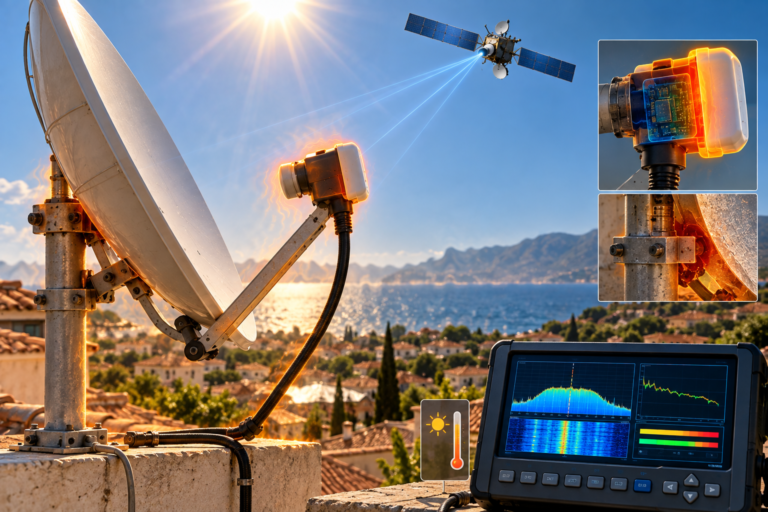
Why Hot Bird Works in Rain but One Carrier Fails
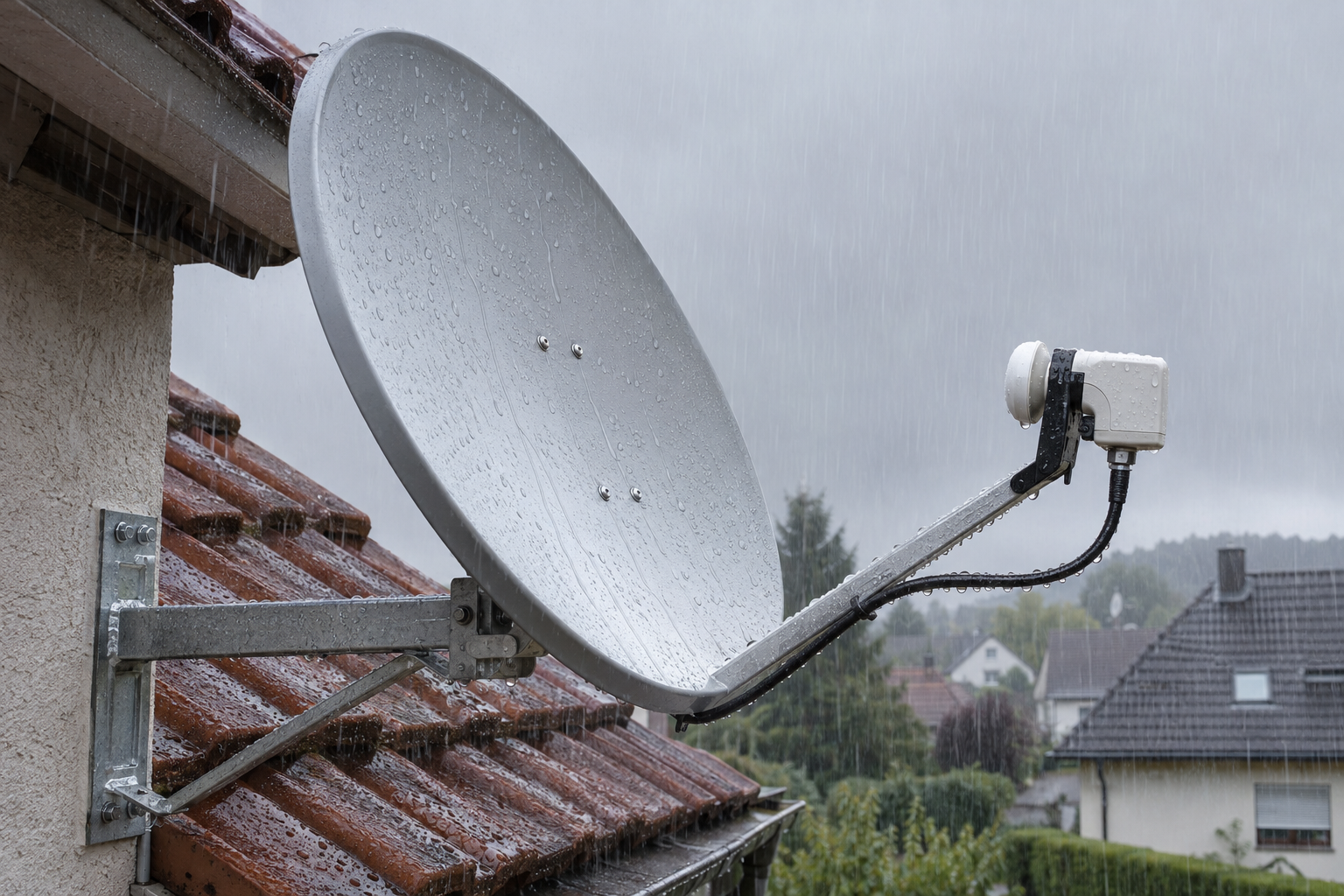
Rain begins falling, but your Hot Bird 13°E channels continue playing normally. Then one transponder starts breaking up. Its picture freezes, the receiver briefly loses lock, and several channels disappear together. Meanwhile, other transponders remain stable throughout the storm. If all those signals arrive from the same orbital position, why does only one fail?
The explanation usually lies in the amount of reception margin each carrier has before the rain begins. Rain attenuation can reduce the usable satellite signal, but different transponders do not necessarily start with identical carrier quality or require identical conditions for successful decoding. A carrier operating close to its threshold may fail while others retain sufficient margin. The challenge is proving that rain attenuation is responsible rather than a water-damaged connector, moving antenna, or incorrect receiver configuration.
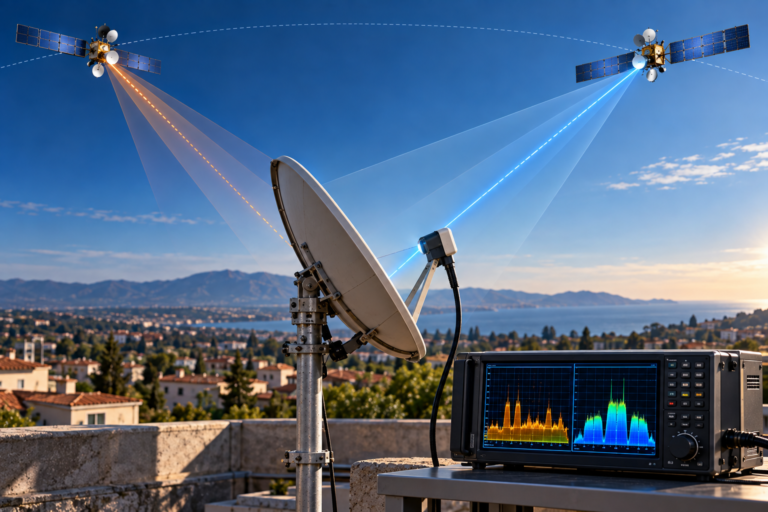
Hot Bird 13°E is served by Eutelsat’s HOTBIRD 13F and 13G satellites. Ku-band reception can be affected by precipitation along the satellite-to-ground propagation path. However, receiving one Hot Bird carrier during rainfall does not establish that every other carrier has sufficient decoding margin. Selective failures should be investigated through verified transmission parameters, signal-quality measurements, and the behavior of the physical installation.
Why Rain Affects Hot Bird Satellite Reception
Satellite signals traveling from space to a receiving antenna pass through the Earth’s atmosphere. Their propagation can be affected by atmospheric gases, clouds, precipitation, and other environmental conditions.
At Ku-band frequencies, rainfall can introduce significant attenuation under certain conditions.
Raindrops interact with the electromagnetic wave, reducing the power that reaches the antenna through absorption and scattering.
The amount of attenuation depends on several variables, including rainfall intensity, operating frequency, polarization, and the effective path through the precipitation.
This is why the same satellite installation may remain stable during light rain but experience interruptions during a heavy storm.
Rain Intensity Is Not the Only Variable
The intensity of rainfall measured at ground level does not fully describe the conditions along the satellite signal path.
The signal travels through a slanted atmospheric path whose geometry depends on the satellite elevation angle at the receiving location.
Rain-cell structure, rain height, and the distribution of precipitation along that path all influence attenuation.
Consequently, two storms that appear similar from the ground may produce different satellite reception results.
Engineering prediction methods such as ITU-R P.618 account for these factors when estimating propagation effects on Earth-space communication links.
Why One Hot Bird Carrier Can Fail While Others Keep Working
The key principle is that satellite reception is evaluated carrier by carrier.
Hot Bird is an orbital position carrying numerous transponders, not one uniform transmission with a single reception threshold.
Individual carriers may differ in received power, modulation configuration, coding requirements, and available link margin.
These differences can become important during rainfall.
A Marginal Carrier Reaches Its Threshold First
Consider an installation that receives several Hot Bird transponders under clear skies.
Most carriers may have comfortable margins above the quality needed for reliable demodulation.
One carrier, however, may operate much closer to its required threshold.
When rainfall reduces usable signal quality, that marginal carrier can become unreliable before the others.
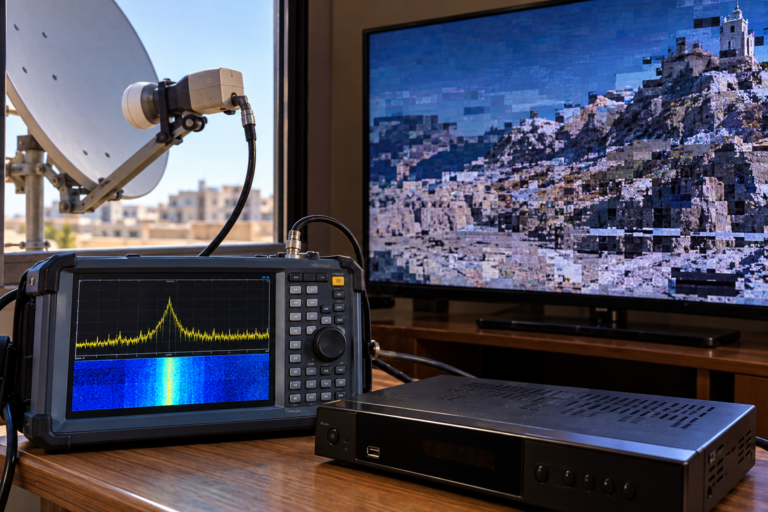
The receiver may begin reporting errors, produce visible picture breakup, or lose the carrier completely.
Other transponders can remain operational because their remaining margin is sufficient.
Several Channels Can Disappear Together
A satellite transponder can carry multiple television and radio services.
If the receiver loses the underlying transport, every service depending on that carrier may become unavailable at the same time.
This does not mean each channel has developed a separate fault.
Grouping the affected services by transponder is therefore one of the most useful early diagnostic steps.
Clear-Sky Margin and Rain Margin Explained
Reception margin describes how much room remains between the available signal quality and the conditions required for successful reception.
In practical troubleshooting, an installer may compare the measured carrier quality with the relevant operating requirements of the transmission.
That difference helps indicate how much deterioration the system may tolerate before service is interrupted.
A Simple Illustrative Example
Suppose two hypothetical carriers are operating above their respective reception thresholds.
Carrier A has an illustrative margin of 5 dB, while Carrier B has only 2 dB.
If atmospheric conditions introduce an additional 3 dB of effective quality degradation, Carrier A may retain sufficient margin while Carrier B falls below its required operating point.
These figures are illustrative only. They are not measurements of actual Hot Bird transponders and do not imply that rain always causes a fixed reduction in MER or C/N.
| Illustrative Carrier | Initial Margin | Assumed Degradation | Remaining Margin |
|---|---|---|---|
| Carrier A | 5 dB | 3 dB | 2 dB |
| Carrier B | 2 dB | 3 dB | -1 dB |
In this simplified example, Carrier B crosses its operating threshold first.
Actual reception behavior depends on the particular waveform, receiver implementation, signal impairments, and propagation conditions.
A carrier’s clear-sky margin and its sensitivity to additional attenuation are related, but not identical concepts. The change in usable modulation quality depends on the complete receiving system, including noise and interference contributions.
Why Modulation and Coding Affect Rain Reliability
Digital satellite transmissions use modulation and forward-error-correction techniques to carry information efficiently and recover data under imperfect reception conditions.
Different transmission modes can require different signal-to-noise conditions for reliable operation.
DVB-S and DVB-S2 Are Not Identical Reception Modes
DVB-S2 supports multiple modulation and coding configurations with different efficiency and robustness characteristics.
A carrier using a more demanding configuration may require higher-quality reception than another carrier using a more robust configuration.
This is one reason two transponders with similar RF input levels may respond differently during deteriorating weather.
However, it would be inaccurate to claim that every DVB-S2 carrier is less rain-resistant than every DVB-S carrier.
The actual requirements depend on the complete transmission configuration and receiver capabilities.
Why Signal Strength Percentages Can Mislead
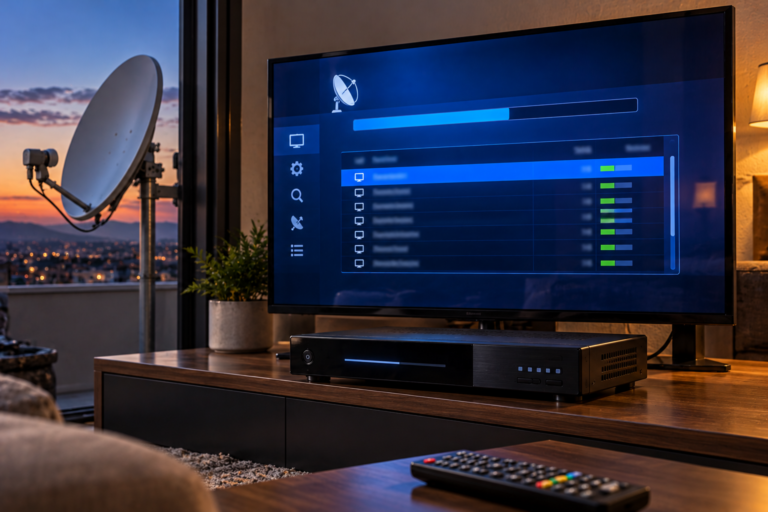
Most consumer receivers display signal strength and signal quality as percentages.
These numbers are generally manufacturer-specific indicators rather than standardized engineering measurements.
A receiver can report a relatively high signal level while the modulation quality is too poor for reliable decoding.
For meaningful diagnosis, measurements such as C/N, MER, and relevant error rates are more informative when interpreted correctly.
The required reception margin should be evaluated against the actual transmission mode rather than a universal receiver percentage.
Does a Higher Downlink Frequency Always Fail First?
Rain attenuation depends partly on operating frequency, and this relationship is important in Ku-band satellite engineering.
However, it does not follow that the highest-frequency Hot Bird transponder must always be the first to fail.
The relative performance of two carriers depends on more than their frequency difference.
Other relevant variables include:
- Available downlink power and local coverage conditions.
- Modulation and coding requirements.
- Receiving antenna gain and efficiency.
- LNB and distribution-system performance.
- Polarization and propagation conditions.
- Existing clear-sky reception margin.
For example, a carrier with a slightly lower downlink frequency but substantially less initial margin may fail before a higher-frequency carrier.
Frequency-dependent rain attenuation should therefore be considered within the complete link budget rather than used as the only explanation.
Rain Fade or a Wet Connector? How to Tell the Difference
Not every satellite reception problem that occurs during rainfall is caused directly by attenuation along the atmospheric path.
Rain can also expose weaknesses in the physical installation.
Water Ingress Into Outdoor Connections
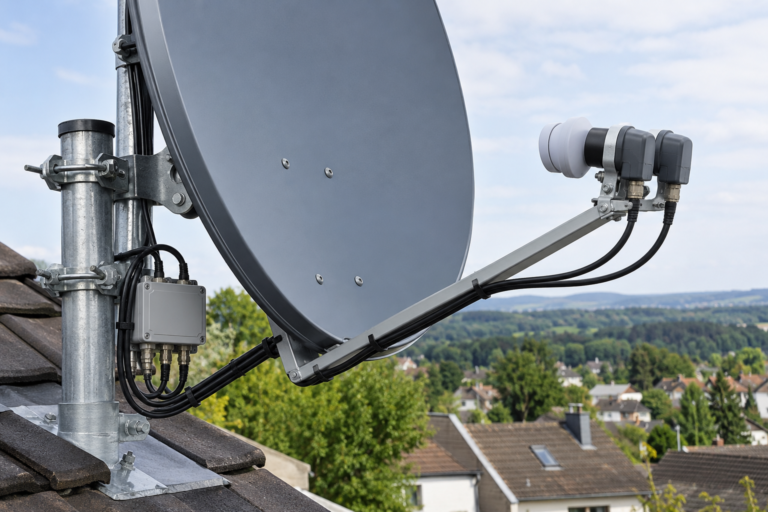
Outdoor F-connectors, coaxial cables, and LNB housings must be protected against environmental exposure.
Moisture entering an unsuitable connection can introduce impedance mismatch, signal loss, corrosion, and unstable electrical contact.
These effects may appear during rainfall and persist after the storm ends.
If one group of frequencies remains unreliable long after conditions have cleared, inspect the outdoor hardware rather than assuming atmospheric attenuation is still responsible.
Wind-Related Dish Movement
Rainstorms are often accompanied by wind.
A poorly secured mast, loose mounting bracket, or flexible reflector assembly may move enough to reduce antenna pointing accuracy.
Transponders with less reception margin can fail first, even though the primary problem is mechanical movement rather than rainfall attenuation.
If the signal varies sharply with wind gusts, investigate the stability of the mounting system.
Water on the Reflector or Feed Assembly
Water collecting on or around parts of the antenna system can also alter RF behavior under some conditions.
However, a wet reflector should not automatically be blamed for every rain-related outage.
The relative contribution of surface wetting, atmospheric attenuation, and installation faults depends on the antenna design and environmental conditions.
First Confirm That the Receiver Is Actually Receiving Hot Bird
Before investigating a suspected rain-sensitive Hot Bird transponder, verify that the receiver is tuned to the intended satellite and that the correct LNB path is selected.
In multi-satellite installations, an incorrect DiSEqC assignment can route the tuner to a different feed.
A receiver may also retain outdated or incorrectly labeled transponder entries.
Our related guide, Why Your Receiver Finds Astra Instead of Hot Bird, explains how incorrect dish alignment, LNB selection, and receiver database settings can produce misleading satellite reception results.
That problem is separate from rain fade, but confirming the intended orbital position is essential before comparing carrier behavior.
Use currently verified transponder parameters and, where supported, received service or network information to confirm the actual signal source.
How to Measure One Carrier’s Performance Before, During and After Rain
The strongest evidence for selective rain fade is a repeatable deterioration in carrier quality that follows changing propagation conditions.
A useful diagnostic comparison involves three observation periods.
1. Establish the Clear-Sky Baseline
Under stable conditions, identify the affected carrier and record its current transmission parameters.
Measure its C/N, MER, error performance, and lock status using appropriate equipment.
Repeat the measurements on several other verified Hot Bird carriers using the same receiving system.
Record the date, weather conditions, and equipment configuration.
2. Observe the Carrier During Rainfall
When rain begins, monitor the same carrier without changing receiver or antenna settings.
Note whether MER or C/N deteriorates before errors and lock failures occur.
Compare the affected carrier against the others.
If one transponder consistently loses usable margin while the rest remain above their operating requirements, the selective-failure pattern becomes clearer.
Do not attempt rooftop adjustments or exposed electrical measurements during a storm.
3. Repeat the Measurement After the Storm
Once conditions have cleared and the system is safe to inspect, repeat the same measurements.
If carrier quality returns to its earlier baseline, temporary propagation attenuation is a plausible explanation.
If the fault persists or becomes intermittent, investigate outdoor connections, moisture damage, switching components, and antenna stability.
A single recovery event is not conclusive proof. Repeatable observations provide stronger evidence.
For each test, document the carrier frequency, polarization, symbol rate, modulation configuration, lock status, C/N, MER, and observable weather conditions.
Compare the same carrier across different conditions rather than treating receiver signal-quality percentages from unrelated transponders as directly equivalent.
What Different Rain-Related Failure Patterns Reveal
| Observed Pattern | Possible Explanation | Recommended Check |
|---|---|---|
| One carrier fails during heavy rain and recovers afterward | Insufficient rain margin | Compare clear-sky and rain-period C/N or MER |
| Several channels on one transponder disappear together | Loss of the shared carrier | Verify transport lock and current parameters |
| Reception remains weak after rain stops | Water ingress, damaged connections, or another persistent fault | Inspect outdoor components when safe |
| Reception fluctuates with wind gusts | Antenna or mounting movement | Check mast rigidity and reflector stability |
| All transponders weaken during severe rainfall | Broad reduction in available reception margin | Measure representative carriers and assess antenna performance |
| Only one receiver loses the affected carrier | Receiver, cable, LNB output, or local distribution issue | Compare equivalent signal paths |
| Channels remain missing in clear weather but the carrier locks | Service database or decoding issue | Verify service information and receiver compatibility |
These patterns narrow the investigation but do not prove a particular cause without supporting measurements.
How to Improve Hot Bird Reception During Rain
Once the cause is established, choose the correction that addresses the actual limitation.
Optimize the Existing Dish Alignment
A slightly misaligned antenna may receive robust carriers successfully while leaving marginal carriers with insufficient reserve.
Professional fine alignment can improve usable margin without requiring a larger reflector.
Use suitable signal-quality measurements rather than maximizing an arbitrary strength percentage.
Inspect Weatherproofing and Outdoor Connections
Check the condition of the LNB housing, coaxial connections, cable routing, and weather seals.
Replace damaged components with appropriate outdoor-rated equipment.
Do not rely on temporary coverings or unsuitable sealing materials that may trap moisture.
Consider a Larger Dish When Link Margin Is Insufficient
A properly installed larger reflector can provide additional receiving antenna gain.
That gain may improve rain reliability when the system’s principal limitation is insufficient carrier-to-noise margin.
However, the correct dish size depends on the receiving location, antenna efficiency, local EIRP, elevation angle, desired weather margin, and transmission requirements.
A larger dish is not a guaranteed cure for every rain-related problem.
Avoid Unnecessary Receiver Rescans
If a carrier loses lock during rain, scanning again will not restore the missing RF margin.
Likewise, replacing a receiver or LNB without evidence may leave the real problem unchanged.
Restore stable signal reception first. Update channel information only when there is a separate reason to believe the service database is outdated.
Reality Check: Rain Does Not Selectively Disable a Channel by Name
Rain attenuation acts on the physical radio propagation path. It does not identify particular television channels or intentionally disable individual services.
Selective channel failures occur because the underlying carriers have different reception conditions, operating requirements, or available margins.
If several channels share one affected carrier, they may fail together even while services on other transponders continue normally.
A carrier that fails during rainfall is not automatically defective, and a receiver that retains other Hot Bird channels is not necessarily receiving every transponder with adequate margin.
Final Verdict
Hot Bird 13°E can continue working during rain while one carrier fails because each transponder has its own available reception margin and operating requirements.
Rain-related attenuation can push a marginal carrier below its decoding threshold before other carriers are affected.
However, moisture-damaged connections, wind-induced antenna movement, incorrect receiver configuration, and other RF faults can produce similar symptoms.
The most reliable diagnosis compares the affected carrier’s measurements under clear skies, during rainfall, and after conditions recover.
Once the cause is known, improve alignment, repair outdoor hardware, or increase antenna margin only where the evidence supports that correction.
Frequently Asked Questions
Why does only one Hot Bird transponder fail during rain?
The affected carrier may have less available reception margin than other transponders. Rain attenuation can push it below the required decoding threshold while the remaining carriers continue operating.
Can several Hot Bird channels disappear because of one weak carrier?
Yes. Multiple television services can share a transponder. When that carrier loses lock, all services depending on it may become unavailable together.
Does rain affect all Hot Bird frequencies equally?
No. Propagation attenuation depends on frequency and other conditions, while the resulting reception failures also depend on each carrier’s available link margin and transmission requirements.
Why does a Hot Bird channel keep freezing after the rain ends?
Persistent problems may involve moisture-damaged connectors, cabling, antenna movement, or another installation fault. Compare post-rain measurements against a known clear-sky baseline.
Will an 80cm dish stop Hot Bird channels disappearing in rain?
A suitable 80cm dish may provide more receiving gain than a smaller reflector, but results depend on installation quality, location, beam coverage, and the required margin. No dish size guarantees uninterrupted reception in every storm.
Can a bad LNB cause problems only when it rains?
Yes. Damaged seals, moisture ingress, or other weather-sensitive hardware problems can cause intermittent faults. However, a rain-related failure does not automatically identify the LNB as the cause.
Should I rescan Hot Bird after losing channels during rain?
Not if the underlying transponder simply lost lock temporarily. Restore stable reception first. Rescanning is relevant when current service or tuning information has changed, not as a remedy for inadequate signal quality.