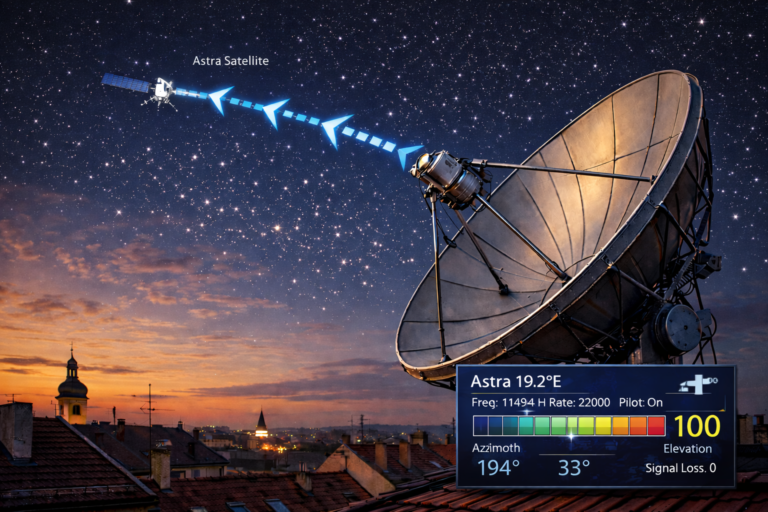
The Real Reason Your Dish Loses Signal During Rain
Estimated Reading Time: 12 minutes
Many people believe a satellite dish loses signal during rain simply because water lands on the reflector. While water on the dish can have a small effect under certain conditions, it is rarely the primary reason satellite television disappears during heavy rainfall. The real cause occurs high above the ground, along the microwave path between the satellite and the receiving antenna.
Satellite television commonly uses Ku-band frequencies, where raindrops absorb and scatter microwave energy. As rainfall becomes heavier, the received carrier gradually weakens compared with background noise. Forward Error Correction can hide this degradation for a while, but once the available signal margin falls below the DVB-S2 decoding threshold, BER rises rapidly, MER falls, and the picture can suddenly freeze or disappear.
Rain fade is an atmospheric propagation phenomenon. The signal is weakened while travelling through precipitation before it reaches the dish. The television picture usually remains perfect until the remaining link margin is exhausted. That is why digital satellite television often appears stable before failing suddenly during heavy rain.
- What Rain Fade Really Means
- Why Ku-Band Signals Are Sensitive to Rain
- How Raindrops Weaken Microwave Signals
- Why Water on the Dish Is Usually Not the Main Problem
- How Signal Margin Determines Whether Reception Survives
- Why BER Rises During Heavy Rain
- How MER Falls Before Signal Loss
- The Role of Forward Error Correction
- Why HD Channels Often Fail First
- How Dish Size Changes Rain Performance
- The Importance of Accurate Dish Alignment
- LNB Performance During Bad Weather
- Wet Connectors Versus Rain Fade
- Why One Storm Causes More Problems Than Another
- How Professional Installers Improve Rain Margin
- Reality Check
- Final Verdict
- FAQ
What Rain Fade Really Means
Rain fade is the gradual loss of microwave signal strength caused by precipitation between the satellite and the receiving antenna.
Unlike terrestrial television, a geostationary satellite signal travels approximately 36,000 kilometres before reaching the dish. Only a tiny part of that path passes through Earth’s atmosphere, but that final section is critical because it contains rain, clouds, water droplets, and atmospheric moisture.
When rainfall becomes sufficiently intense, the satellite carrier arriving at the dish contains less usable energy than it did under clear-sky conditions.
The receiver does not immediately lose lock. Instead, the available reception margin slowly decreases until the decoding threshold is crossed.
Why Ku-Band Signals Are Sensitive to Rain
Most direct-to-home satellite television services operate in the Ku-band, generally between about 10.7 GHz and 12.75 GHz.
These microwave frequencies provide excellent satellite coverage and allow reasonably sized domestic dishes. However, they are also affected by precipitation more than lower microwave frequencies.
Water droplets interact with electromagnetic waves whose wavelength is comparable to the size of the droplets themselves.
Part of the signal energy is absorbed and converted into heat. Another portion is scattered away from the original propagation direction.
Both mechanisms reduce the useful carrier arriving at the receiving antenna.
How Raindrops Weaken Microwave Signals
Every raindrop behaves as a tiny obstacle within the propagation path.
Instead of allowing all microwave energy to continue travelling directly toward the receiving dish, the droplets absorb some energy and redirect another portion in different directions.
The heavier the rainfall, the more water occupies the signal path and the greater the accumulated attenuation becomes.
Longer propagation paths through intense rain cells produce larger losses than short paths through light showers.
This explains why tropical storms often affect satellite reception much more severely than brief light rain.
Why Water on the Dish Is Usually Not the Main Problem
Many viewers look outside during rain, notice water covering the reflector, and assume this is the reason television reception disappeared.
In reality, the reflector itself normally continues functioning well even when wet.
Small amounts of water on a properly shaped metal dish have only a limited influence compared with the attenuation already occurring throughout the atmospheric path.
The important loss usually occurs before the signal even reaches the antenna.
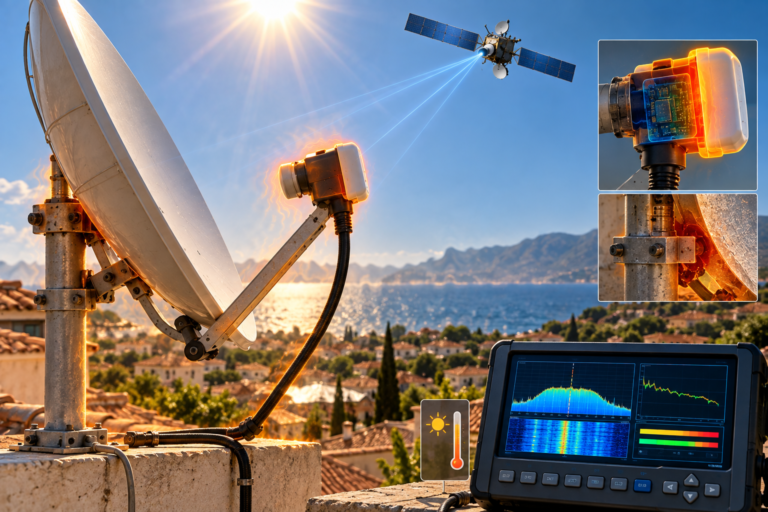
Water becomes more important when it enters connectors, accumulates inside damaged LNB covers, or creates long-term corrosion within the receiving system.
How Signal Margin Determines Whether Reception Survives
Every DVB-S2 transmission requires a minimum carrier quality for reliable decoding.
When weather is clear, a correctly installed system normally operates comfortably above that minimum requirement.
This difference between current reception conditions and the decoding threshold is called the signal margin.
Rain gradually consumes that reserve.
A well-aligned installation with generous margin may continue operating through heavy rainfall. A marginal installation may lose reception during relatively modest showers because very little reserve existed before the rain began.
| Installation Condition | Clear Weather | Heavy Rain |
|---|---|---|
| Large signal margin | Stable reception | Usually remains operational |
| Moderate signal margin | Stable reception | Brief pixelation may occur |
| Very small signal margin | Picture appears perfect | Rapid loss of reception |
| Poor alignment | May appear acceptable | Fails quickly during rainfall |
| Large dish with accurate alignment | High reserve | Improved weather resistance |
Why BER Rises During Heavy Rain
As the carrier becomes weaker relative to background noise, the receiver has greater difficulty distinguishing modulation symbols correctly.
Incorrect symbol decisions produce additional bit errors.
Initially these appear only as higher pre-FEC BER because Forward Error Correction repairs them successfully.
As rainfall intensifies, the correction system eventually reaches its practical limit.
Post-FEC errors then begin reaching the transport stream, creating pixelation, freezing, audio interruptions, and finally complete signal loss.
How MER Falls Before Signal Loss
MER measures how closely received modulation symbols match their ideal constellation positions.
Rain introduces additional noise relative to the wanted carrier, causing constellation points to spread farther from their ideal locations.
This reduction in MER normally occurs before the receiver completely loses lock.
Professional installers therefore monitor MER during installation because it reveals how much practical reception margin remains before visible failure begins.
Consumer signal-strength bars often fail to show this gradual deterioration clearly.
The Role of Forward Error Correction
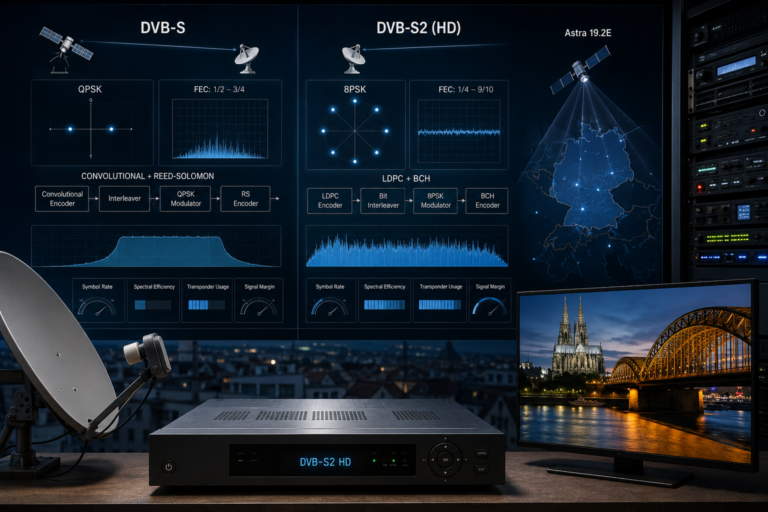
DVB-S2 uses powerful LDPC and BCH Forward Error Correction to repair damaged data.
This correction process is the reason digital television often remains perfectly clear during the early stages of rain fade.
Instead of displaying gradually increasing picture noise like analogue television, the receiver silently repairs many transmission errors.
Only when the incoming damage exceeds the correction capability does visible picture corruption appear.
This creates the familiar experience of television working perfectly until heavy rainfall suddenly pushes reception beyond the decoding threshold.
Why HD Channels Often Fail First
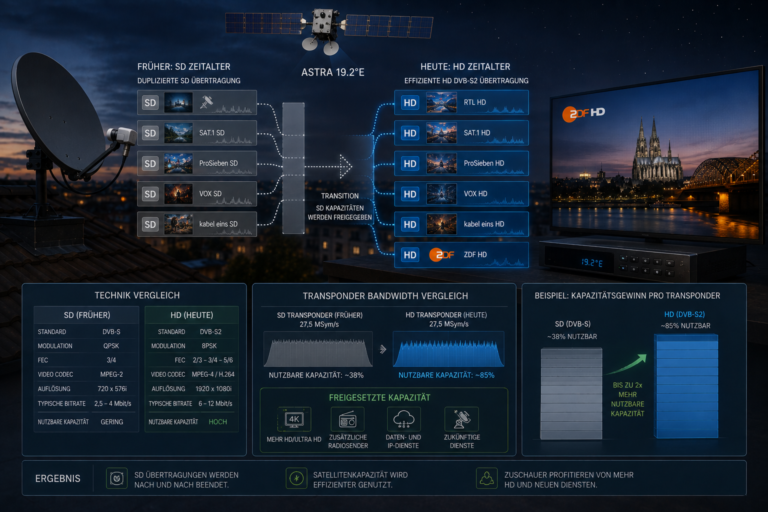
Many HD services use DVB-S2 together with modulation formats such as 8PSK that may require cleaner reception than older QPSK services using more robust transmission configurations.
This does not mean HD resolution itself causes rain sensitivity.
The important factor is the transmission configuration selected for that particular transponder.
If the HD transponder already operates with less reception margin than nearby SD services, rainfall may cause the HD channels to disappear first.
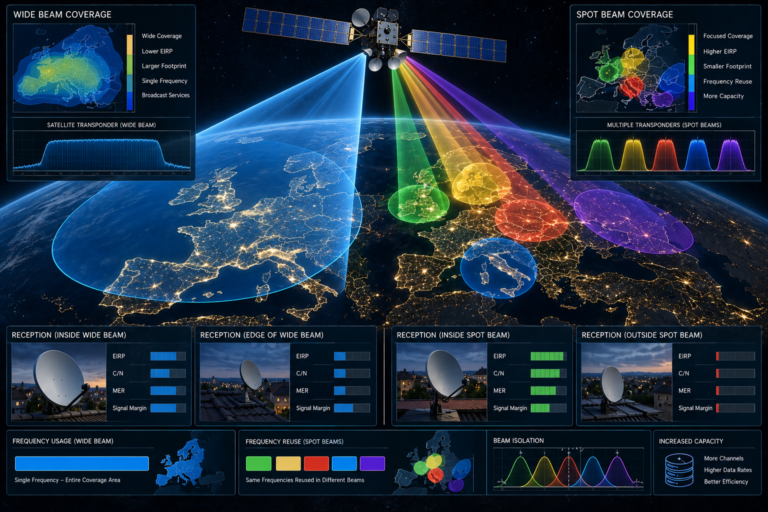
Another HD multiplex on a different beam or using different coding may remain completely stable under the same weather conditions.
How Dish Size Changes Rain Performance
A larger parabolic reflector collects more microwave energy from the wanted satellite.
This increases antenna gain and improves the carrier level arriving at the LNB.
The additional received energy creates more signal margin before bad weather begins.
As rainfall reduces the carrier, the larger dish still remains above the decoding threshold for longer than a smaller antenna installed at the same location.
Dish size cannot eliminate atmospheric attenuation, but it can provide additional reserve against it.
The Importance of Accurate Dish Alignment
Dish alignment determines how efficiently the reflector concentrates the satellite signal onto the LNB feedhorn.
Even very small pointing errors reduce the wanted carrier.
The picture may still appear perfect in clear weather because enough margin remains.
Rain removes part of that remaining reserve, exposing alignment errors that previously remained invisible.
This explains why many viewers believe rain caused the installation problem, when the underlying issue was actually insufficient alignment accuracy.
LNB Performance During Bad Weather
The LNB is responsible for amplifying extremely weak microwave signals before frequency conversion.
Its internal noise figure, oscillator stability, phase noise, and gain all influence overall reception quality.
A high-quality LNB preserves more usable carrier information than a noisy or ageing unit.
Although replacing the LNB cannot stop atmospheric attenuation, it can improve the overall reception margin available before rain fade becomes visible.
Correct LNB skew also remains important because poor polarization isolation reduces the available signal quality even before weather losses begin.
Wet Connectors Versus Rain Fade
Rain fade and water-damaged connectors are different faults even though they often appear during the same weather conditions.
Rain fade affects the microwave signal while it travels through the atmosphere.
Water entering poorly sealed F-connectors creates attenuation, corrosion, impedance mismatch, and intermittent electrical contact within the coaxial distribution system.
Unlike atmospheric rain fade, connector damage often continues causing problems long after the rain has stopped.
Professional troubleshooting should therefore inspect outdoor connectors whenever rain-related reception problems persist after clear weather returns.
Why One Storm Causes More Problems Than Another
Not all rainfall produces the same microwave attenuation.
The amount of loss depends on rainfall intensity, the depth of the rain cell, the path through precipitation, drop size distribution, local climate, satellite elevation angle, and the existing reception margin.
A brief shower may have almost no visible effect.
A slow-moving thunderstorm containing extremely intense precipitation can produce several decibels of additional attenuation and quickly exhaust the available link margin.
This explains why neighbouring storms of apparently similar size may produce very different effects on television reception.
How Professional Installers Improve Rain Margin
Professional installation focuses on maximizing usable signal quality rather than simply achieving channel lock.
Fine adjustment of azimuth, elevation, and LNB skew increases the wanted carrier while reducing interference.
Installers verify MER, BER, and stable reception across multiple transponders rather than relying only on signal strength.
Outdoor connectors are weatherproofed carefully to prevent moisture ingress, and damaged cables or poorly mounted dishes are replaced where necessary.
Where local climate regularly produces severe rainfall, a larger reflector may provide valuable additional fade margin.
Understanding how digital reception behaves during rain also requires understanding the sudden threshold effect described in our guide to why satellite TV works until it suddenly doesn’t. The two phenomena are closely connected because rain primarily reduces the remaining signal margin rather than instantly removing the entire satellite signal.
Rain itself is not always responsible for every weather-related reception problem.
Loose dish mounts, ageing LNBs, poor alignment, damaged coaxial cables, water-filled connectors, and inadequate dish size often reduce the available signal margin long before bad weather arrives.
Heavy rain simply exposes weaknesses that already existed within the receiving system.
Satellite dishes lose signal during rain primarily because microwave energy is absorbed and scattered by precipitation before reaching the antenna. The resulting reduction in carrier quality decreases the available signal margin.
Forward Error Correction hides many transmission errors while sufficient margin remains, allowing the picture to stay perfect even as BER slowly rises and MER falls.
Once rainfall reduces the link below the DVB-S2 decoding threshold, the receiver can no longer recover enough correct data. Pixelation, freezing, audio interruption, and complete signal loss follow rapidly.
Reliable reception during poor weather depends on accurate dish alignment, proper LNB skew, healthy MER, low BER, good-quality hardware, weatherproof connectors, and enough signal margin to survive atmospheric attenuation.
| Question | Answer |
|---|---|
| Why does my satellite dish lose signal when it rains? | Heavy rain absorbs and scatters Ku-band microwave signals, reducing the carrier arriving at the dish until the receiver falls below its decoding threshold. |
| Is water on the dish the main cause? | Usually not. Most of the attenuation occurs while the signal travels through the rain, not because the reflector becomes wet. |
| What is rain fade? | Rain fade is the reduction of microwave signal strength caused by precipitation between the satellite and the receiving antenna. |
| Why does the picture disappear suddenly? | Forward Error Correction hides errors until the remaining signal margin becomes too small. The receiver then crosses the digital decoding threshold. |
| Does a larger dish improve rain performance? | Yes. A larger reflector provides higher antenna gain and increases available signal margin. |
| Can better alignment reduce rain problems? | Yes. Accurate alignment maximizes the wanted carrier and improves the available fade margin. |
| Can a faulty LNB make rain fade worse? | Yes. Poor noise performance or oscillator instability reduces the available reception margin before rainfall begins. |
| Why do HD channels often disappear first? | Many HD services use transmission configurations that require cleaner reception, leaving less margin during heavy rain. |
| Can damaged connectors cause similar symptoms? | Yes. Water entering outdoor connectors creates electrical problems that can resemble rain fade and may continue after the weather improves. |
| Will an amplifier stop rain fade? | No. An amplifier cannot recover signal quality already lost along the atmospheric propagation path. |