Why Your Receiver Shows 90% Signal but No Picture
Estimated Reading Time: 12 minutes
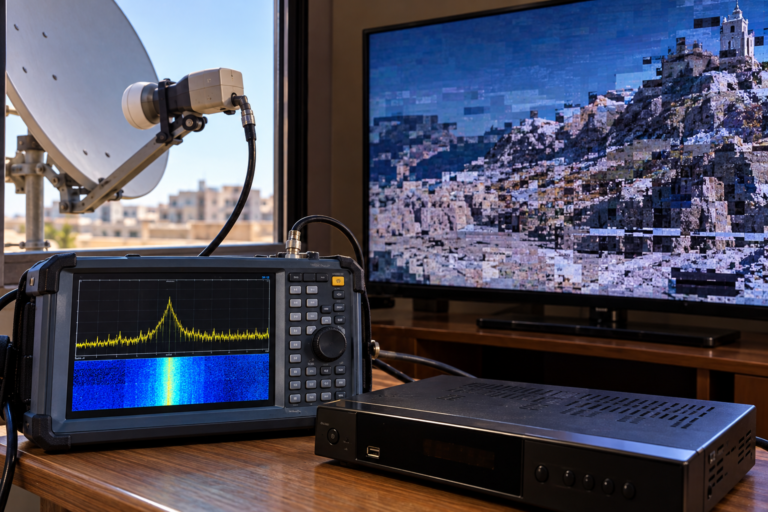
A satellite receiver showing 90 percent signal strength while the television remains black seems contradictory. If the signal is that strong, why is there no picture? The answer is that the strength meter usually represents only one early stage of the reception chain. It can tell you that RF energy is reaching the tuner, but it cannot prove that the receiver has locked the correct satellite carrier, recovered valid DVB-S2 data, or decoded the television service successfully.
A picture appears only after several separate processes succeed. The dish must point at the correct satellite, the LNB must convert the correct frequency and polarization, the tuner must acquire the wanted carrier, the demodulator must recover its symbols, Forward Error Correction must repair the data, the transport stream must contain the expected service, and the receiver must support its video and audio formats. A failure at any stage after RF detection can leave the strength bar high while the screen remains empty.
Signal strength is not the same as signal quality or successful channel decoding. A high strength percentage can be produced by the correct carrier, another satellite, an unwanted transponder, interference, or simply substantial RF energy entering the tuner. The receiver still needs carrier lock, correct DVB-S2 parameters, manageable BER, sufficient MER, a valid transport stream, and compatible video decoding before a television picture can appear.
- What the 90% Signal Reading Really Means
- Why Signal Strength Is Not Proof of Satellite Lock
- You May Be Pointed at the Wrong Satellite
- Why Signal Quality Can Be Zero While Strength Is High
- Incorrect Frequency and Symbol Rate
- Polarization and LNB Control Problems
- Wrong LNB Local Oscillator Settings
- DVB-S Versus DVB-S2 Compatibility
- QPSK and 8PSK Receiver Compatibility
- How BER Can Prevent a Picture
- Why MER Matters More Than Raw Power
- Transport Stream Lock Versus RF Lock
- When the Receiver Finds the Channel but Cannot Decode Video
- H.264, HEVC, and Codec Compatibility
- When the Problem Is Not Satellite Reception
- How to Troubleshoot 90% Signal With No Picture
- Reality Check
- Final Verdict
- FAQ
What the 90% Signal Reading Really Means
On most consumer satellite receivers, the signal-strength percentage is not a calibrated measurement of the wanted satellite carrier.
It is commonly derived from information inside the tuner or Automatic Gain Control system. The value gives a rough indication of how much RF energy is entering the selected part of the tuner.
That energy may include the wanted carrier, thermal noise, nearby transponders, interference, or a carrier from another satellite position.
Different receiver manufacturers also use different software scales. A reading of 90 percent on one receiver may correspond to a completely different RF condition from 90 percent on another model.
The number is therefore useful mainly as a relative indication. It does not certify successful digital reception.
Why Signal Strength Is Not Proof of Satellite Lock
The tuner can detect substantial RF power before the DVB-S2 demodulator has identified a usable signal.
Successful lock requires much more. The receiver must identify the carrier frequency accurately, recover symbol timing, recognize the modulation, obtain physical-layer synchronization, and successfully process the Forward Error Correction structure.
If any of those stages fails, quality can remain at zero while strength stays high.
This is why professional installers pay much more attention to signal quality, MER, BER, and lock status than to raw strength alone.
You May Be Pointed at the Wrong Satellite
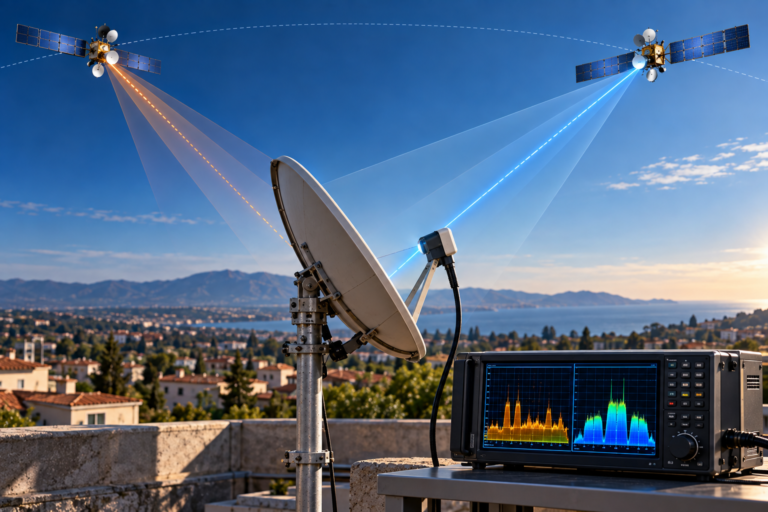
One of the most common causes of high strength with no picture is alignment with the wrong orbital position.
Geostationary satellites can appear relatively close together in the sky. During dish alignment, a reflector may intercept a strong neighboring satellite before reaching the intended one.
The receiver detects plenty of RF power and the strength meter rises. However, the requested transponder does not exist on that satellite, so the receiver cannot obtain valid DVB-S2 lock.
This situation is particularly common when aligning a dish using the strength bar alone.
A known active transponder from the intended satellite should always be used, and successful digital quality or lock should confirm the correct orbital position.
Why Signal Quality Can Be Zero While Strength Is High
Signal quality measures whether the receiver can make useful sense of the RF energy entering the tuner.
A strong carrier contaminated by noise or interference can therefore produce high strength and poor quality at the same time.
Incorrect dish alignment may reduce the wanted carrier relative to adjacent satellite energy. Incorrect LNB skew can allow interference from the opposite polarization. Local interference can also enter through poorly shielded cable or connectors.
In all of these cases, the tuner still sees power. The DVB-S2 demodulator simply cannot distinguish the wanted symbols reliably enough to recover data.
| Receiver Reading | Likely Meaning | Possible Cause |
|---|---|---|
| High strength, zero quality | RF energy present but no valid digital lock | Wrong satellite, wrong frequency, unsupported standard, severe interference |
| High strength, low unstable quality | Carrier detected but close to decoding threshold | Misalignment, poor skew, noise, weak margin |
| High strength, high quality, no video | DVB-S2 reception probably successful | Codec, service, output, or access issue |
| Low strength, zero quality | Very little usable RF reaches tuner | Cable, LNB power, dish direction, connector fault |
| Normal quality but occasional freezing | Intermittent errors or decoder problem | BER spikes, cable fault, LNB drift, receiver instability |
Incorrect Frequency and Symbol Rate
The receiver needs the correct transponder parameters before it can demodulate a channel.
Frequency identifies where the carrier is located within the satellite spectrum. Symbol rate tells the receiver how rapidly symbols are being transmitted.
If either value is substantially incorrect, the tuner may still detect nearby RF energy and display high signal strength, but the demodulator cannot synchronize with the actual transmission.
A blind scan can sometimes find the carrier automatically, while manual tuning depends on accurate parameters.
Frequency lists can also become outdated after an operator moves services between transponders, so old stored parameters should not automatically be assumed correct.
Polarization and LNB Control Problems
Satellite capacity is reused by transmitting services on different polarizations.
In a common Universal LNB installation, the receiver changes the DC voltage sent through the coaxial cable to select the required polarization state.
If the receiver produces the wrong voltage, the cable has excessive voltage drop, a connector has poor electrical contact, or a switch is faulty, the LNB may remain on the wrong polarization.
The receiver can still show high RF strength because another group of transponders is being received. The wanted carrier, however, is missing.
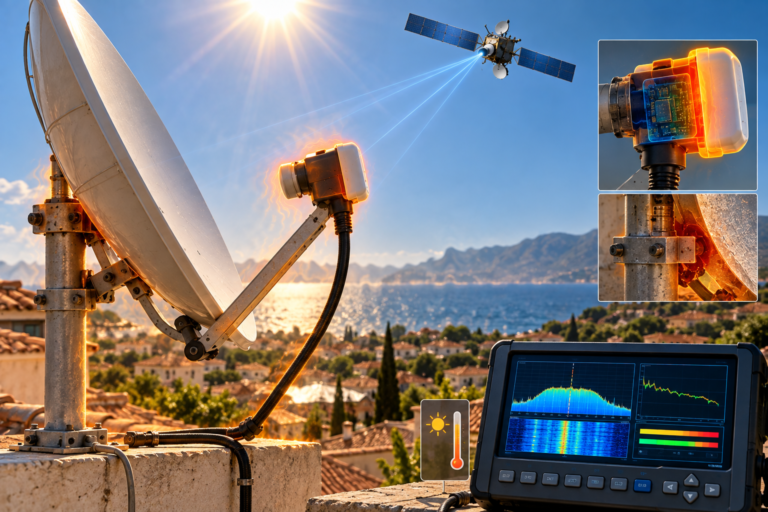
Incorrect LNB skew can produce a related problem. The correct polarization is selected electrically, but insufficient physical isolation allows too much opposite-polarized energy into the feed.
Wrong LNB Local Oscillator Settings
The receiver does not tune the original Ku-band downlink frequency directly. The LNB converts it to an intermediate frequency using its local oscillator.
A typical Universal LNB uses 9.750 GHz for the low band and 10.600 GHz for the high band.
The receiver must know these oscillator values to calculate the correct tuner frequency.
If the LNB type is configured incorrectly, the receiver may tune the wrong intermediate frequency even though the satellite frequency entered on screen appears correct.
The result can be high strength with no lock or a scan that finds channels on unexpected frequency values.
DVB-S Versus DVB-S2 Compatibility
A receiver designed only for DVB-S cannot demodulate a DVB-S2 transmission.
This creates a classic high-strength, no-picture situation. The tuner detects the carrier’s RF energy, but the digital demodulator does not understand the physical-layer format.
The strength bar therefore responds while quality remains at zero.
Modern HD services commonly use DVB-S2 because it provides much greater efficiency and more flexible modulation and Forward Error Correction than the original DVB-S system.
When only newer transponders fail while older DVB-S services continue working, receiver compatibility should be checked before the dish is adjusted.
QPSK and 8PSK Receiver Compatibility
DVB-S2 can use different modulation formats, including QPSK and 8PSK for many broadcast applications.
Older or limited hardware may support only certain standards or modulation combinations.
Even when the receiver technically supports 8PSK, that transmission may require better MER and carrier quality than a nearby robust QPSK service.
This can make one transponder fail while another produces perfect reception at the same dish position.
The failure is therefore not always a simple compatibility problem. It can also indicate that the installation lacks enough margin for the particular MODCOD being used.
How BER Can Prevent a Picture
BER measures the number of incorrect bits produced during digital reception.
Forward Error Correction repairs many errors before the programme data reaches the video decoder.
As long as the incoming BER remains within the correction capability of the DVB-S2 decoder, the recovered stream can remain perfect.
If BER becomes too high, the decoder can no longer reconstruct valid frames reliably. The receiver may show some signal quality but fail to produce a usable transport stream.
Under slightly better conditions, the same system might display intermittent blocks or brief freezing instead of a completely black screen.
Why MER Matters More Than Raw Power
MER, or Modulation Error Ratio, describes how closely received constellation symbols match their ideal positions.
A high-power signal with poor MER is difficult to demodulate because its symbols have been distorted by noise, interference, phase instability, or other impairments.
This is why increasing signal strength with an amplifier does not necessarily solve a no-picture problem.
If the wanted modulation has already been damaged, amplifying it also amplifies much of the unwanted noise and interference.
The receiver needs clean modulation and enough decoding margin, not simply the highest possible RF level.
Transport Stream Lock Versus RF Lock
Reception progresses through several levels of successful lock.
The tuner may detect RF power first. Carrier synchronization follows. The receiver then identifies DVB-S2 physical-layer framing and demodulates the protected data.
Only after Forward Error Correction and baseband recovery can the receiver reconstruct the underlying programme stream.
A failure between any of these stages can leave earlier indicators looking normal.
This is why a diagnostic screen that distinguishes carrier lock, FEC lock, and transport stream status can provide much more information than two simple percentage bars.
When the Receiver Finds the Channel but Cannot Decode Video
Sometimes the receiver successfully scans the channel, displays its name, shows programme information, and reports excellent signal quality, yet the television still has no picture.
At that point, the RF path is probably functioning.
The problem has moved further into the decoder chain.
The selected service contains separate compressed video and audio streams. The receiver must recognize the video codec and have sufficient hardware support to decode it.
A successful DVB-S2 lock does not guarantee that every service carried within the recovered transponder can be displayed.
H.264, HEVC, and Codec Compatibility
Older satellite receivers commonly support MPEG-2 and H.264 video. Newer services may use HEVC to reduce the bitrate required for a given picture quality.
A receiver without HEVC decoding hardware can still receive a DVB-S2 transponder carrying HEVC channels.
It may display the service name because the programme tables are readable. Audio may even work if the audio codec is supported.
The video remains black because the receiver cannot reconstruct the compressed picture.
This distinction is essential. Dish realignment cannot solve a codec compatibility problem.
When the Problem Is Not Satellite Reception
A black television screen can also occur after the satellite receiver has decoded the programme successfully.
HDMI cables can fail. The receiver may be configured for an output resolution or refresh mode that the television does not accept correctly. HDMI handshaking can occasionally fail after equipment changes.
The television may simply be switched to the wrong input.
Receiver firmware faults, overheating, memory problems, or a failing power supply can also interrupt video output while the tuner remains locked.
The important diagnostic principle is to identify the last confirmed working stage before changing hardware.
How to Troubleshoot 90% Signal With No Picture
Start by checking signal quality rather than strength. If quality is zero, concentrate on the RF and demodulation stages.
Confirm that the dish is pointed at the correct satellite by testing a known active transponder. Verify frequency, polarization, symbol rate, LNB type, and DiSEqC port configuration.
Check whether the receiver supports DVB-S2 and the required modulation format. If only one band or polarization is missing, inspect the LNB control voltage, 22 kHz switching, cable, connectors, and external switches.
If quality is high and the channel is found successfully, move the diagnosis forward. Check whether audio works, whether programme information appears, and whether the receiver supports the video’s codec.
Test another channel on the same transponder. If every service on that transponder fails, investigate reception or transport recovery. If one service alone has no video, codec or service-level differences become more likely.
Finally, test the HDMI cable, output resolution, television input, receiver temperature, and firmware if the internal satellite diagnostics appear normal.
For a deeper understanding of where each of these failures occurs, our guide explaining what happens inside a satellite receiver follows the complete path from tuner acquisition through DVB-S2 decoding to the final television output.
A signal-strength percentage is not proof that the receiver is correctly pointed at the desired satellite or successfully decoding the requested channel.
Consumer receivers also calculate strength and quality differently, so a reading of 90 percent has no universal engineering meaning across all brands.
The useful question is not “How high is the strength bar?” but “Which stage of the receiving chain has successfully locked?” That distinction prevents unnecessary dish adjustments and equipment replacement.
A satellite receiver can show 90 percent signal and still have no picture because signal strength represents only RF energy entering an early part of the receiving chain.
A television picture requires several additional stages to succeed. The receiver must be pointed at the correct satellite, tune the correct frequency and polarization, use the correct LNB settings, synchronize with the carrier, understand the DVB-S2 modulation, maintain acceptable MER and BER, recover a valid transport stream, and support the programme’s video codec.
If strength is high but quality is zero, investigate the satellite, tuning parameters, LNB configuration, modulation, and RF quality. If both strength and quality are healthy but video is missing, investigate transport, codec, receiver, and output stages instead.
Separating RF detection from actual decoding turns a confusing 90 percent signal reading into a logical troubleshooting problem.
| Question | Answer |
|---|---|
| Why does my receiver show 90% signal but zero quality? | The tuner detects RF energy, but it has not successfully locked and decoded the wanted digital carrier. Wrong satellite alignment, tuning errors, or incompatibility are common causes. |
| Does high signal strength prove I am on the correct satellite? | No. A nearby satellite can produce a strong RF reading while the requested transponder remains unavailable. |
| Can wrong LNB settings cause high signal but no picture? | Yes. Incorrect local oscillator values can make the receiver tune the wrong intermediate frequency. |
| Can an old receiver detect DVB-S2 signal strength? | Yes. Its tuner may detect the RF energy even if its demodulator cannot decode DVB-S2. |
| Why does the channel name appear but there is no video? | The transport stream may be received correctly while the receiver lacks support for the video codec, such as HEVC. |
| Can bad LNB skew cause this problem? | Yes. Incorrect skew can increase cross-polarization interference and reduce MER enough to prevent reliable lock. |
| Can an amplifier fix high strength with low quality? | Usually not. An amplifier raises signal level but cannot restore modulation quality already damaged by interference, noise, or poor alignment. |
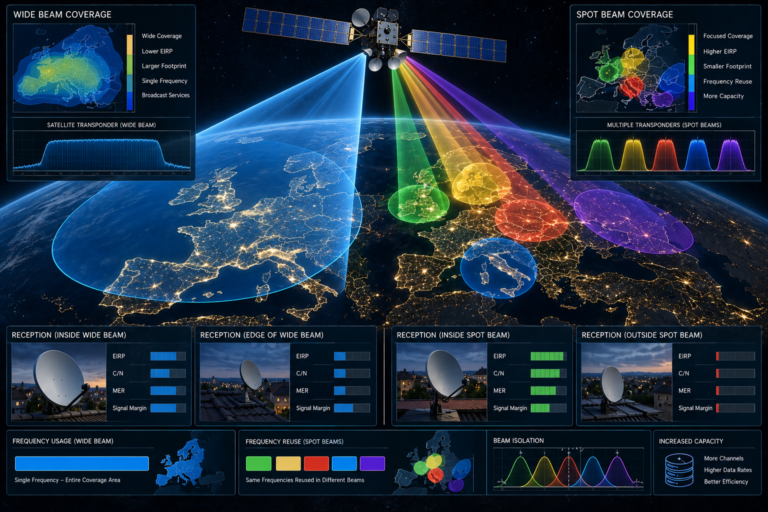
| Why do some transponders work while another shows no picture? | Different transponders can use different frequencies, beams, polarizations, modulation modes, FEC rates, and signal margins. |
| Can BER be too high even with strong signal? | Yes. Strong RF power can coexist with noise, interference, phase errors, or polarization problems that produce a high error rate. |
| What should I check first? | Check quality or digital lock first, then verify satellite position, frequency, symbol rate, polarization, LNB configuration, DVB-S2 compatibility, and finally codec and video output. |