What BER Really Means on a Satellite Receiver
Estimated Reading Time: 11 minutes
BER is one of the most useful measurements available on a satellite receiver, yet it is also one of the most misunderstood. Viewers often see it beside signal strength or signal quality without knowing whether a higher or lower number is better, what the value actually represents, or why it can change even when the dish has not moved.
BER stands for Bit Error Rate. It describes how many received digital bits are wrong compared with the data originally transmitted by the satellite. In practical terms, BER reveals how difficult the receiver is finding it to reconstruct the television signal correctly. A low error rate usually indicates clean reception, while a rising error rate shows that noise, interference, weak signal margin, poor alignment, or hardware instability is beginning to damage the data.
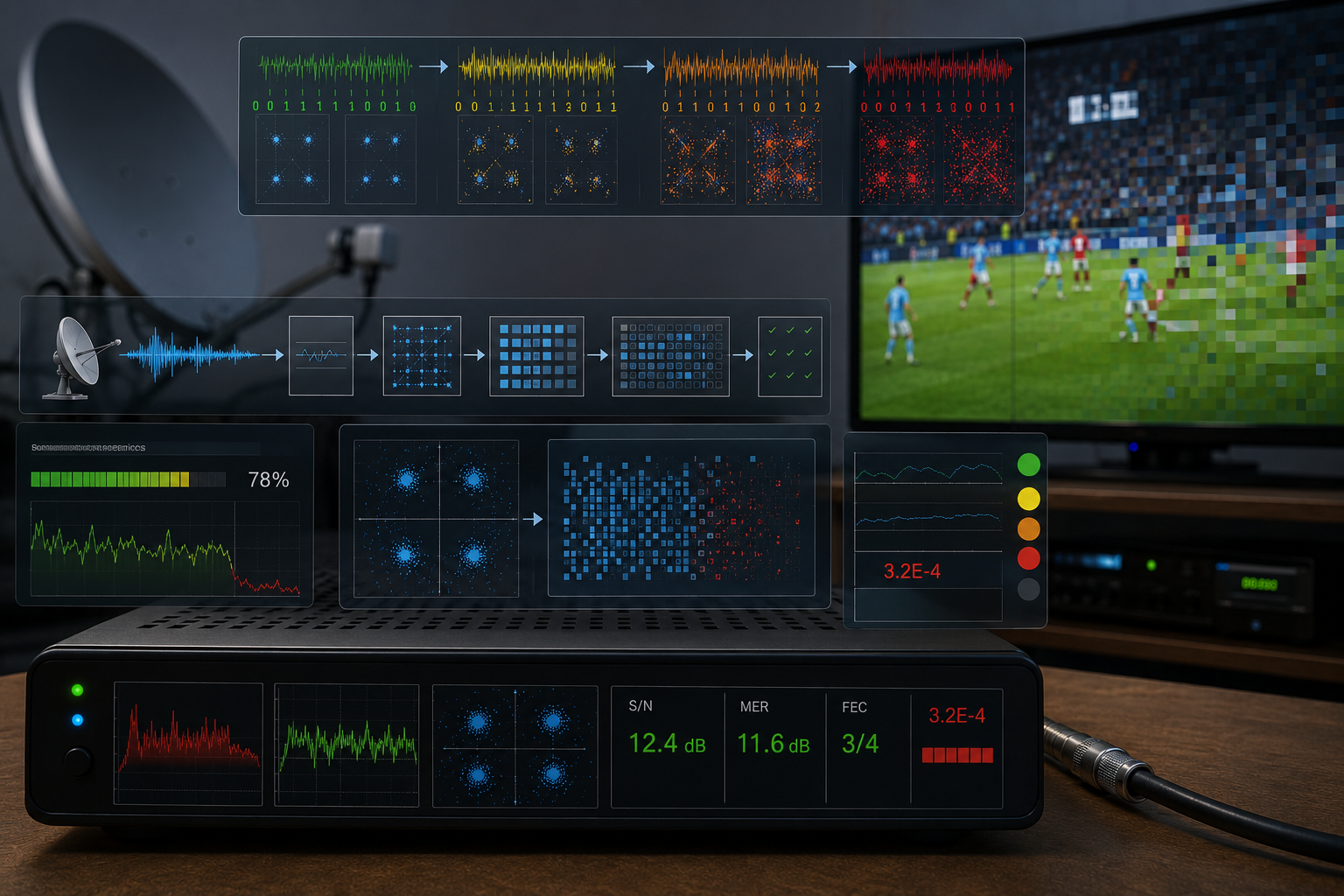
Satellite television is transmitted as digital data rather than as a complete picture travelling through space. The receiver must identify millions of modulation symbols, convert them into bits, repair damaged information, rebuild the transport stream, and finally decode the video and audio. BER measures the errors appearing within that digital recovery process.
- What BER Actually Measures
- Why Bit Errors Appear in Satellite Reception
- Why a Perfect Picture Can Still Contain Errors
- Pre-FEC BER and Post-FEC BER
- How DVB-S2 Repairs Damaged Data
- What Happens When Error Correction Reaches Its Limit
- Why BER Can Change While Signal Strength Stays Stable
- The Relationship Between BER, MER, and Signal Margin
- How Dish Alignment Affects BER
- How Rain and Weather Increase BER
- LNB, Cable, and Connector Problems
- Why Receiver BER Readings Look Different
- How to Use BER During Troubleshooting
- Reality Check
- Final Verdict
- FAQ
What BER Actually Measures
Digital satellite broadcasting represents information as bits. Each bit is expected to reach the receiver in the correct state. When noise or distortion causes the receiver to interpret a transmitted bit incorrectly, a bit error has occurred.
BER compares the number of incorrect bits with the total number of received bits. For example, a BER of 1 × 10⁻⁴ means that approximately one bit in every ten thousand is incorrect at the measurement point.
Professional equipment may display BER in scientific notation. Consumer receivers often simplify it into a percentage, a bar, an error count, or a value that moves towards zero as reception improves.
The important point is that BER does not measure how powerful the signal is. It measures how accurately the receiver is recovering the transmitted data.
Why Bit Errors Appear in Satellite Reception
A satellite signal travels more than 35,000 kilometres from a geostationary satellite to a receiving dish. By the time it reaches the LNB, the signal is extremely weak and must be amplified, frequency-converted, transported through coaxial cable, tuned, demodulated, and decoded.
Several impairments can introduce errors during this process. Atmospheric attenuation can reduce the carrier level. Thermal noise can make symbol decisions less certain. Incorrect dish alignment can weaken the wanted signal while increasing the influence of adjacent satellites.
Poor LNB skew can allow signals from the opposite polarization to interfere with the selected transponder. Frequency drift and phase noise inside the LNB can also spread or rotate modulation points, making them harder for the receiver to identify.
Cable loss, corroded connectors, moisture, electrical interference, unstable power, and receiver tuner limitations can add further errors.
BER therefore reflects the combined condition of the complete reception chain rather than one isolated component.
Why a Perfect Picture Can Still Contain Errors
A common misunderstanding is that a clear television picture means the received signal contains no errors.
Digital satellite systems are designed to tolerate a certain amount of corruption. Error correction processes detect and repair many damaged bits before they reach the video decoder.
The receiver may therefore be correcting thousands of errors while the viewer sees a perfectly stable HD picture. As long as the correction system can recover the original information, the damage remains invisible.
This explains why BER can begin rising before any visible problem appears. It is often an early warning that the reception margin is becoming smaller.
A receiver operating with low BER has a comfortable safety reserve. A receiver showing rapidly rising BER may still display a clear picture, but even a small additional loss could push the system beyond its correction capability.
Pre-FEC BER and Post-FEC BER
BER can be measured at different stages of the decoding process. The two most important measurements are commonly described as pre-FEC BER and post-FEC BER.
Pre-FEC BER measures errors before Forward Error Correction has repaired the data. It shows how damaged the raw demodulated signal is when it first reaches the error-correction system.
Post-FEC BER measures the errors that remain after correction. Under healthy conditions, post-FEC BER should be extremely low or effectively zero because the decoder has successfully repaired the damaged bits.
A moderate pre-FEC BER combined with zero post-FEC errors can still produce flawless reception. It means errors exist, but the correction system is handling them successfully.
When post-FEC errors begin appearing, the decoder is no longer able to repair everything. Visible picture and audio faults usually follow quickly.
| Measurement Stage | What It Shows | Typical Meaning |
|---|---|---|
| Pre-FEC BER | Errors before Forward Error Correction | Shows the raw condition of the demodulated signal |
| Post-FEC BER | Errors remaining after correction | Shows whether damaged data is reaching the transport stream |
| Low pre-FEC, zero post-FEC | Very few raw errors and full correction | Healthy reception with strong margin |
| Rising pre-FEC, zero post-FEC | More errors are being corrected | Picture may remain perfect, but margin is shrinking |
| Post-FEC errors present | Correction is no longer fully successful | Pixelation, freezing, audio loss, or signal failure may appear |
How DVB-S2 Repairs Damaged Data
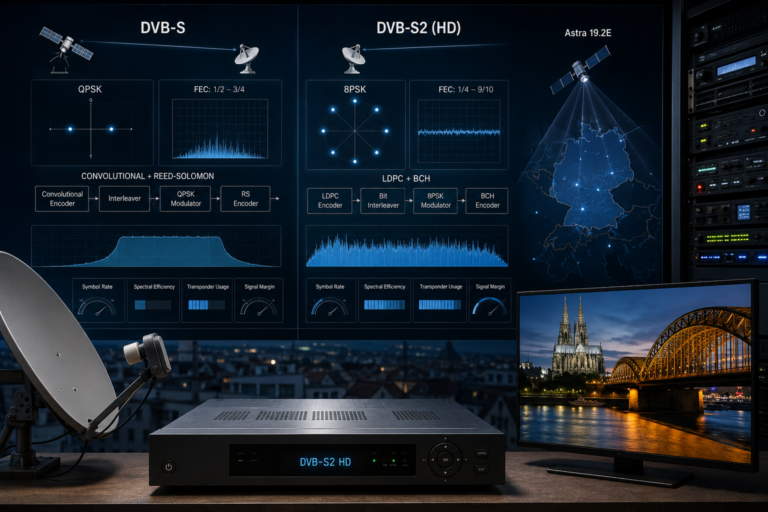
DVB-S2 uses powerful Forward Error Correction to improve reliability. The main correction stages include Low-Density Parity-Check coding and Bose-Chaudhuri-Hocquenghem coding, commonly shortened to LDPC and BCH.
LDPC performs most of the heavy error correction. It analyses structured relationships inside the coded data and repeatedly attempts to determine the most likely original bits.
BCH coding provides an additional outer correction stage. It helps remove residual errors that remain after LDPC processing.
These systems allow DVB-S2 to operate much closer to theoretical channel limits than older broadcasting systems. They also explain why a digital picture can remain perfect even when the received signal contains substantial raw errors.
However, error correction is not unlimited. Every modulation and coding combination requires a minimum carrier quality. Once the incoming errors exceed the decoder’s capability, recovery begins to fail rapidly.
What Happens When Error Correction Reaches Its Limit
When BER rises beyond the correction capacity, damaged information begins reaching the MPEG transport stream.
The video decoder may lose part of a compressed frame, causing blocks or sections of the picture to freeze. Because later frames may depend on earlier reference frames, a single damaged packet can affect several moments of video.
Audio may mute, repeat, distort, or disappear because its packets are also incomplete. The receiver may continue attempting to decode until synchronization becomes impossible.
If the error rate rises further, the receiver loses transport stream lock, demodulator lock, or carrier lock. At that stage, the picture disappears completely and the receiver may display a no-signal or no-service message.
When conditions improve, the receiver must reacquire the carrier, recover symbol timing, complete error-correction synchronisation, and rebuild the transport stream before normal playback resumes.
Why BER Can Change While Signal Strength Stays Stable
Signal strength measures received RF power, while BER measures data accuracy. The two values are related, but they are not interchangeable.
A dish can receive the same total amount of RF power while the wanted carrier becomes more contaminated by noise or interference. In that case, the strength bar may remain almost unchanged while BER becomes significantly worse.
Poor LNB skew is a good example. The LNB may continue receiving strong energy, but additional interference from the opposite polarization makes the transmitted symbols more difficult to distinguish.
An amplifier can create a similar effect if it raises both the wanted carrier and the surrounding noise. The displayed strength may increase, while BER improves very little or becomes worse if the amplifier introduces distortion.
For this reason, installers do not judge reception quality from signal strength alone.
The Relationship Between BER, MER, and Signal Margin
BER, MER, and signal margin describe different parts of the same reception problem.
MER, or Modulation Error Ratio, measures how closely the received symbols match their ideal positions. Higher MER usually indicates cleaner modulation and more reliable symbol decisions.
BER measures the errors that result when symbol decisions are incorrect. As MER deteriorates, BER generally increases.
Signal margin describes the distance between current reception quality and the minimum threshold required for the selected modulation and coding mode.
A system with high MER, low BER, and comfortable signal margin is likely to remain stable during normal weather changes. A system with marginal MER and rising BER may work perfectly in clear weather but fail during rain, wind, or temperature changes.
These values are most useful when interpreted together rather than in isolation.
How Dish Alignment Affects BER
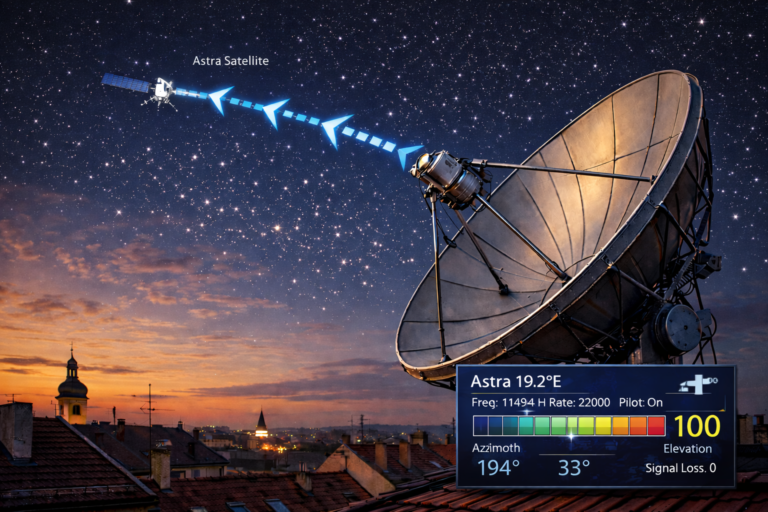
Accurate dish alignment maximises the wanted carrier and reduces the relative influence of noise and adjacent-satellite interference.
A dish that is slightly misaligned may still produce a strong signal-strength reading, especially on powerful transponders. However, the reduced carrier quality causes more symbol errors, which increases BER.
Fine dish adjustment should therefore be performed while monitoring quality, MER, carrier-to-noise ratio, or BER. The best position is usually the one that produces the lowest error rate and the greatest margin, not necessarily the highest raw strength percentage.
It is also important to test more than one transponder. One frequency may appear healthy while another is closer to the reception threshold because of different modulation, FEC, beam coverage, polarization, or transponder power.
How Rain and Weather Increase BER
Rain absorbs and scatters part of the Ku-band signal travelling between the satellite and the dish. This reduces the carrier level and therefore decreases the margin above the receiver’s decoding threshold.
As the carrier becomes weaker relative to noise, the demodulator makes more incorrect symbol decisions. Pre-FEC BER begins to rise.
At first, Forward Error Correction repairs the additional errors and the picture remains clear. If rainfall intensifies, the error rate can exceed the correction limit, producing pixelation and freezing.
Strong wind can also increase BER if it moves the dish or flexes the mounting structure. Water entering connectors can create longer-lasting attenuation and impedance problems even after the rain has stopped.
Temperature changes may affect LNB oscillator stability, cable attenuation, and electronic noise. These effects are usually small, but they become important when the installation already has very limited margin.
LNB, Cable, and Connector Problems
The LNB is responsible for receiving, amplifying, and frequency-converting the satellite carrier. Excessive internal noise, oscillator drift, phase noise, or unstable gain can make symbol recovery more difficult and increase BER.
Aging or low-quality LNBs may perform acceptably on robust transponders but struggle with more demanding DVB-S2 signals.
Coaxial cable introduces loss between the LNB and the receiver. Long cable runs, damaged insulation, poor shielding, sharp bends, unsuitable splitters, and low-quality wall plates can reduce carrier quality or allow external interference into the system.
Connectors are particularly important. A loose centre conductor can produce intermittent errors. Corrosion and moisture can create attenuation, reflections, or electrical instability.
These faults may cause BER to jump suddenly even when the signal-strength reading appears normal.
Why Receiver BER Readings Look Different
Consumer satellite receivers do not use one universal BER display format.
One receiver may show a numerical value in scientific notation. Another may show an error counter, percentage, coloured bar, or a value that rises when reception improves.
Some devices display pre-FEC errors, while others display post-FEC errors or a proprietary calculation derived from several measurements.
This means that a BER value from one receiver should not be compared directly with a value from another brand unless both devices document the same measurement method and scale.
The most reliable approach is to monitor trends on the same receiver. If BER becomes worse after changing dish position, LNB skew, cable, or weather conditions, the reception path has probably deteriorated.
How to Use BER During Troubleshooting
Begin with a known active transponder and observe the BER reading under stable weather conditions. Record the value so later adjustments can be compared against the same reference.
Move the dish in very small steps while monitoring the error rate. Allow the receiver or field meter time to update after every movement. The objective is to minimise BER while maintaining stable lock.
Adjust LNB skew carefully, especially when nearby transponders use opposite polarizations. Correct skew can reduce cross-polarization interference and produce a noticeable BER improvement even when signal strength changes very little.
Test the low and high frequency bands, along with horizontal and vertical polarizations. A problem affecting only one group may indicate an LNB switching fault, cable issue, connector problem, or local interference source.
If BER becomes worse during rain, the system probably lacks sufficient fade margin. Check dish size, alignment, cable loss, LNB condition, and mechanical stability.
When BER rises while the strength reading remains high, the deeper reason is often the difference between total RF power and usable carrier quality. Our guide to why signal quality matters more than signal strength explains this distinction in detail.
There is no single universal BER number that represents good reception on every consumer receiver. Manufacturers use different scales, measurement points, and software formulas.
A low or zero post-FEC error rate is generally desirable, but the most useful diagnostic method is to observe how BER changes on the same receiver, transponder, and installation.
BER should also be considered alongside MER, carrier-to-noise ratio, signal margin, and lock stability. One measurement alone cannot always identify the exact fault.
BER is not simply another signal percentage. It measures how accurately a satellite receiver is recovering digital information from the transmitted carrier.
A rising pre-FEC BER shows that the receiver is correcting more damaged data. Post-FEC errors indicate that correction is beginning to fail and visible problems may soon appear.
For reliable DVB-S2 reception, the goal is not merely strong RF power. The complete system must deliver a clean carrier with low BER, healthy MER, accurate dish alignment, correct LNB skew, stable hardware, and enough signal margin to survive normal changes in weather and equipment performance.
| Question | Answer |
|---|---|
| What does BER mean on a satellite receiver? | BER means Bit Error Rate. It measures how many received digital bits are incorrect compared with the transmitted data. |
| Should BER be high or low? | In standard engineering measurements, lower BER is better. However, some consumer receivers reverse or simplify the scale, so the device manual should be checked. |
| Can the picture look perfect when BER is present? | Yes. Forward Error Correction can repair many errors before they reach the video decoder. |
| What is the difference between pre-FEC and post-FEC BER? | Pre-FEC BER measures errors before correction, while post-FEC BER measures errors that remain after correction. |
| Why does BER rise during rain? | Rain weakens the satellite carrier, reduces signal margin, and causes the demodulator to make more incorrect symbol decisions. |
| Can poor dish alignment increase BER? | Yes. Misalignment weakens the wanted carrier and may increase interference from nearby satellites. |
| Can bad LNB skew affect BER? | Yes. Incorrect skew reduces polarization isolation and allows unwanted signals to interfere with the selected transponder. |
| Why do two receivers show different BER values? | They may use different tuners, measurement stages, scales, and software calculations, so their readings are not always directly comparable. |
| Does high signal strength guarantee low BER? | No. A strong signal can still contain noise, interference, distortion, or polarization errors that produce a high bit error rate. |