Why Tring Satellite Signal Changes During Hot Weather
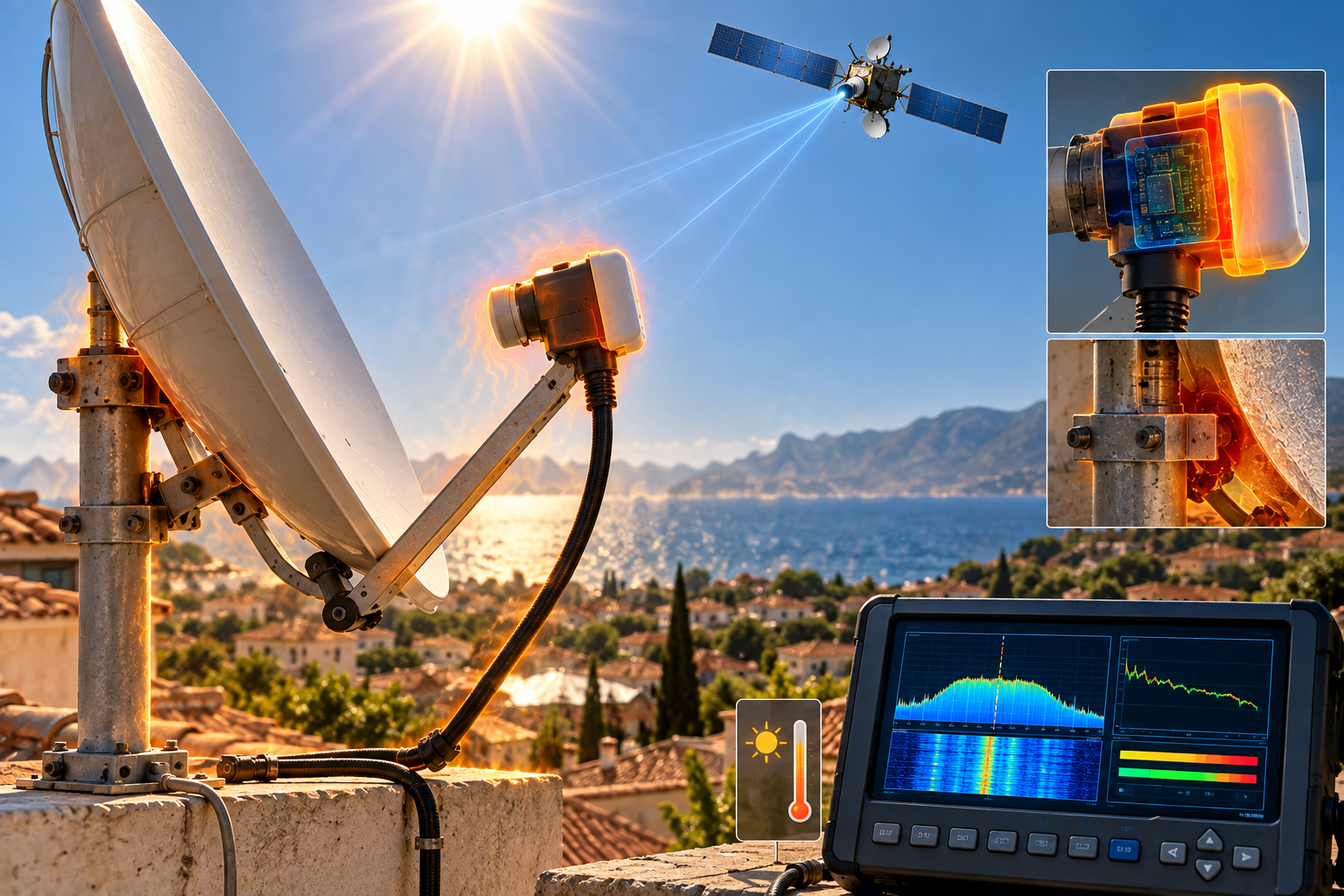
Estimated Reading Time: 8 minutes
A Tring satellite installation can appear perfectly stable early in the morning but show lower quality, occasional pixelation or brief interruptions after the equipment has spent hours under intense summer heat. When the signal improves again in the evening, it is easy to conclude that hot air is simply weakening the satellite transmission.
The real engineering explanation is more complicated. Heat can affect the LNB, coaxial cable, receiver electronics and even the mechanical geometry of the outdoor antenna system. In an installation with healthy signal margin, these small changes may never become visible. In a marginal system, however, temperature can expose weaknesses that were already close to the DVB-S2 decoding threshold.
Hot weather is not the same phenomenon as rain fade. Heavy rain can directly introduce significant Ku-band propagation attenuation. High temperature more often changes the behaviour of components in the receiving system or exposes an installation that already has limited margin. The correct diagnosis therefore requires comparing RF quality under different conditions rather than assuming that the satellite itself becomes weaker every afternoon.
- Does Heat Really Weaken a Satellite Signal?
- Why the LNB Is Important During Hot Weather
- How LNB Frequency Drift Can Affect Reception
- Temperature and Receiver Noise Performance
- How Heat Changes Coaxial Cable Performance
- Thermal Expansion Can Affect Dish Alignment
- The Receiver Can Also Become Too Hot
- Why Marginal Tring Reception Shows the Problem First
- Hot Weather Is Not Rain Fade
- How to Test a Heat-Related Signal Problem
- Reality Check
- Final Verdict
- FAQ
Does Heat Really Weaken a Satellite Signal?
It is misleading to describe a hot summer day as though temperature simply reduces the power transmitted by the satellite.
The complete satellite link includes the spacecraft, atmospheric propagation path, receiving dish, feed, LNB, coaxial cable and receiver. A change observed on the receiver’s quality meter can originate from several points in that chain.
For a domestic installation, the outdoor electronics and mechanical components can become much hotter than the surrounding air when exposed to direct sunlight.
A dark LNB housing, metal bracket or cable exposed to strong solar radiation can reach a significantly different operating temperature from the same equipment during the night.
Electronic characteristics change with temperature. Materials expand and contract. Cable attenuation can vary. Oscillators can drift.
Normally, properly designed equipment is expected to operate across a specified temperature range. That does not mean its RF characteristics remain absolutely identical at every temperature.
If the system has sufficient reception margin, these variations should remain harmless. Problems become much more noticeable when the installation is already marginal.
Why the LNB Is Important During Hot Weather
The LNB sits outside, directly at the antenna feed, and is one of the components most exposed to environmental temperature changes.
Its job is critical.
The dish focuses the incoming Ku-band satellite energy toward the feed. The LNB receives that extremely weak microwave signal, amplifies it and converts it to a lower intermediate frequency suitable for transmission through coaxial cable.
This process depends on active electronic components whose behaviour is influenced by temperature.
A good-quality LNB should remain within its specified operating performance across normal environmental conditions. An ageing or low-quality unit may show larger variations.
Problems can also develop after years outdoors because of moisture, damaged seals, corrosion or repeated heating and cooling cycles.
A temperature-sensitive LNB does not necessarily fail completely. It may continue working while its frequency stability or RF performance changes just enough to reduce the margin of a difficult carrier.
This can create the classic symptom: good reception during cooler hours and unstable reception after prolonged exposure to sunlight.
How LNB Frequency Drift Can Affect Reception
The LNB does not simply amplify the original satellite frequency. It converts the Ku-band signal to an intermediate frequency by mixing it with a local oscillator.
The stability of that oscillator therefore matters.
As temperature changes, the oscillator frequency can shift slightly. Modern receiver demodulators can tolerate a certain amount of frequency error and can compensate during carrier acquisition and tracking.
But that tolerance is not unlimited.
If an ageing or unstable LNB drifts excessively, a receiver may take longer to acquire the carrier, show unstable quality or eventually lose lock.
The exact behaviour depends on the LNB architecture, receiver design, symbol rate and other characteristics of the signal.
Modern PLL-based LNB designs can provide good frequency stability, but the presence of PLL technology alone does not guarantee that every unit will behave identically under all environmental conditions.
A defective component can still become temperature-sensitive.
Temperature and Receiver Noise Performance
Every receiving system contains noise.
The wanted satellite carrier reaches the dish at a very low power level, so the quality of the first amplification stages is particularly important.
Electronic noise performance can vary with physical temperature. This is one reason RF engineers care about the noise characteristics of receiving equipment rather than looking only at raw signal level.
However, it would be an exaggeration to say that ordinary summer heat automatically causes a dramatic loss of satellite reception through LNB noise alone.
A healthy installation should have enough margin to tolerate normal component variation.
Heat-related changes become important when combined with other weaknesses: a slightly undersized dish, imperfect alignment, long cable run, ageing LNB or carrier already operating close to threshold.
The combined effect can be enough to make a previously invisible weakness appear on screen.
How Heat Changes Coaxial Cable Performance
The coaxial cable between the LNB and receiver is another temperature-sensitive component.
RF cable attenuation is not absolutely constant under every condition. Electrical characteristics vary with frequency, cable construction, length and temperature.
In a short, high-quality cable run, the practical change caused by temperature may be insignificant.
In a long or already marginal installation, additional losses can contribute to the overall problem.
The condition of connectors is often more important than the small intrinsic temperature coefficient of the cable itself.
Outdoor connectors experience repeated heating and cooling. If weather sealing is poor, moisture and oxidation can create unstable electrical connections. Materials expand at different rates, and an already weak connector can become intermittent.
| Component | Possible Temperature-Related Effect | Possible Symptom |
|---|---|---|
| LNB | Oscillator or RF performance changes | Quality variation or intermittent carrier lock |
| Coaxial cable | Small change in RF attenuation | Reduced margin in long or marginal installations |
| F-connectors | Thermal cycling exposes poor contact or corrosion | Intermittent signal behaviour |
| Dish structure | Thermal expansion of metal components | Small alignment or feed-position change |
| Receiver | Internal temperature increases | Tuner, demodulator or system instability if cooling is inadequate |
Thermal Expansion Can Affect Dish Alignment
A satellite dish is a mechanical structure as well as an RF antenna.
The reflector, mounting bracket, pole and LNB holder are made from materials that expand and contract as temperature changes.
Under normal circumstances, these movements are small and should not cause a correctly installed antenna to lose reception.
But a marginal installation can be much less forgiving.
If the dish is already slightly off its optimum azimuth or elevation, a small movement in the mounting structure can reduce the available antenna gain further.
Feed position is also important. The reflector is designed to concentrate incoming energy at a particular focal region. A damaged or flexible LNB support can allow the feed position to change.
Larger antennas generally have narrower beamwidths, making accurate pointing increasingly important.
This does not mean that a normal dish should visibly move every time the sun appears. If temperature produces large alignment changes, the mounting system itself deserves inspection.
The Receiver Can Also Become Too Hot
The outdoor installation is not the only possible source of temperature-related instability.
Satellite receivers generate heat internally.
A receiver installed inside a closed cabinet, stacked directly on other warm electronics or covered by objects may have inadequate ventilation.
During hot weather, the ambient indoor temperature can increase enough to make an existing cooling problem worse.
The tuner and demodulator must process the incoming DVB-S2 carrier continuously. Other components handle transport-stream processing, video decoding and conditional-access functions where applicable.
Thermal instability inside the receiver can therefore create symptoms that resemble a satellite signal problem.
A useful clue is whether the problem begins only after the receiver has been operating for a long period and disappears after it has been switched off and allowed to cool.
This is not proof, but it provides a direction for further testing.
Why Marginal Tring Reception Shows the Problem First
Temperature variation becomes especially visible when the Tring carrier being received already has limited link margin at the installation.
Digital reception can hide this condition remarkably well.
The receiver may display a perfect picture even while operating only slightly above its required demodulation threshold.
Forward error correction can continue recovering the data until the impairment becomes too large.
Then the picture can deteriorate abruptly.
This is the digital cliff.
If temperature causes only a small deterioration, an installation with healthy margin remains stable. A marginal installation may begin producing errors.
Installation A has substantial MER margin in the morning. A small temperature-related change occurs during the afternoon, but reception remains safely above threshold.
Installation B begins the day only slightly above threshold. The same small change is enough to produce rising BER, pixelation or temporary loss of lock.
This is why a heat-related problem often tells you as much about the original installation margin as it does about temperature itself.
If reception also suffers from apparently random interruptions, see What Causes Random Satellite Signal Drops.
Hot Weather Is Not Rain Fade
Heat and rain should not be treated as the same propagation problem.
Heavy rain can directly attenuate Ku-band satellite signals because water along the propagation path absorbs and scatters microwave energy.
That is rain fade.
Hot weather by itself does not normally produce the same mechanism.
Temperature-related reception problems are often dominated by the behaviour of the local receiving equipment and installation, although atmospheric conditions can also influence radio propagation in more complex ways.
For normal direct-to-home troubleshooting, the distinction is useful:
| Condition | Main Mechanism to Consider First |
|---|---|
| Heavy rain | Direct Ku-band propagation attenuation and reduced fade margin |
| Strong wind | Mechanical movement of dish or mounting structure |
| Extreme outdoor heat | LNB, cabling and mechanical temperature effects |
| Overheated receiver | Local tuner, demodulator or electronics instability |
| Problem under all conditions | General alignment, RF-chain, receiver or carrier-margin issue |
How to Test a Heat-Related Signal Problem
The most useful test is repeatability.
Do not compare only the receiver’s arbitrary signal-strength percentage. Record the behaviour of the same carrier at different times under similar weather conditions.
If suitable measuring equipment is available, compare MER and BER.
Check whether the quality consistently deteriorates after the outdoor equipment has been heated for several hours and improves after cooling.
Then isolate components systematically.
1. Identify exactly which Tring carriers or channels are affected.
2. Compare morning, midday and evening reception on the same carrier.
3. Measure MER and BER rather than relying only on receiver percentages.
4. Confirm accurate dish alignment and LNB skew.
5. Inspect the LNB for age, physical damage and water ingress.
6. Inspect outdoor connectors and weather sealing.
7. Check the coaxial cable for damage or excessive length.
8. Verify that the dish mount and LNB holder are mechanically rigid.
9. Ensure the receiver has adequate ventilation.
10. Replace or substitute one component at a time if further isolation is required.
Changing several components simultaneously may restore reception, but it prevents you from identifying the actual fault.
A controlled test is far more useful.
Reality Check
Hot weather does not automatically mean that the Tring satellite signal transmitted from space has become weaker.
The observed change at the receiver can originate from the LNB, local oscillator, cable, connectors, dish structure, receiver electronics or simply an installation that began with insufficient signal margin.
Normal temperature variation should not destroy reception in a properly engineered system with healthy margin. If a small daily temperature change repeatedly causes freezing or loss of lock, that behaviour is evidence worth investigating rather than something that should automatically be considered normal.
Also remember that consumer “signal strength” percentages are not standardized RF measurements. A small change in the displayed percentage does not by itself identify the technical cause.
Final Verdict
When Tring satellite reception changes during hot weather, temperature is often exposing a weak point in the receiving system rather than simply weakening the satellite transmission itself.
The LNB can experience oscillator and RF-performance changes. Cable and connectors can behave differently after prolonged heating. Mechanical components can expand slightly, and an inadequately ventilated receiver can develop its own thermal problems.
Most of these effects are small in a healthy installation. They become important when the DVB-S2 carrier already has limited MER and link margin.
The correct solution is therefore not to assume that summer weather is unavoidable interference. Measure the same carrier under different temperature conditions, verify alignment and margin, inspect the LNB and RF path, and isolate any component whose behaviour consistently changes with temperature.
Frequently Asked Questions
| Question | Answer |
|---|---|
| Does hot weather directly weaken satellite TV signals? | Not in the same way as heavy rain. Heat can affect receiving equipment, cabling and mechanical alignment, and these effects can expose an installation with limited reception margin. |
| Can an LNB lose performance when it gets hot? | Its electrical characteristics can vary with temperature. A healthy LNB should remain within its operating specification, but ageing or defective units may become noticeably temperature-sensitive. |
| Can LNB frequency change with temperature? | Yes. Local oscillator frequency can drift with temperature. Receiver demodulators tolerate some error, but excessive drift from a faulty or unstable LNB can make acquisition or tracking more difficult. |
| Why does my Tring signal improve at night? | If the pattern is repeatable, cooling of the LNB, receiver, cabling or mechanical structure may be involved. The system should be tested rather than assuming temperature alone is the cause. |
| Can heat move a satellite dish? | Materials expand with temperature, but a rigid, correctly installed domestic dish should tolerate normal thermal changes. If small movement causes failure, alignment or mechanical stability may already be marginal. |
| Can a satellite receiver overheat? | Yes. Poor ventilation can raise internal temperature and potentially cause instability. Keep ventilation openings clear and avoid trapping the receiver inside an excessively hot enclosed space. |
| Is hot-weather signal loss the same as rain fade? | No. Rain fade primarily involves microwave attenuation caused by precipitation along the propagation path. Heat-related problems often involve local equipment and installation behaviour. |
| Should I replace the LNB immediately if reception changes with heat? | No. First confirm the pattern and inspect alignment, MER, BER, cable, connectors, receiver ventilation and mechanical stability. Component substitution is most useful when performed systematically. |
| Why are only some Tring channels affected by heat? | Different services can use different carriers, frequencies and polarizations. A marginal RF path may therefore affect one group of services before others. |