The Real Reason Tring TV Signal Feels Unstable
Estimated Reading Time: 10 minutes
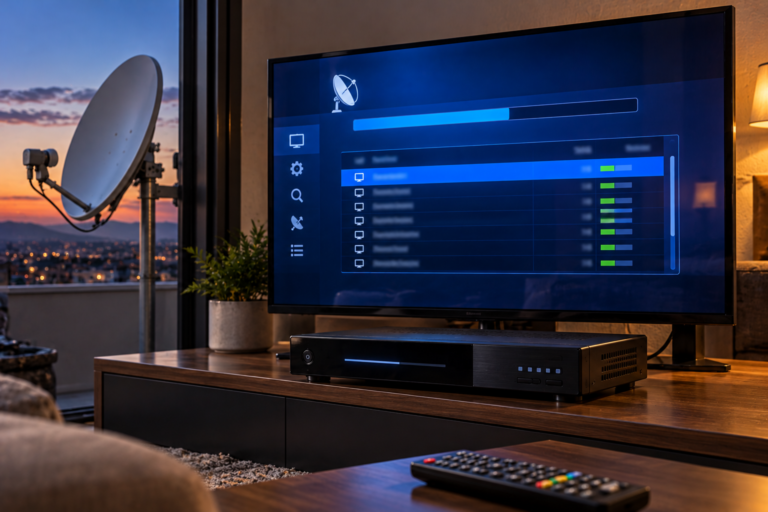
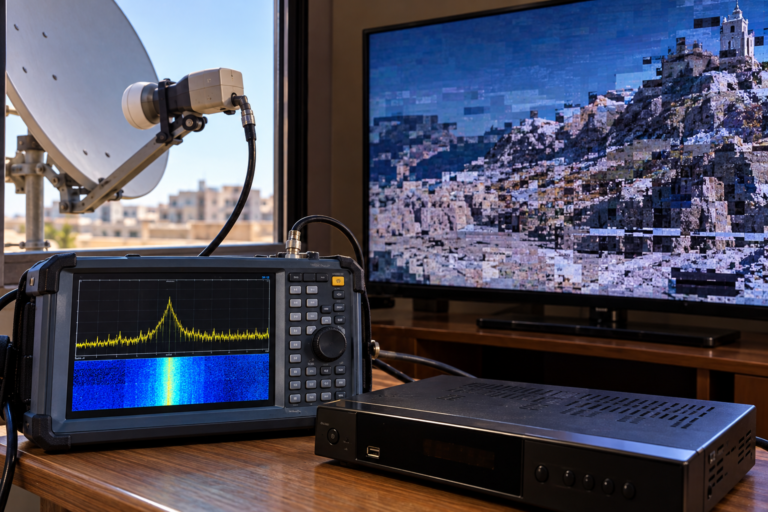
Many Tring TV viewers describe their reception as “unstable.” One evening every channel works perfectly, while the next day the picture freezes briefly, the signal quality meter fluctuates, or HD channels begin to pixelate before quickly recovering. These symptoms often appear random, but from an engineering perspective they usually follow a logical chain of events inside the satellite receiving system.
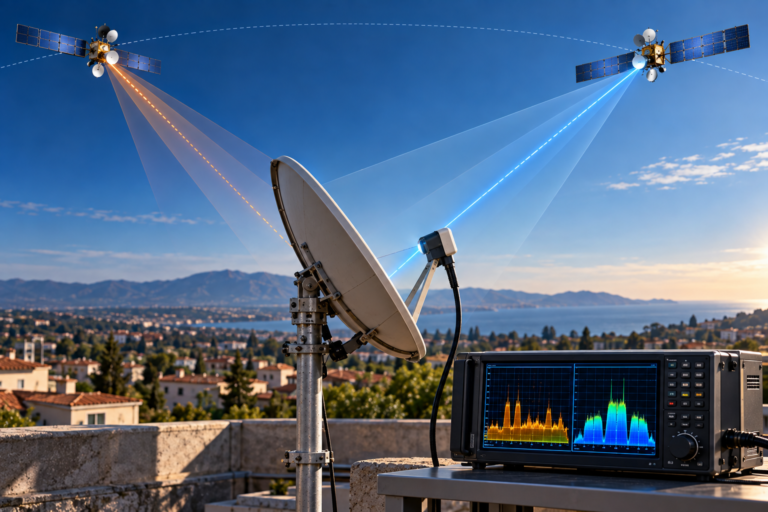
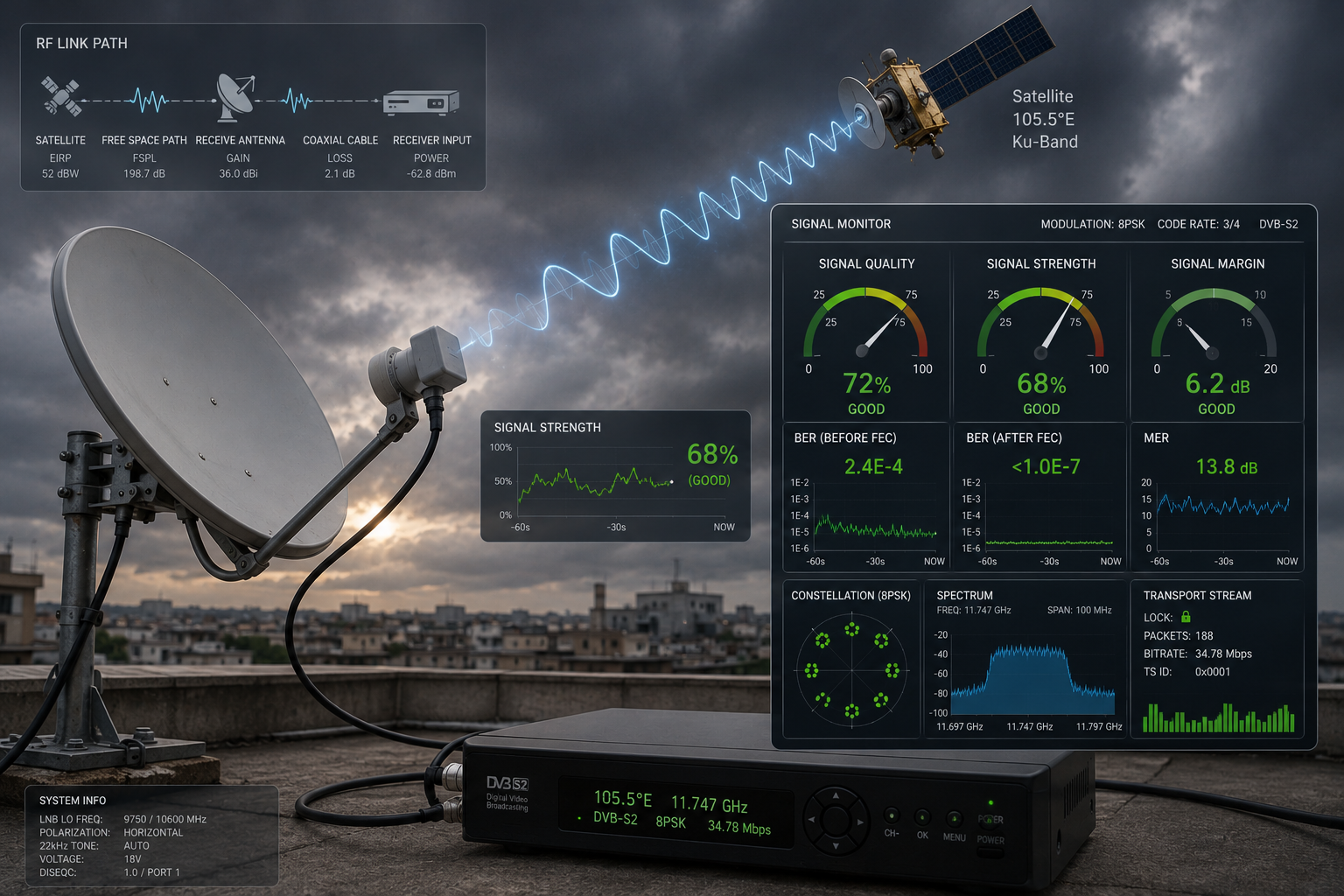
Satellite television depends on a continuous RF link between a geostationary satellite and the receiver inside your home. Every component in that chain, from the satellite transponder to the dish, LNB, coaxial cable, tuner, and DVB-S2 decoder, contributes to reception stability. When one part of the chain becomes marginal, the entire system may appear unreliable even though nothing has actually failed.
An unstable Tring TV signal is rarely caused by changing transmission power from the satellite. In most situations, the instability originates inside the receiving system where signal margin gradually changes due to weather, dish alignment, RF noise, LNB performance, or decoder synchronization.
- What Does Signal Stability Really Mean?
- Why Signal Strength Is Not The Whole Story
- Signal Margin Is Your Hidden Safety Buffer
- How BER And MER Reveal Instability
- The Role Of The LNB
- Environmental Effects On RF Signals
- Receiver Synchronization And Transport Streams
- How To Diagnose An Unstable Signal Logically
- Reality Check
- Final Verdict
- FAQ
What Does Signal Stability Really Mean?
A stable satellite signal is one that remains comfortably above the minimum decoding threshold under changing operating conditions. Stability does not simply mean receiving a high signal level. Instead, it means the receiver continuously receives enough clean information for the DVB-S2 demodulator and decoder to maintain synchronization without exhausting their error correction capability.
This explains why a system may appear perfect during one part of the day yet become unreliable later. The received signal itself changes very little, but the available decoding margin changes as noise and small impairments accumulate.
Why Signal Strength Is Not The Whole Story
Many satellite receivers display separate indicators for signal strength and signal quality. Although these values often move together, they measure different aspects of reception.
Signal strength mainly reflects the RF energy arriving at the tuner input. Signal quality represents how accurately that signal can actually be demodulated. A strong signal containing excessive noise, distortion, or frequency instability may still produce decoding errors even though the strength meter appears healthy.
Professional broadcast engineers usually place greater emphasis on quality-related measurements because they directly determine whether the transport stream can be reconstructed successfully.
Signal Margin Is Your Hidden Safety Buffer
Signal margin is one of the most important concepts in satellite reception.
Think of it as a reserve that protects the receiver from temporary changes in reception conditions. Every installation has a decoding threshold below which the DVB-S2 demodulator can no longer recover the incoming signal. Operating several decibels above that threshold provides valuable protection against rain fade, slight dish movement, thermal noise, and other impairments.
When signal margin becomes too small, even a minor reduction in carrier quality may cause the receiver to lose synchronization for a fraction of a second before quickly recovering.
How BER And MER Reveal Instability
Bit Error Rate, or BER, measures how many received bits contain errors before and after Forward Error Correction. A consistently low BER indicates that the decoder is receiving clean information. As interference or RF impairments increase, BER begins rising until the correction algorithms approach their operating limits. :contentReference[oaicite:0]{index=0}
MER, or Modulation Error Ratio, measures how accurately the received constellation matches the transmitted modulation. Because MER reflects the combined effects of noise, distortion, oscillator errors, and other impairments, it often provides an excellent indication of overall reception quality. :contentReference[oaicite:1]{index=1}
| Parameter | What It Indicates | Typical Effect |
|---|---|---|
| Signal Strength | Received RF power | Shows whether the tuner is receiving the carrier |
| Signal Quality | Overall demodulation performance | Determines stable reception |
| BER | Bit transmission errors | Higher BER increases pixelation risk |
| MER | Constellation accuracy | Lower MER reduces decoding reliability |
| Signal Margin | Distance above decoding threshold | Provides protection against changing conditions |
The Role Of The LNB
The Low Noise Block converter is far more than a simple amplifier. It captures the microwave signal reflected by the dish, amplifies it while introducing as little additional noise as possible, and converts it into a lower intermediate frequency that can travel through coaxial cable.
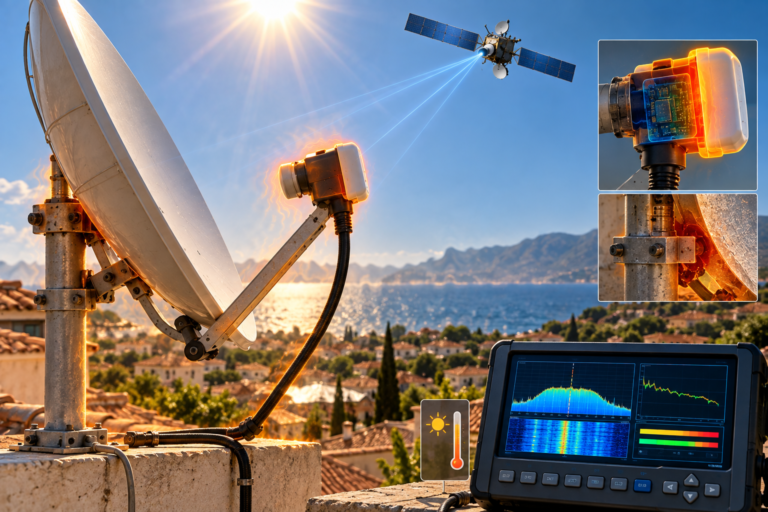
Its local oscillator must also remain stable. If oscillator drift increases because of temperature changes or component aging, the receiver has to perform additional carrier tracking to remain synchronized. DVB-S2 equipment is specifically designed to tolerate a limited amount of LNB frequency instability, but excessive drift reduces the available operating margin. :contentReference[oaicite:2]{index=2}
Even when the receiver successfully tracks these changes, repeated frequency corrections slightly increase the processing workload inside the demodulator, making marginal installations feel less stable than well-aligned systems.
Environmental Effects On RF Signals
Satellite signals travel approximately 36,000 kilometers from a geostationary satellite before reaching the receiving dish. Along this path they encounter numerous environmental influences.
Rain droplets absorb microwave energy, producing rain fade. Moisture on connectors increases attenuation. High temperatures slightly change electronic component behavior inside the LNB, while strong winds can shift dish pointing by a surprisingly small angle.
None of these effects normally cause problems when sufficient signal margin exists. However, if the installation already operates close to its decoding threshold, several small impairments occurring simultaneously may noticeably reduce reception stability.
Receiver Synchronization And Transport Streams
Inside the receiver, synchronization occurs continuously. The tuner tracks carrier frequency, symbol timing, and phase while the demodulator reconstructs digital symbols from the incoming waveform. After error correction, the receiver rebuilds the MPEG transport stream before passing compressed video and audio to the decoder.
If synchronization briefly slips because RF quality drops below the required level, the receiver must reacquire accurate timing before decoding can continue. During that short period viewers may notice freezing, brief audio interruptions, or fluctuating quality readings rather than complete signal loss.
Modern DVB-S2 receivers are specifically engineered to compensate for oscillator drift, timing errors, and RF impairments while maintaining synchronization whenever possible. :contentReference[oaicite:3]{index=3}
How To Diagnose An Unstable Signal Logically
Instead of replacing equipment immediately, first determine whether the instability follows a pattern.
If reception becomes unstable only during rainfall, limited signal margin is the most likely explanation. If instability appears after hot afternoons, inspect the LNB and outdoor connectors. If signal quality fluctuates constantly in all weather conditions, verify dish alignment before considering component replacement.
A careful inspection of coaxial connectors, dish mounting hardware, and LNB skew often reveals the real cause without replacing otherwise functional equipment.
If your Tring TV sports channels occasionally appear delayed or briefly freeze during live broadcasts, our detailed guide on the hidden reason Total TV sports feeds lag behind explains how decoder buffering and transport stream synchronization influence live satellite viewing.
Most unstable satellite reception is not caused by the satellite itself. The majority of intermittent problems originate within the receiving installation where small reductions in signal margin gradually reduce the receiver’s ability to maintain reliable DVB-S2 synchronization.
The real reason Tring TV signals sometimes feel unstable is that modern satellite reception depends on maintaining sufficient signal margin rather than simply receiving enough RF power. Dish alignment, BER, MER, LNB stability, environmental conditions, and receiver synchronization all work together to determine whether the DVB-S2 decoder continues reconstructing a clean transport stream. Understanding these engineering principles allows problems to be diagnosed logically instead of replacing equipment unnecessarily.
| Question | Answer |
|---|---|
| Can signal strength remain high while reception is unstable? | Yes. High RF power does not guarantee low BER or good MER. |
| Why does the signal improve again after a few seconds? | The receiver often regains synchronization once signal quality rises above the decoding threshold. |
| Does a new LNB always solve instability? | No. Dish alignment and signal margin should always be checked first. |
| Can weather affect reception without causing complete signal loss? | Yes. Small reductions in signal margin may only produce temporary instability. |
| Why do engineers monitor BER and MER? | These measurements reveal decoding quality much more accurately than signal strength alone. |