Sky Italia Streaming Stability Explained Why It Changes Constantly
Estimated reading time: 10 to 12 minutes.
Sky Italia streaming does not behave like a fixed system. Sometimes it feels perfectly smooth, and moments later it becomes unstable with buffering or quality drops. This constant change is one of the defining characteristics of internet based streaming.
The reason is simple but often misunderstood. Streaming stability depends on multiple dynamic factors that change in real time. Network conditions, server load, adaptive bitrate logic, and device performance all interact continuously. Unlike satellite systems, there is no fixed signal to maintain. Everything is constantly adjusting.
Quick Context. Sky Italia streaming stability changes constantly because adaptive streaming reacts to network conditions, latency fluctuations, and system load in real time.
Table of Contents
What streaming stability really means
Adaptive streaming and constant adjustments
Network variability and instability
Latency fluctuations over time
What streaming stability really means
Streaming stability refers to how consistently video data is delivered and played without interruptions. It is not just about speed. It is about timing and continuity.
A stable stream delivers data at a steady rate. An unstable stream delivers data unevenly, even if overall speed is high.
This is why stability can change even when your connection seems fine.
Adaptive streaming and constant adjustments
Sky Italia uses adaptive streaming, which continuously adjusts video quality based on current conditions. The system monitors bandwidth and switches between quality levels dynamically. :contentReference[oaicite:0]{index=0}
This means the system is always reacting. It increases quality when conditions improve and lowers it when conditions worsen.
These adjustments happen constantly, which creates the feeling that stability is changing all the time.
Network variability and instability
Internet networks are not constant. Data travels through multiple routes and nodes before reaching your device.
These routes can change. Congestion can appear and disappear. Even small variations affect delivery timing.
Streaming reacts to these changes immediately. This is why stability is never fixed.
Latency fluctuations over time
Latency measures how quickly data travels. It can change depending on network conditions.
Higher latency slows down data delivery. Lower latency improves responsiveness.
Because latency changes during the day, streaming performance changes with it.
This explains why the same stream can feel smooth at one moment and delayed at another.
Server load and demand spikes
Streaming systems rely on servers to deliver content. When many users watch at the same time, server demand increases.
Sky Italia uses scalable infrastructure to handle these peaks, allowing it to respond to demand changes dynamically. :contentReference[oaicite:1]{index=1}
However, even scalable systems can experience temporary pressure. This can affect how quickly data is delivered.
During major events, stability may fluctuate due to increased demand.
Buffer behavior and stability
The buffer acts as a protective layer between data delivery and playback. It absorbs small interruptions.
When data arrives consistently, the buffer remains stable. When delivery becomes irregular, the buffer level changes.
This causes visible effects such as buffering or quality shifts.
Buffer behavior reflects underlying network conditions.
Device performance influence
The device also affects stability. It must decode video, manage buffers, and render frames in real time.
If the device struggles, playback becomes inconsistent even if the network is stable.
This creates a combined effect. Stability depends on both delivery and processing.
Different devices can produce different stability levels on the same connection.
Real world example of stability changes
Consider watching a live match. At the start, quality is high and playback is smooth. As more viewers join, network load increases.
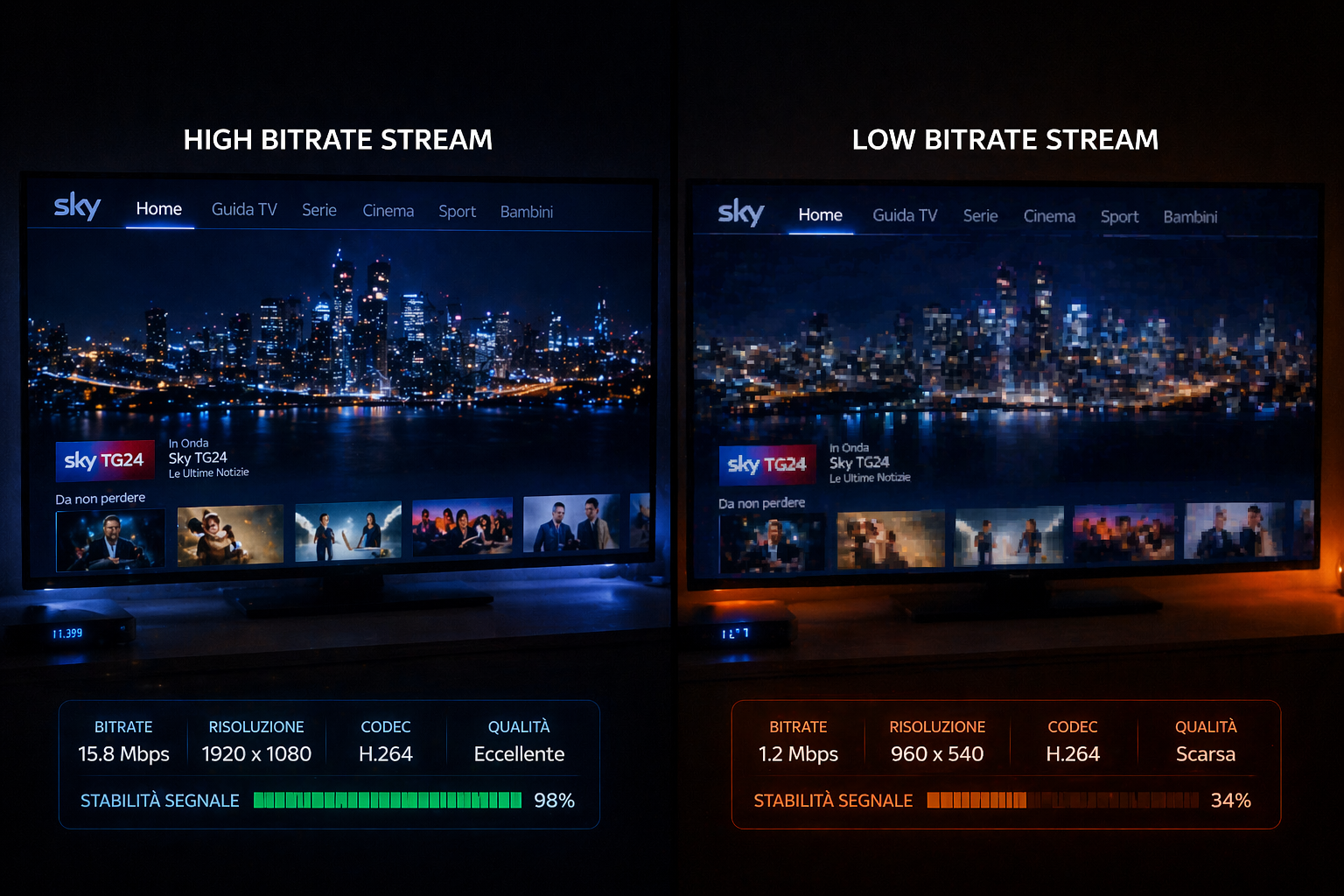
The system responds by lowering bitrate to maintain playback. This reduces quality but prevents interruptions.
If conditions improve, quality increases again. This cycle repeats continuously.
For more details on timing related behavior, see this guide Sky Italia Streaming Delay Explained.
| Factor | Technical Behavior | Effect | Result |
|---|---|---|---|
| Adaptive streaming | Quality switching | Constant adjustment | Variable stability |
| Network changes | Data flow variation | Inconsistent delivery | Buffer fluctuation |
| Latency shifts | Delay changes | Timing issues | Playback variation |
| Server load | High demand | Slower response | Quality drop |
| Device limits | Processing delay | Frame inconsistency | Perceived instability |
Reality Check
Streaming stability is not designed to be constant. It is designed to adapt. What looks like instability is often the system adjusting to maintain playback under changing conditions.
Final Verdict
Sky Italia streaming stability changes constantly because it is built on adaptive systems that react to real time conditions. Network variability, latency shifts, server load, and device performance all influence the experience. Unlike traditional broadcasting, streaming is dynamic by design. Stability is not fixed. It is continuously managed and adjusted to keep the stream running.
FAQ
| Question | Answer |
|---|---|
| Why does streaming stability change constantly | Because the system adapts to changing network and system conditions in real time |
| Is instability a problem | Not always. It is often the system adjusting to maintain playback |
| Does network affect stability | Yes. Network variability is one of the main causes |
| Can devices affect stability | Yes. Device performance impacts playback consistency |
| How can I improve stability | Use a stable connection and ensure your device performs well |