Sky Italia Network Load Explained Why Streams Slow Down
Estimated reading time: 11 to 13 minutes.
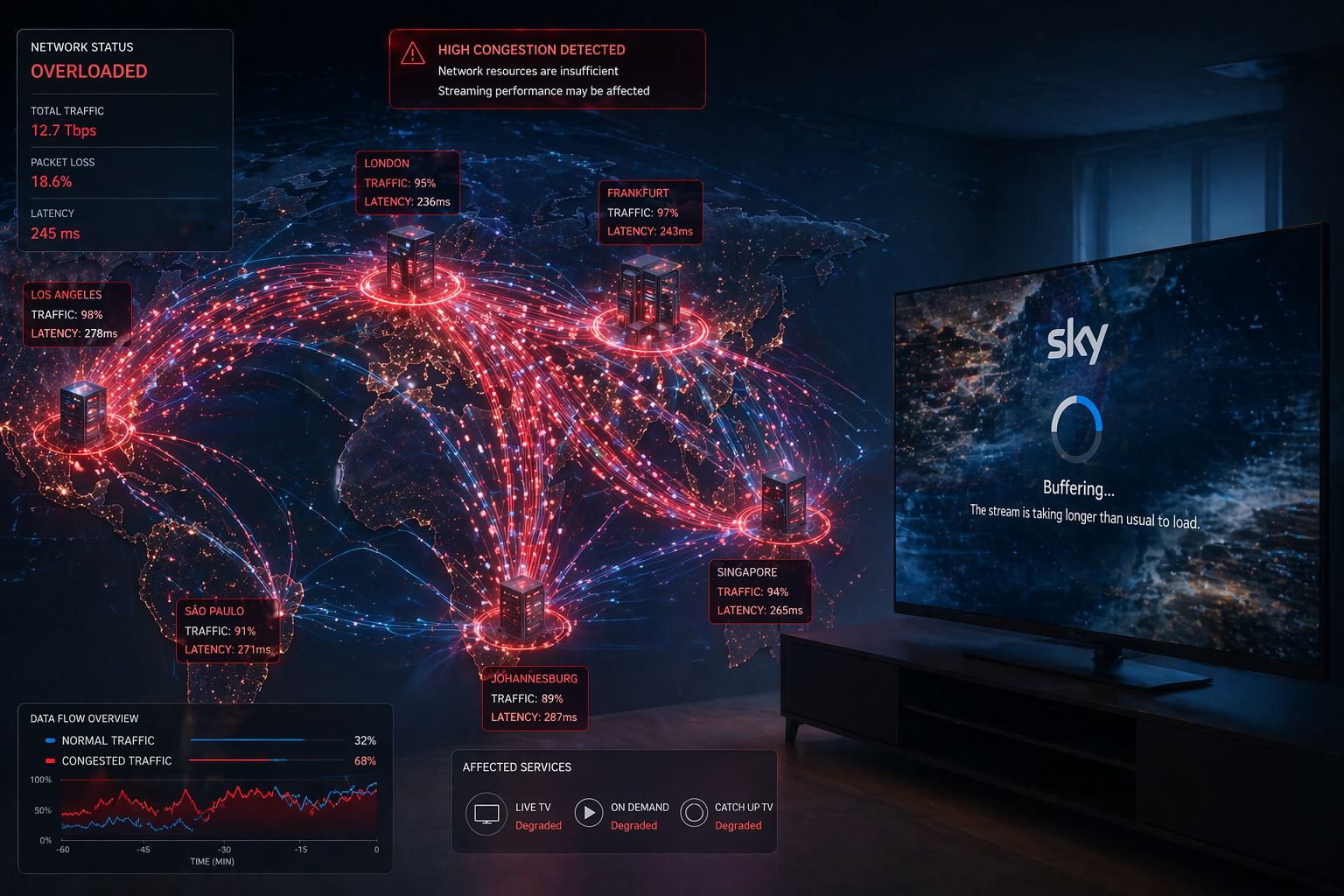
Sky Italia streaming may feel fast at one moment and suddenly slow down the next, even without any change in your connection settings. This behavior is strongly linked to network load, which is one of the most important but least understood factors in streaming performance.
Network load is not just about how many people are online. It is about how much data is moving through the network at the same time, how efficiently it is routed, and how evenly it is distributed. When load increases, the system must adapt, and that is when slowdowns begin to appear.
Quick Context. Sky Italia streams slow down when network load increases because congestion, latency, and shared bandwidth reduce consistent data delivery.
What network load really means
Network load refers to the total amount of data traffic moving through the network at a given time. It includes streaming, downloads, browsing, and all other online activity.
When load is low, data flows smoothly with minimal delay. When load increases, the network becomes busy and must handle more requests simultaneously.
This increased demand changes how efficiently data is delivered.
Why high load causes slow streaming
Streaming requires a continuous and stable flow of data. When network load is high, this flow becomes inconsistent.
Even if total speed remains high, interruptions in timing affect playback. This leads to buffering or quality reduction.
Streaming systems react by lowering bitrate to maintain playback continuity.
This is why streams appear slower during heavy usage periods.
Congestion and data queues
When too much data is sent through the network, congestion occurs. Data packets must wait in queues before being transmitted.
This waiting time creates delays. The longer the queue, the slower the delivery.
Congestion directly affects streaming because it breaks the steady flow of data.
It is one of the main causes of slow performance.
Shared bandwidth limitations
Bandwidth is shared among many users. During peak usage, each user receives a smaller portion of available capacity.
This reduces the effective bandwidth for streaming, even if your connection supports higher speeds.
Streaming performance depends on how much consistent bandwidth is available, not just maximum capacity.
This shared behavior explains why performance drops during busy periods.
Latency increase under load
Latency increases when the network is under pressure. Data takes longer to travel between servers and devices.
This delay affects how quickly video segments arrive. :contentReference[oaicite:0]{index=0}
Higher latency disrupts playback timing and increases the chance of buffering.
Latency is often more important than speed when diagnosing slow streaming.
CDN role in managing load
Content Delivery Networks are designed to reduce load impact by distributing traffic across multiple servers. :contentReference[oaicite:1]{index=1}
Instead of one central server, many servers deliver content closer to users. This reduces congestion and improves efficiency.
Some systems even use multiple CDNs and select the best one dynamically based on performance. :contentReference[oaicite:2]{index=2}
This helps balance load and maintain stability.
Adaptive streaming response
Adaptive streaming adjusts video quality based on current network conditions.
When load increases, the system lowers bitrate to avoid interruptions. :contentReference[oaicite:3]{index=3}
This results in lower quality but continuous playback.
The system prioritizes stability over maximum resolution.
Real world scenario
During a live event, thousands or millions of users start streaming at the same time.
Network load increases sharply. Congestion appears, latency rises, and bandwidth becomes shared across more users.
The system responds by lowering bitrate and redistributing traffic.
For a deeper understanding of how stability changes under load, see this guide Sky Italia Streaming Stability Explained.
| Factor | Technical Change | Effect | Result |
|---|---|---|---|
| Network load | More traffic | Slower delivery | Streaming slowdown |
| Congestion | Packet queue | Delay increase | Buffering |
| Shared bandwidth | Reduced allocation | Lower bitrate | Quality drop |
| Latency | Higher delay | Timing disruption | Lag |
| Adaptive system | Quality adjustment | Stability maintained | Variable experience |
Reality Check
Streaming slowdowns during high network load are not always caused by your local connection. They are often the result of shared infrastructure under heavy demand.
Final Verdict
Sky Italia streams slow down when network load increases because the system must handle more data than usual. Congestion, latency spikes, and shared bandwidth reduce the consistency of delivery. Adaptive streaming helps maintain playback, but it cannot fully eliminate these effects. Understanding network load explains why performance changes and helps set realistic expectations for streaming behavior.
FAQ
| Question | Answer |
|---|---|
| What is network load | The total amount of data traffic in the network |
| Why does streaming slow down | Because high load causes congestion and delays |
| Does speed fix load issues | No. Stability and shared bandwidth are more important |
| What is congestion | When data exceeds network capacity |
| Can CDNs reduce load impact | Yes. They distribute traffic across multiple servers |