Why German Sports Channels Need Higher Bitrates for Fast-Moving Video

Estimated Reading Time: 8 minutes
A football match can be much harder to compress than a news presenter sitting in a studio, even when both programmes are transmitted at the same resolution. Fast camera pans, moving players, detailed crowds and the texture of the pitch force a video encoder to describe far more visual change from frame to frame.
This is why sports broadcasting can benefit from higher video bitrates. But the important word is video. A programme’s video bitrate is not the same thing as the symbol rate of the satellite carrier, and a sports channel does not automatically receive more RF power simply because its pictures contain fast motion. The challenge begins primarily inside the compression and distribution chain.
Fast-moving sports generally require more compression resources to preserve a given level of picture quality than relatively static material. Broadcasters can respond with additional bitrate, more efficient codecs, better encoders, statistical multiplexing or a combination of these techniques. There is no single bitrate that every German sports channel must use.
- What Video Bitrate Actually Means
- Why Sports Are Difficult to Compress
- What Happens During Fast Motion
- Why Crowds and Grass Are Difficult for Encoders
- What Happens When Bitrate Is Too Limited
- How Statistical Multiplexing Helps
- H.264, HEVC and Encoder Efficiency
- Why Resolution Does Not Tell the Whole Story
- Video Bitrate Is Not Satellite Symbol Rate
- Compression Problems Versus RF Problems
- Reality Check
- Final Verdict
- FAQ
What Video Bitrate Actually Means
Digital television video is compressed before transmission. Instead of sending every pixel of every frame as completely independent raw information, an encoder searches for spatial and temporal redundancy and represents the pictures much more efficiently.
The video bitrate describes how much digital data is allocated to the encoded video over time. More available bits can give the encoder greater freedom to preserve fine detail and complex motion, although bitrate alone does not determine final picture quality.
Codec generation, encoder implementation, configuration, source quality, frame structure and processing all matter.
This means two television services using similar bitrates can still produce noticeably different pictures. A sophisticated encoder may use its available capacity more efficiently than an older or poorly configured system.
Why Sports Are Difficult to Compress
Compression works particularly well when large parts of a picture remain predictable between frames. A studio interview is a simple example. The background may remain almost unchanged while only the presenter’s face and body move.
A football broadcast can be very different.
Players run in multiple directions. The ball moves rapidly. Cameras pan across the pitch. The crowd contains thousands of small visual features. Advertising boards change. Grass creates fine texture across a large part of the image.
During some shots, almost the entire frame changes position from one frame to the next.
The encoder must represent all of this while operating within a finite data budget.
| Video Scene | Compression Complexity | Why |
|---|---|---|
| Static studio presenter | Usually relatively low | Large areas remain predictable between frames |
| Slow interview | Low to moderate | Limited motion and relatively stable background |
| Football wide shot | High | Players, grass, crowd and camera movement create substantial detail and change |
| Rapid camera pan | Potentially very high | Large portions of the frame move simultaneously |
| Close-up with blurred background | Often lower than a detailed wide shot | Less fine detail may need to be preserved across the complete frame |
The exact bitrate requirement cannot be predicted from the programme category alone. Some sports scenes compress relatively easily, while others create an abrupt increase in complexity.
What Happens During Fast Motion
Modern video codecs do not normally encode every television frame from scratch. They can use information from other frames to predict what the next or previous image should contain.
Conceptually, the encoder may identify areas that have moved and describe their displacement rather than repeatedly transmitting all of the visual information in those areas.
This is where motion estimation and motion compensation become important.
When motion is predictable, compression can be highly efficient. When movement becomes complex, the encoder needs more information to represent the differences accurately.
Football combines several difficult conditions. The camera itself may move while many independent objects move within the scene. A player can cross a detailed background, the ball may travel rapidly, and the crowd may contain constant small changes.
Fast cuts between cameras add another challenge because prediction based on previous pictures suddenly becomes much less useful.
More available bitrate gives the encoder additional room to describe this complexity without discarding as much visual information.
Why Crowds and Grass Are Difficult for Encoders
Motion is only part of the problem. Fine spatial detail also consumes compression resources.
A football pitch may contain millions of small variations in grass texture. Stadium crowds create dense patterns of faces, clothing, seats, banners and movement. From a wide camera angle, these become large regions filled with fine high-frequency detail.
That is fundamentally different from a smooth studio wall or an out-of-focus background.
When the camera pans, the encoder must deal with both high spatial complexity and high temporal complexity at the same time.
This combination is one reason football is a useful stress test for television compression. A picture that looks excellent during a static pre-match interview may reveal compression limitations immediately when the match begins and the camera starts following play.
What Happens When Bitrate Is Too Limited
An encoder cannot create unlimited information from a fixed data budget. If scene complexity rises while the available bitrate remains constrained, it must compress more aggressively.
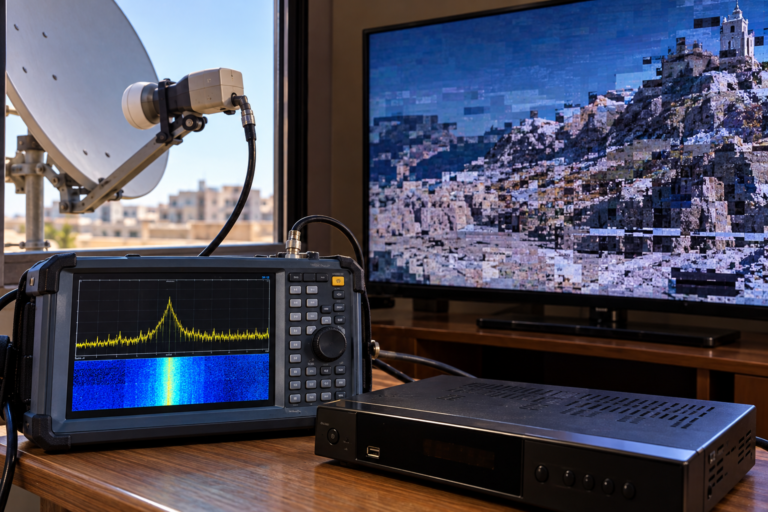
The result does not necessarily appear as an obvious complete failure. Instead, viewers may notice loss of texture, reduced fine detail, unstable edges or other compression artefacts.
Grass can become smoother or less natural during motion. Fine crowd detail may turn into an indistinct texture. Rapid movement may look significantly softer than static frames.
Blocking and mosquito-like artefacts around high-contrast edges can also become visible under difficult compression conditions, although the exact appearance depends strongly on the codec and encoder.
If the picture becomes soft or visibly compressed during rapid movement while reception remains stable, the problem may be video compression rather than satellite reception. RF errors and insufficient video bitrate are different engineering problems.
How Statistical Multiplexing Helps
Satellite capacity is valuable, so broadcasters do not necessarily assign every television programme a large fixed video bitrate continuously.
One powerful approach is statistical multiplexing.
Multiple encoded television services can share capacity within a multiplex. Instead of permanently allocating exactly the same video bitrate to each service, the system can vary the allocation according to changing content complexity.
Imagine one service showing a complex football match while another shows a relatively static studio programme. The sports encoder may benefit from additional capacity at that moment, while the studio programme can maintain acceptable quality with less.
Later, the requirements can change.
This makes capacity allocation more efficient than assuming every programme needs its peak bitrate at all times.
Statistical multiplexing is particularly useful because video complexity is dynamic. Even within one football match, a static graphic, a close-up interview and a rapidly panning wide shot do not impose the same encoding demand.
However, statistical multiplexing cannot create unlimited capacity. If several services become highly complex simultaneously, the multiplex still has a finite total data budget.
H.264, HEVC and Encoder Efficiency
Higher bitrate is only one way to improve compressed video quality.
Codec efficiency also matters.
H.264/AVC became a major format for HD television distribution because it can provide substantially more efficient compression than older MPEG-2 video under appropriate conditions. HEVC can achieve greater compression efficiency again, particularly for demanding applications, although actual performance depends on implementation and configuration.
It would therefore be misleading to compare two channels by bitrate without knowing how they are encoded.
A newer or better encoder using a more efficient codec may produce comparable or superior subjective quality while transmitting fewer bits than another system.
Encoder sophistication matters within the same codec too. Real-time broadcast encoding involves complex decisions about prediction, quantisation, frame structures and allocation of bits to different areas of the image.
For this reason, there is no universal statement such as “football needs X Mbit/s.” The required bitrate depends on the target quality and the complete encoding system.
Why Resolution Does Not Tell the Whole Story
Viewers often use resolution as a shortcut for picture quality. In practice, resolution tells only part of the story.
A nominal HD service can still look poor if the source is weak, the video has undergone excessive transcoding, or the encoder has too little bitrate for the scene complexity.
Conversely, an efficiently encoded service can preserve impressive detail without simply maximizing bitrate.
Frame rate and scanning format also influence sports presentation. Higher temporal resolution can improve the representation of movement, while spatial resolution affects the amount of picture detail that must be encoded.
European television has historically used different HD production and distribution formats, including 720p and 1080i. Comparing them purely by pixel count ignores the relationship between spatial detail, temporal representation, deinterlacing and compression.
The important point is that resolution, bitrate and perceived quality are related but not interchangeable measurements.
Video Bitrate Is Not Satellite Symbol Rate
This distinction is essential in satellite engineering.
The video bitrate describes the encoded video data associated with a programme. The symbol rate describes how many modulation symbols the RF carrier transmits per second.
They exist at different layers of the system.
A DVB-S2 carrier might transport a multiplex containing several television channels, radio services and associated data. Those services share the capacity ultimately provided by the physical carrier.
The carrier has one physical symbol rate. Individual television channels inside that multiplex do not each have their own satellite symbol rate.
With QPSK, each uncoded modulation symbol can represent two raw bits. With 8PSK, it can represent three raw bits. But the useful payload bitrate cannot be obtained simply by multiplying symbol rate by those values because FEC, framing, pilots, headers and other transmission overhead must also be considered.
This is why a sports broadcaster increasing the video bitrate of one service does not necessarily change the symbol rate of the satellite transponder carrying it. Capacity can instead be redistributed within the existing multiplex, provided sufficient capacity is available.
Compression Problems Versus RF Problems
A heavily compressed football picture and a satellite signal near the digital decoding threshold can both produce an unpleasant viewing experience, but they should not be diagnosed as the same fault.
| Symptom | Likely Engineering Area | Relevant Factors |
|---|---|---|
| Fine grass detail disappears mainly during motion | Video compression | Bitrate, codec, encoder, source complexity |
| Crowd becomes soft during rapid camera pans | Video compression | Motion complexity and available encoding resources |
| Picture breaks into severe blocks and audio interrupts during rain | RF reception | Link margin, MER, BER, rain attenuation |
| Several services on one carrier fail together | RF/transponder reception | Carrier lock, frequency, polarization, modulation, FEC |
| Picture is consistently soft despite perfect reception | Source or compression chain | Source quality, bitrate, transcoding, encoder configuration |
A receiver’s “signal strength” display cannot tell you whether a football service has been compressed aggressively. Likewise, increasing dish diameter does not repair video information that was discarded by an encoder before the signal ever reached the satellite.
This distinction also helps explain why satellite television can sometimes look different from an IPTV or OTT version of the same programme. The delivery paths may use different encodes, bitrates or additional transcoding stages. For more detail, see Why German Satellite TV Can Look Better Than IPTV.
Reality Check
Not every German sports channel necessarily uses a higher bitrate than every non-sports channel. Actual bitrate allocation depends on the broadcaster, codec, encoder, multiplex configuration, source format and distribution strategy.
The engineering principle is more precise: fast, detailed sports content can require more encoded data to maintain a given picture quality than less complex material under otherwise comparable encoding conditions.
Higher bitrate is also not automatically better. Efficient encoding, a clean source and intelligent bitrate allocation can matter as much as the raw number of bits transmitted.
Final Verdict
Sports television is demanding because both motion and detail can change rapidly across large areas of the picture. Football is a particularly difficult example because the encoder must handle moving players, camera pans, detailed grass, complex crowds and frequent cuts while remaining within a limited data budget.
Additional video bitrate can help preserve detail during these difficult scenes, but it is only one part of the solution. Codec efficiency, encoder quality and statistical multiplexing all influence the final result.
Most importantly, video bitrate should not be confused with satellite RF parameters. The symbol rate, modulation and FEC describe the physical carrier. Video bitrate describes compressed programme data inside the broadcast chain. Understanding that separation makes it much easier to distinguish a compression-quality problem from a genuine satellite reception problem.
Frequently Asked Questions
| Question | Answer |
|---|---|
| Do sports channels always use higher bitrates? | No. Actual bitrate depends on the broadcaster and encoding system. Sports content can benefit from more bitrate because fast motion and complex detail are difficult to compress, but there is no universal rule that every sports channel uses more. |
| Why does football sometimes look blurry during camera movement? | Rapid movement and detailed scenes increase compression complexity. If the encoder has insufficient resources for the target quality, fine detail may be discarded or become less stable during motion. |
| Why are football crowds difficult to compress? | A stadium crowd contains large amounts of fine spatial detail and many independently moving elements. This becomes especially demanding during wide shots and camera pans. |
| Does higher bitrate always mean better picture quality? | No. Source quality, codec efficiency, encoder design and processing are also important. Bitrate comparisons are most meaningful when the other encoding conditions are understood. |
| Is video bitrate the same as satellite symbol rate? | No. Video bitrate belongs to the compressed programme stream. Symbol rate belongs to the physical RF carrier and specifies the number of modulation symbols transmitted per second. |
| Does every channel on a satellite transponder have its own symbol rate? | No. Services multiplexed onto the same physical carrier share that carrier’s symbol rate. Their individual video and audio bitrates can differ. |
| Can a bigger satellite dish improve a heavily compressed sports picture? | No. If RF reception is already error-free, a larger dish cannot restore picture information removed during video encoding. It can improve reception margin, but not source compression quality. |
| How does statistical multiplexing help sports channels? | It allows available multiplex capacity to be distributed dynamically. A complex sports programme can receive more encoding capacity when needed while less demanding services use less, within the total available capacity. |