How Spot Beams Affect Satellite Reception
Estimated Reading Time: 12 minutes
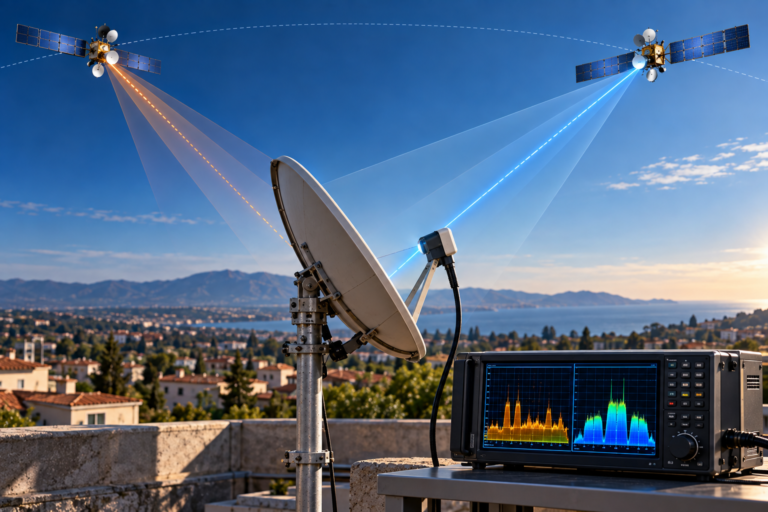
A satellite does not always illuminate an entire continent with one broad signal. Some satellites use spot beams that concentrate RF power and capacity over much smaller geographic regions. Inside the intended beam, reception can be strong and efficient. Move far enough outside that region and the same carrier may become difficult or impossible to receive, even though the satellite remains visible above the horizon.
This is fundamentally different from assuming that every service at one orbital position has the same European footprint. Satellite payloads can use wide beams, regional beams, spot beams, or combinations of them. SES, for example, describes Astra 1P at 19.2E as a wide-beam satellite, while Astra 1Q was designed with both wide-beam and high-throughput spot-beam capabilities. Spot beams are therefore an important satellite engineering concept, but they should not be assumed for every Astra television transponder.
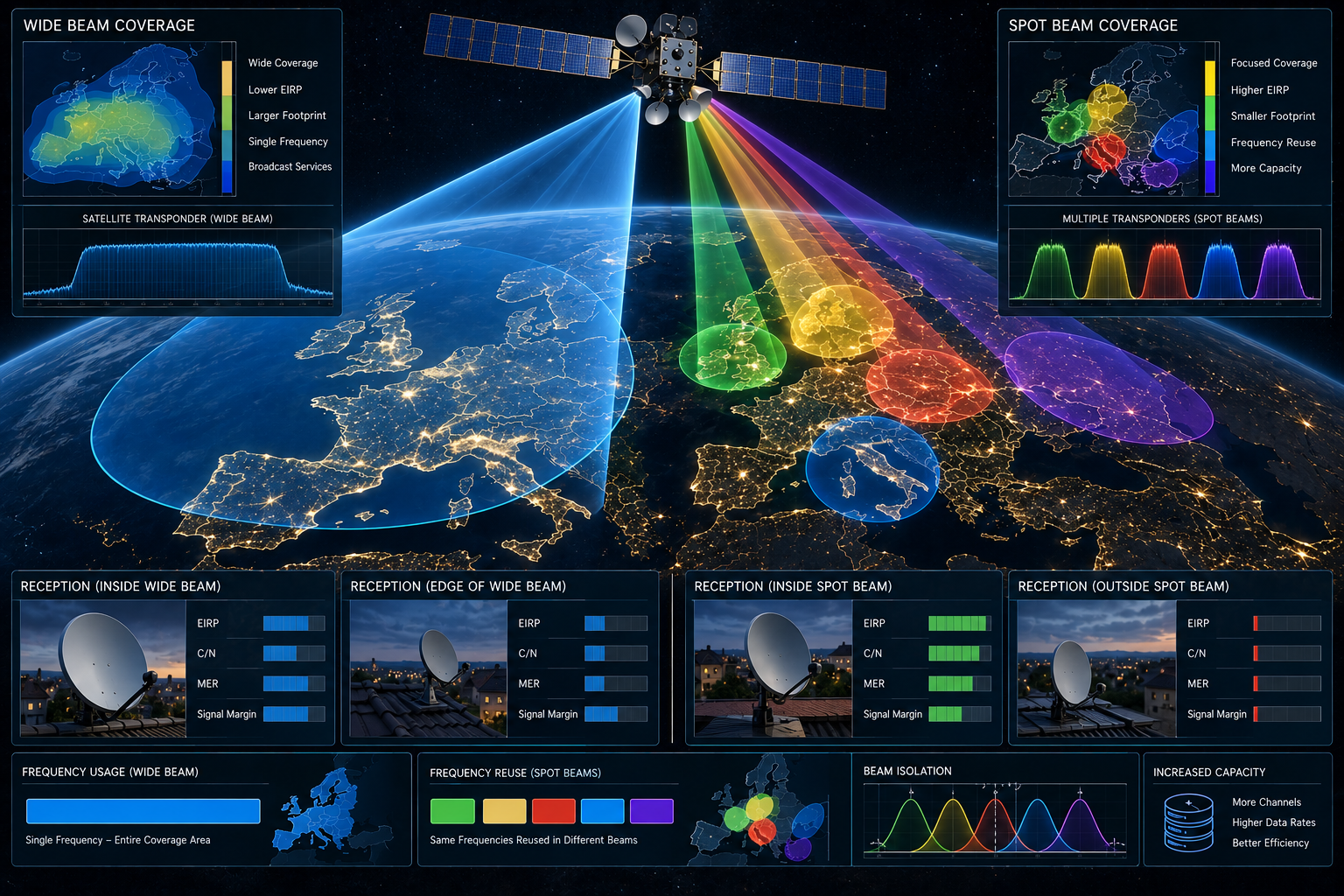
A spot beam concentrates a satellite’s available RF power and capacity into a smaller geographic area. This can increase EIRP and enable frequency reuse inside carefully separated coverage zones. The tradeoff is geographic restriction: reception normally becomes progressively more difficult as the receiving location moves away from the intended beam.
- What a Satellite Spot Beam Is
- How a Spot Beam Differs From a Wide Beam
- Why Satellites Use Spot Beams
- How Spot Beams Concentrate EIRP
- Why Reception Changes Near the Beam Edge
- Why Coverage Does Not Stop at a Perfect Line
- How Dish Size Affects Out-of-Beam Reception
- Why a Larger Dish Has Limits
- How Spot Beams Enable Frequency Reuse
- Why Frequency Reuse Requires Beam Isolation
- How Spot Beams Increase Satellite Capacity
- Why MER and BER Change Near the Beam Edge
- Why Rain Margin Becomes More Important
- Why One Transponder Can Work While Another Fails
- How Astra Uses Different Beam Architectures
- How to Diagnose a Suspected Beam-Coverage Problem
- Reality Check
- Final Verdict
- FAQ
What a Satellite Spot Beam Is
A spot beam is a relatively narrow satellite antenna beam designed to concentrate RF energy over a selected geographic region.
Instead of spreading available transmitter power across a very large area, the satellite antenna focuses it toward a smaller footprint.
This is similar in principle to concentrating light with a directional lamp rather than illuminating an entire room uniformly.
In RF engineering terms, the spacecraft antenna provides greater directional gain toward the target region.
That gain contributes to higher effective radiated power within the intended footprint and allows the satellite operator to use available spectrum and power more efficiently.
How a Spot Beam Differs From a Wide Beam
A wide beam is designed to cover a large geographic region.
For direct-to-home television, this can be extremely useful because one transmission can reach viewers across several countries using ordinary fixed dishes.
A spot beam serves a smaller region.
The narrower coverage allows power and capacity to be concentrated where they are needed rather than being distributed over markets that may not require the service.
Neither architecture is universally better. They solve different engineering problems.
| Feature | Wide Beam | Spot Beam |
|---|---|---|
| Coverage area | Large region or multiple countries | Smaller targeted region |
| RF power distribution | Spread across a wider footprint | Concentrated geographically |
| Frequency reuse | More limited geographically | Can be highly effective with separated beams |
| Typical objective | Broad distribution | Regional capacity and targeting |
| Reception outside target area | Often possible across a broad footprint | Can decline rapidly away from the target region |
| Dish requirement | Depends on regional EIRP | Can change substantially near beam edges |
| Capacity efficiency | Excellent for one-to-many broad coverage | Excellent for geographically concentrated demand |
Why Satellites Use Spot Beams
A satellite has limited spectrum, amplifier power, and payload resources.
Sending every carrier across the largest possible footprint is not always efficient.
Suppose a service is intended primarily for one geographic market. Concentrating the beam over that market can improve link performance while avoiding unnecessary coverage elsewhere.
Spot beams can also support frequency reuse, which dramatically increases the amount of information a satellite system can carry.
For high-throughput satellite systems, this is one of the most important advantages of multi-beam payload design.
How Spot Beams Concentrate EIRP
EIRP stands for Effective Isotropic Radiated Power.
It represents the effective transmitted power in a particular direction after transmitter power and antenna gain are considered.
A highly directional satellite antenna can provide more gain toward a smaller target area.
That does not mean the satellite magically creates additional electrical power. It means the antenna distributes available RF energy more selectively.
Inside the intended spot beam, this can provide strong carrier levels and a healthy satellite link budget.
Why Reception Changes Near the Beam Edge
The antenna gain of a spot beam decreases away from its main coverage region.
As the receiving location moves toward the edge of the footprint, available EIRP can decline.
The dish therefore receives less wanted carrier power.
If the installation originally had substantial signal margin, reception may continue normally for some distance.
Eventually, however, the reduction in carrier-to-noise performance moves the receiver closer to the minimum required by the DVB-S2 modulation and coding configuration.
Once that threshold is crossed, reception can fail abruptly.
Why Coverage Does Not Stop at a Perfect Line
Coverage maps can make a satellite footprint look as if reception stops exactly at a drawn border.
Real antenna patterns are more complicated.
The signal normally decreases through coverage contours rather than disappearing instantly at one geographic line.
Terrain, dish gain, local interference, LNB performance, atmospheric conditions, and the exact satellite antenna pattern also influence real-world reception.
This is why viewers slightly outside a published target region may sometimes receive a service with a larger antenna, while another location that appears nearby can have very different results.
How Dish Size Affects Out-of-Beam Reception
Increasing dish diameter increases receiving antenna gain when frequency and antenna efficiency remain comparable.
This can compensate for some reduction in satellite EIRP.
A service that is unreliable on a small dish near the edge of a beam may become stable with a larger and accurately aligned reflector.
The larger antenna collects more of the incoming microwave energy and concentrates it toward the feed.
This improves the available carrier-to-noise ratio and can restore useful decoding margin.
Why a Larger Dish Has Limits
A larger dish cannot recover a signal that has become arbitrarily weak.
Far outside the intended beam, satellite EIRP may be too low for a practical domestic antenna.
Other limitations can also appear.
Side lobes, neighbouring beams, frequency reuse, cross-polarization, local interference, and the noise performance of the receiving system can all influence whether increasing dish diameter remains useful.
A larger dish also has a narrower beamwidth, so alignment becomes more critical.
Therefore, “just use a bigger dish” is not a universal solution to spot-beam reception.
How Spot Beams Enable Frequency Reuse
Frequency reuse is one of the major reasons modern high-capacity satellites use multiple spot beams.
Normally, transmitting two independent signals on exactly the same frequency toward the same geographic area would create interference.
But if two beams are sufficiently separated geographically, the same frequency resource can potentially be reused.
This concept is similar to cellular networks, where frequencies can be reused in cells separated sufficiently to control interference.
The satellite can therefore deliver much more total system capacity than would be possible if every frequency could be used only once across the entire footprint.
Why Frequency Reuse Requires Beam Isolation
Frequency reuse works only when unwanted energy from neighbouring beams is controlled carefully.
Satellite antenna patterns are therefore engineered to provide strong gain inside the intended region and reduced gain toward areas using the same frequency independently.
Polarization can provide another dimension of frequency reuse.
Operators may combine geographic separation, frequency planning, polarization, and advanced payload control to maximize capacity while maintaining acceptable interference levels.
This makes spot-beam planning a complete RF system problem rather than simply drawing small circles on a map.
How Spot Beams Increase Satellite Capacity
Imagine a satellite with one continent-wide beam and a fixed block of spectrum.
Once that spectrum is fully occupied, additional capacity becomes difficult to add.
Now divide the coverage region into many carefully isolated spot beams.
If the same spectrum can be reused across separated beams, total satellite throughput can increase dramatically.
This is why spot-beam architectures are particularly valuable for broadband and other high-throughput applications where different geographic areas require large amounts of independent capacity.
Why MER and BER Change Near the Beam Edge
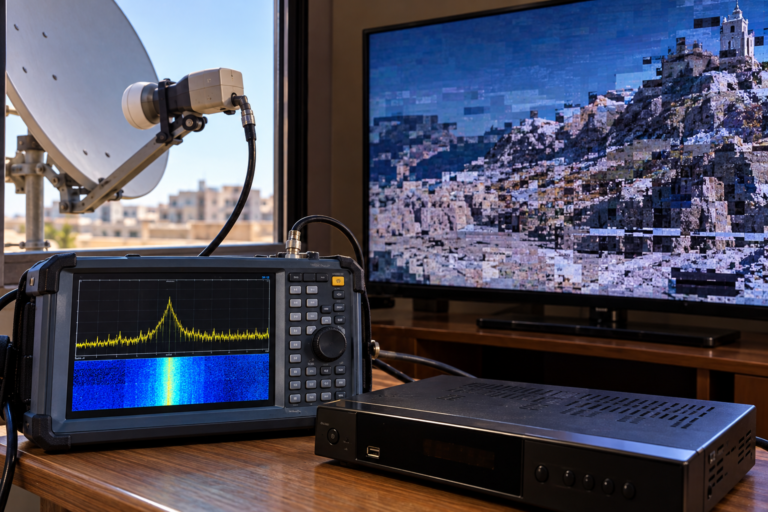
MER measures how clearly the receiver can distinguish the transmitted modulation states.
When wanted carrier power falls relative to noise and interference, constellation points become less distinct and MER deteriorates.
BER then begins to increase as the demodulator makes more incorrect symbol decisions.
DVB-S2 Forward Error Correction can repair many of those errors while enough margin remains.
But once the correction capability is exceeded, the familiar digital cliff appears.
Pictures pixelate, audio breaks up, frames freeze, and eventually the receiver loses the service completely.
Why Rain Margin Becomes More Important
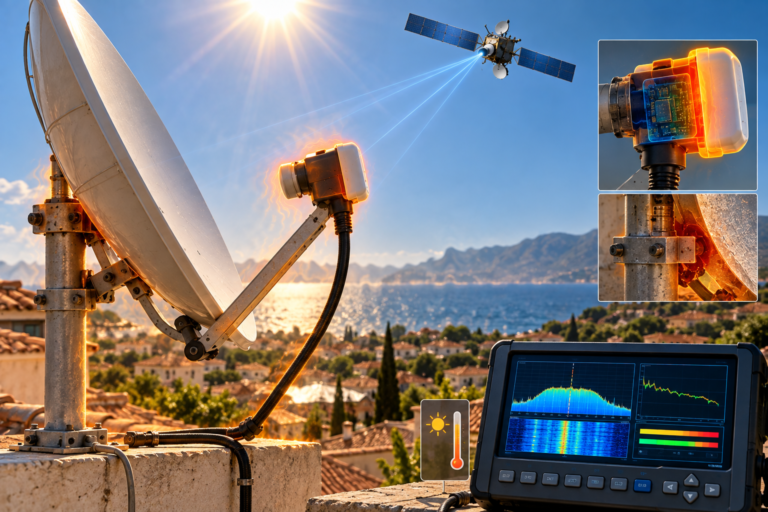
A spot-beam service can appear completely stable in clear weather while operating with little reserve near an outer coverage contour.
Rain then adds attenuation to the Ku-band path.
A household near the centre of the beam may have enough clear-sky margin to absorb that loss.
A household near the edge may not.
The second installation can therefore lose reception during moderate weather even though both locations receive a perfect picture under clear conditions.
This is why a successful channel lock is not the same as a well-engineered reception margin.
Why One Transponder Can Work While Another Fails
Channels at the same orbital position do not necessarily share the same beam architecture.
Different transponders can originate from different payloads or even different colocated spacecraft.
They may also use different frequencies, polarizations, power levels, modulation, FEC, and antenna coverage patterns.
One carrier may therefore be strong at a particular European location while another operates close to threshold.
This is an important troubleshooting clue. If most channels from an orbital position work but one specific transponder repeatedly fails, the problem should not automatically be blamed on the overall dish direction.
How Astra Uses Different Beam Architectures
Astra provides a useful example of why the term “satellite beam” must be used carefully.
SES describes Astra 1P, which entered service at 19.2E in December 2024, as a powerful wide-beam satellite supporting television distribution across Europe. This makes it suitable for the broad direct-to-home television role associated with the 19.2E neighbourhood. ([ses.com](https://www.ses.com/press-release/astra-1p-starts-delivering-content-across-europe?utm_source=chatgpt.com))
Astra 1Q represents a different and more flexible payload concept. SES says the satellite is designed with both wide beams and high-throughput spot beams and can be reconfigured in orbit. ([ses.com](https://www.ses.com/press-release/ses-orders-two-new-replacement-satellites-astra-1p-and-astra-1q-19.2-degrees-east?utm_source=chatgpt.com))
The engineering lesson is important: Astra should not be described as if every service uses a spot beam, and a satellite carrying spot-beam capability does not mean every transponder is necessarily transmitted through one.
How to Diagnose a Suspected Beam-Coverage Problem
Start by identifying the exact satellite, transponder, frequency, polarization, symbol rate, modulation, and FEC used by the failing service.
Then compare several transponders from the same orbital neighbourhood.
If all carriers are weak, inspect dish alignment, dish size, line of sight, LNB skew, cable losses, and the overall regional coverage.
If only one carrier or one group of related carriers is weak, investigate its specific beam and transponder characteristics.
Measure MER and BER where possible instead of relying only on receiver strength percentages.
If reception works in clear weather but disappears quickly during rain, insufficient link margin is a strong possibility.
And if the installation lies near or outside the intended coverage area, a larger dish may help only if enough usable carrier energy is still present.
For a broader explanation of how geographic coverage changes even with wide-beam television satellites, see why Astra signal changes across Europe, including EIRP contours, dish gain, elevation, weather, and footprint-edge reception.
Not every weak satellite signal outside its main market is caused by a spot beam.
Wide beams also have stronger and weaker coverage contours. Dish alignment, frequency response, LNB skew, cable attenuation, weather, interference, and different transponder parameters can create similar symptoms.
Likewise, Astra 19.2E should not automatically be described as a spot-beam television platform. Astra 1P is specifically described by SES as a wide-beam satellite, while other satellite designs such as Astra 1Q incorporate spot-beam capabilities. ([ses.com](https://www.ses.com/press-release/astra-1p-starts-delivering-content-across-europe?utm_source=chatgpt.com))
A beam-coverage diagnosis therefore requires information about the actual carrier and payload rather than an assumption based only on orbital position.
Spot beams affect satellite reception by concentrating RF power and capacity into deliberately limited geographic areas.
Inside the intended region, this can provide strong EIRP, efficient spectrum use, and excellent link performance. Toward the edge of the beam, available carrier power decreases and the receiving installation needs more antenna gain and greater attention to alignment and RF losses.
Spot beams also make frequency reuse possible. By separating coverage geographically, satellite operators can reuse spectrum in different regions and dramatically increase total system capacity.
For viewers, the practical consequence is simple: being able to see the satellite in the sky does not guarantee that every beam or transponder from that orbital position can be received. The relevant factors are the actual footprint, local EIRP, dish gain, interference environment, MER, BER, and available margin above the decoder threshold.
| Question | Answer |
|---|---|
| What is a satellite spot beam? | A spot beam is a relatively narrow satellite antenna beam that concentrates RF power and capacity over a selected geographic region. |
| Is a spot beam stronger than a wide beam? | It can provide higher EIRP within its target area because antenna gain is concentrated geographically, but actual performance depends on the complete payload design. |
| Why do satellites use spot beams? | They allow geographic targeting, efficient power use, high capacity, and frequency reuse between sufficiently separated regions. |
| Does reception stop exactly at the edge of a spot beam? | No. Real antenna patterns normally decline through coverage contours rather than ending at a perfect geographic line. |
| Can a larger dish receive a spot beam outside its target area? | Sometimes. Greater antenna gain can compensate for reduced EIRP near the beam edge, but far outside the intended footprint a practical dish may not provide enough margin. |
| What is frequency reuse? | It is the reuse of the same spectrum in sufficiently isolated beams or regions to increase total satellite capacity. |
| Why does rain cause problems near a beam edge? | Edge locations often have less clear-sky margin, so additional Ku-band rain attenuation can push reception below the decoding threshold sooner. |
| Why can one transponder work while another fails? | Transponders can use different beams, frequencies, polarizations, power levels, modulation, FEC, or even different colocated spacecraft. |
| Is Astra 1P a spot-beam satellite? | SES describes Astra 1P as a wide-beam Ku-band satellite serving the 19.2E European television neighbourhood. ([ses.com](https://www.ses.com/press-release/astra-1p-starts-delivering-content-across-europe?utm_source=chatgpt.com)) |
| Does Astra use spot-beam technology? | Some Astra spacecraft designs include it. SES describes Astra 1Q as having both wide-beam and high-throughput spot-beam capabilities. ([ses.com](https://www.ses.com/press-release/ses-orders-two-new-replacement-satellites-astra-1p-and-astra-1q-19.2-degrees-east?utm_source=chatgpt.com)) |
| How can I tell whether poor reception is caused by beam coverage? | Compare the exact transponder with other carriers, check its published footprint where available, and measure MER, BER, dish alignment, LNB performance, and clear-sky margin. |
| Does strong signal strength prove reliable spot-beam reception? | No. Reliable reception depends on modulation quality and margin above the required decoding threshold, not an unstandardized receiver strength percentage alone. |