Why German HD Channels Need DVB-S2
Estimated Reading Time: 12 minutes
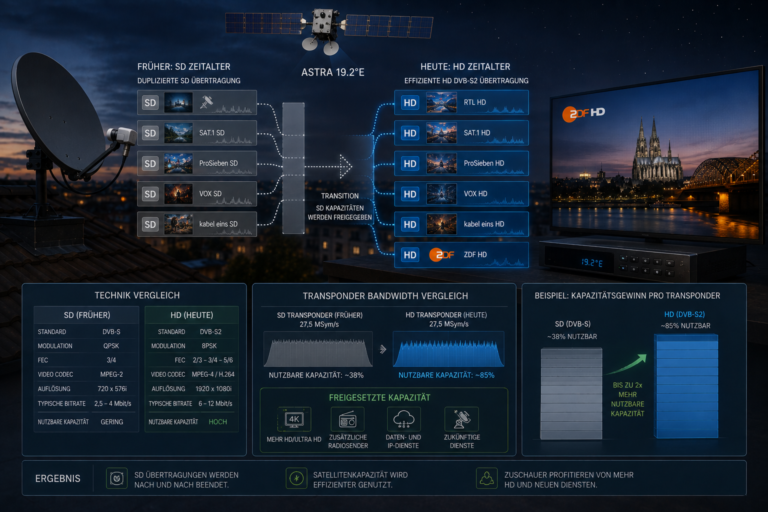
Many German HD satellite services on Astra 19.2E use DVB-S2 because high-definition television requires efficient use of limited transponder capacity. DVB-S2 improves the physical transmission layer through more flexible modulation and much stronger Forward Error Correction than the original DVB-S system. This allows broadcasters to carry more useful data through a satellite transponder while maintaining reliable reception within the intended coverage area.
There is one important technical distinction, however. HD does not inherently require DVB-S2. A high-definition video stream could technically be carried through other transmission systems if enough capacity were available. DVB-S2 became important because it provides the efficiency and flexibility needed for modern satellite broadcasting. Video compression such as H.264 or HEVC reduces the bitrate of the pictures, while DVB-S2 determines how those compressed bits survive the RF journey from the satellite to the receiver.
DVB-S2 and HD describe different parts of the television system. HD describes the video format. H.264 or HEVC compresses that video. DVB-S2 carries the resulting digital data across the satellite RF link. The receiver must successfully recover the DVB-S2 carrier before its video decoder can begin reconstructing the HD picture.
- Why HD and DVB-S2 Are Not the Same Thing
- Why DVB-S Was No Longer the Ideal Solution
- How DVB-S2 Uses Satellite Capacity More Efficiently
- QPSK Versus 8PSK
- Why Forward Error Correction Matters
- How LDPC and BCH Protect the Data
- What MODCOD Means
- Why German HD Reception Can Need Better Signal Margin
- How MER Affects DVB-S2 Reception
- What BER Tells the Receiver
- Why HD Can Fail While SD Still Works
- The Role of H.264 and HEVC
- What Happens Inside the Receiver
- Why Dish Alignment Becomes Important
- LNB and Cable Effects on DVB-S2
- How to Diagnose German HD Reception Problems
- Reality Check
- Final Verdict
- FAQ
Why HD and DVB-S2 Are Not the Same Thing
The first concept to understand is that DVB-S2 does not define picture resolution.
HD television is created at the video layer. The programme is captured, processed, and compressed into a digital video stream. That stream is combined with audio, programme information, and other data before transmission.
DVB-S2 operates lower in the chain. Its job is to transform digital information into a protected RF transmission that can travel through the satellite link and be recovered by a receiver.
Therefore, saying that HD automatically requires DVB-S2 is technically inaccurate. The better explanation is that DVB-S2 provides the efficiency and coding flexibility that made it highly suitable for large-scale HD satellite distribution.
Why DVB-S Was No Longer the Ideal Solution
The original DVB-S standard was highly successful and remains an important part of satellite broadcasting history.
It was designed when digital television had very different capacity requirements. Standard-definition MPEG-2 television dominated early digital satellite systems, and QPSK provided a robust way to transport those services.
As broadcasters moved toward HD, more efficient video compression helped, but improving the physical satellite layer offered additional capacity gains.
DVB-S2 introduced stronger coding and additional modulation options, allowing broadcasters to choose a better balance between bitrate and robustness.
How DVB-S2 Uses Satellite Capacity More Efficiently
Satellite transponder bandwidth is finite. A broadcaster cannot continuously increase the amount of spectrum available on an existing transponder.
The engineering challenge is therefore to transmit more useful information through the available bandwidth without making reception impractical.
DVB-S2 addresses this with flexible modulation and coding configurations.
A broadcaster can select a robust configuration when reception reliability is the priority or choose a more spectrally efficient configuration when the satellite link provides enough carrier quality.
This flexibility is particularly valuable for HD multiplexes carrying several high-bitrate services.
QPSK Versus 8PSK
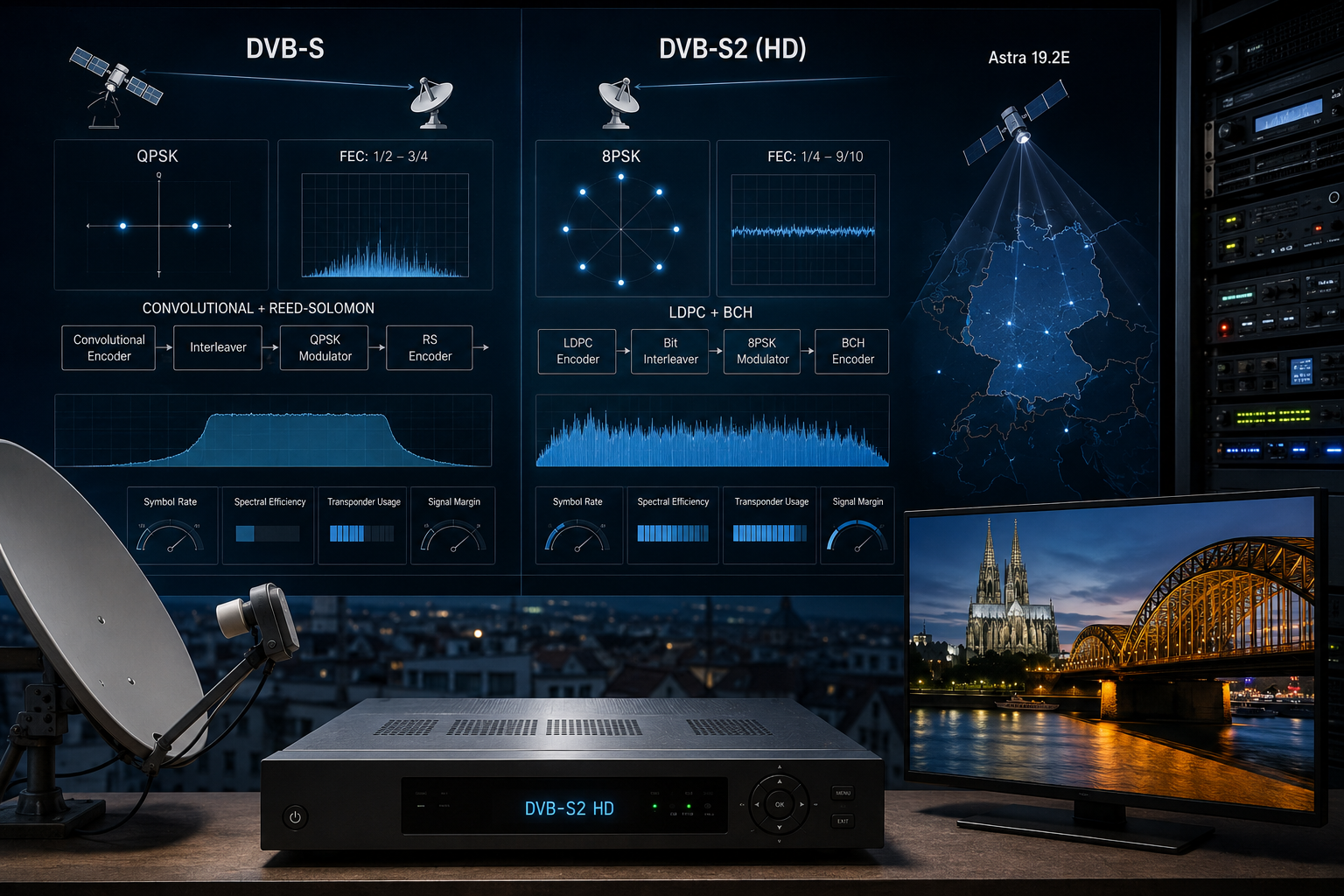
QPSK represents information using four main phase states. Each transmitted symbol can therefore represent two bits.
8PSK uses eight phase states and can represent three bits per symbol.
This allows more information to be transported for a given symbol rate, but there is a tradeoff.
The eight constellation positions are closer together than the four QPSK positions. Noise, phase errors, interference, and other impairments can therefore make the states harder for the receiver to distinguish.
For comparable coding assumptions, 8PSK generally requires a cleaner signal than QPSK. This is one reason some DVB-S2 HD transponders can expose a marginal satellite installation more quickly than robust SD transmissions.
| Technical Element | What It Does | Effect on German HD Reception |
|---|---|---|
| DVB-S2 | Defines the modern satellite physical transmission system | Allows more efficient use of transponder capacity |
| QPSK | Uses four principal constellation states | Offers robust transmission with lower bits per symbol |
| 8PSK | Uses eight constellation states | Improves capacity but can require better reception conditions |
| LDPC | Provides powerful Forward Error Correction | Repairs large numbers of transmission errors efficiently |
| BCH | Adds an outer error-correction stage | Helps clean residual errors after LDPC decoding |
| MER | Measures modulation quality | Shows how clearly the receiver can distinguish symbols |
| BER | Measures bit errors | Shows how much error correction is being demanded |
| H.264 or HEVC | Compresses the television pictures | Reduces the bitrate needed for HD video |
Why Forward Error Correction Matters
A satellite signal never arrives at the receiver completely untouched.
Thermal noise, atmospheric attenuation, phase noise, interference, polarization leakage, and imperfections in the receiving system all reduce signal quality.
Forward Error Correction adds controlled redundancy before transmission so the receiver can detect and repair many errors without asking the satellite to retransmit the information.
This is essential for television broadcasting because a satellite transponder continuously sends the same stream toward millions of potential receivers. There is no individual retransmission process for every household.
How LDPC and BCH Protect the Data
One of the major technical advances in DVB-S2 is its powerful coding architecture.
DVB-S2 uses Low Density Parity Check coding together with BCH coding. These stages allow the receiver to recover data reliably even when the raw demodulated signal contains errors.
LDPC performs the main error-correction work. BCH provides an additional outer coding stage that helps remove residual errors.
This strong Forward Error Correction allows DVB-S2 systems to operate relatively close to theoretical communication limits when correctly engineered.
For the viewer, all of this processing remains invisible until the signal becomes too poor for the correction system to recover the data.
What MODCOD Means
DVB-S2 does not have one universal reception threshold.
The modulation format and coding rate are selected together. This combination is commonly described as the MODCOD.
A robust QPSK configuration can operate under poorer reception conditions than a more capacity-oriented 8PSK configuration.
This means two German HD transponders can behave differently even if both use DVB-S2.
The actual decoding requirement depends on the complete MODCOD rather than the DVB-S2 label alone.
Why German HD Reception Can Need Better Signal Margin
Signal margin is the difference between the current reception condition and the point where the receiver can no longer decode the carrier reliably.
Suppose a DVB-S2 HD transponder operates comfortably above its required threshold. Small changes caused by rain, cable loss, or temperature have little visible effect.
If the same transponder is received only slightly above the threshold, those changes can remove the remaining margin.
The receiver then moves rapidly from a perfect picture to pixelation, freezing, or complete loss of lock.
This digital threshold behaviour explains why a channel can look perfect immediately before it fails.
How MER Affects DVB-S2 Reception
MER, or Modulation Error Ratio, is one of the most useful measurements when evaluating a DVB-S2 carrier.
It indicates how closely the received constellation points correspond to their ideal positions.
A high MER means the receiver sees well-defined modulation states. A falling MER means noise, interference, distortion, or phase errors are making the symbols less distinct.
Raw signal strength cannot provide this information.
A receiver can show a high RF level while MER is poor because unwanted energy is present alongside the wanted carrier.
What BER Tells the Receiver
BER measures the proportion of bits that are being recovered incorrectly.
It is important to distinguish between errors before and after Forward Error Correction.
A DVB-S2 receiver can tolerate a certain amount of pre-FEC error because LDPC and BCH are designed to correct damaged data.
As reception deteriorates, pre-FEC errors increase and the decoder has to work closer to its correction limit.
Once the system can no longer correct enough errors, post-FEC errors reach the recovered data and television reception begins to fail visibly.
Why HD Can Fail While SD Still Works
Viewers sometimes find that an older SD channel remains stable while a German HD service disappears during marginal conditions.
This does not mean that picture resolution itself is directly making the satellite wave harder to receive.
The channels may be on completely different transponders. The SD carrier may use DVB-S with robust QPSK and have generous signal margin, while the HD service may use a different DVB-S2 MODCOD with a higher required carrier quality.
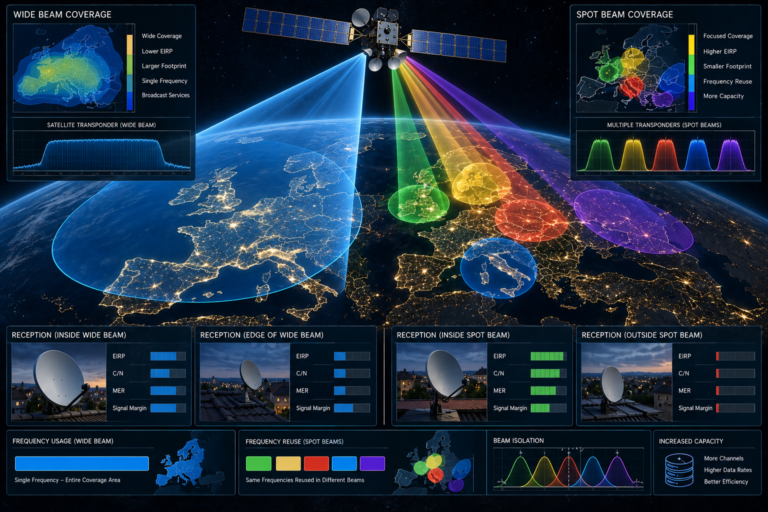
Their beam coverage, frequency, polarization, and transmitted power may also differ.
The correct comparison is therefore between the complete RF configurations, not simply between HD and SD labels.
The Role of H.264 and HEVC
Efficient video compression is another major part of modern HD broadcasting.
H.264, also known as AVC, can provide substantially better compression efficiency than older MPEG-2 video. HEVC can improve efficiency further for suitable applications.
These codecs reduce the number of bits needed to represent the television pictures.
DVB-S2 then carries those bits across the satellite link.
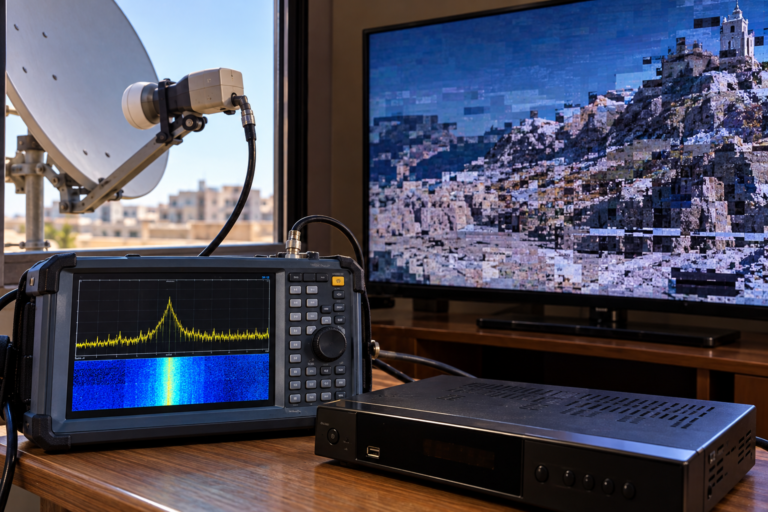
This distinction also explains why a receiver can show excellent DVB-S2 signal quality but still display no picture. The tuner and demodulator may have recovered the transport stream correctly while the video decoder lacks support for the codec used by the service.
What Happens Inside the Receiver
When a German HD channel is selected, the receiver first commands the LNB to provide the required band and polarization.
The tuner selects the corresponding intermediate frequency. Carrier recovery then determines the precise frequency and phase of the incoming signal.
The demodulator identifies the DVB-S2 physical-layer structure and recovers the transmitted symbols.
LDPC and BCH processing correct transmission errors. The recovered data is then reconstructed into the broadcast stream, where the receiver identifies the selected television service.
Only after these stages succeed does the video decoder process the compressed H.264, HEVC, or other supported video stream and produce pictures for the television output.
Why Dish Alignment Becomes Important
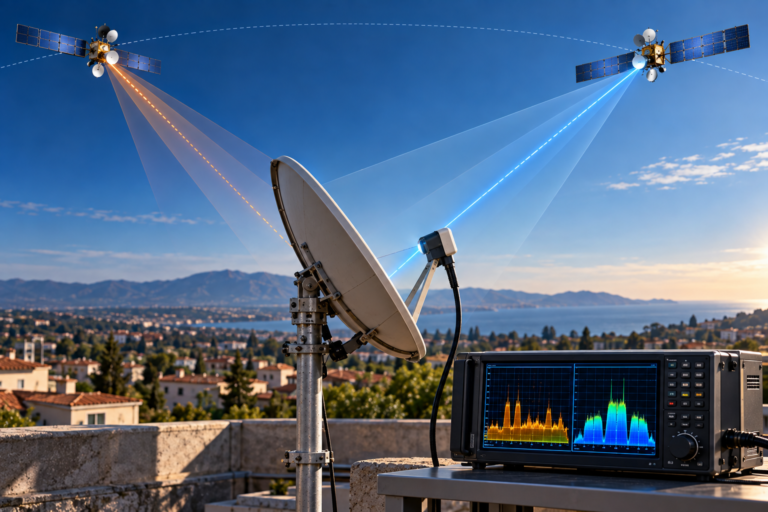
A dish does not simply need to find Astra 19.2E. It should be aligned accurately enough to provide healthy margin on the more demanding transponders.
Small azimuth or elevation errors reduce the wanted carrier relative to noise and other unwanted energy.
A strong transponder may hide this problem because it still has substantial margin.
A more demanding DVB-S2 carrier can reveal the alignment error first.
For this reason, installers should optimize alignment using signal quality or MER across several representative frequencies rather than maximizing the receiver’s raw strength percentage on one strong transponder.
LNB and Cable Effects on DVB-S2
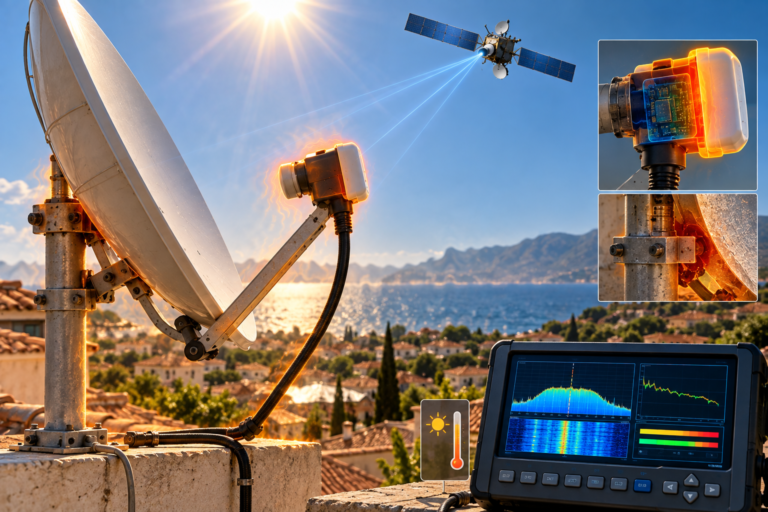
The LNB contributes gain, frequency conversion, oscillator stability, noise, and polarization selection to the reception chain.
Poor LNB skew can increase cross-polarization interference and reduce MER. An ageing local oscillator can add frequency instability or phase noise. A defective band-switching circuit can make selected frequencies disappear completely.
The coaxial distribution system can also reduce available margin.
Long cables introduce attenuation, with loss generally increasing as intermediate frequency rises. Poor connectors can add impedance discontinuities, corrosion, intermittent contact, or shielding problems.
DVB-S2 cannot compensate for unlimited degradation. Forward Error Correction is powerful, but the receiver still needs a sufficiently clean carrier at its tuner input.
How to Diagnose German HD Reception Problems
Begin by determining whether every HD channel fails or only specific transponders.
If several services on the same DVB-S2 transponder fail together, investigate the RF path first. Compare signal quality, MER, BER, polarization, frequency band, and weather behaviour.
If only one polarization performs poorly, inspect LNB skew, receiver voltage, connectors, switches, and cable resistance.
If high-band frequencies fail while low-band channels work, investigate 22 kHz switching and the LNB high-band oscillator.
If the receiver reports strong quality and stable DVB-S2 lock but one channel still has no picture, move the diagnosis beyond the RF layer. Check video codec support, service configuration, authorization where applicable, and receiver firmware.
Understanding the orbital system itself also helps explain why so many German HD services are concentrated at this position. Our guide to why Astra 19.2E is Germany’s most important satellite explains the coverage, transponder capacity, broadcaster ecosystem, and infrastructure behind the German satellite market.
German HD channels do not need DVB-S2 simply because their pictures are high definition. HD is a video characteristic, while DVB-S2 is a satellite transmission standard.
The reason DVB-S2 became so important for HD is engineering efficiency. Strong Forward Error Correction, flexible modulation, and improved use of transponder capacity allow broadcasters to transport modern high-bitrate services more efficiently than with older satellite technology.
Likewise, an HD channel failing before an SD channel does not prove that HD radio waves are inherently weaker. The two services may use different transponders, MODCODs, beams, frequencies, and signal margins.
DVB-S2 is fundamental to modern German HD satellite broadcasting because it makes limited satellite capacity more useful while providing powerful protection against transmission errors.
Its combination of flexible modulation, LDPC and BCH Forward Error Correction, and selectable coding rates allows broadcasters to balance capacity against reception robustness. When combined with efficient video compression such as H.264 or HEVC, this makes it practical to carry multiple high-quality television services within limited transponder bandwidth.
The tradeoff is that some efficient DVB-S2 configurations require good MER and adequate signal margin. Dish alignment, LNB skew, oscillator stability, cable loss, interference, and weather can therefore determine whether a marginal HD carrier remains above its decoding threshold.
The receiver does not care whether the viewer calls a programme HD or SD. It first has to recover the RF carrier, synchronize with the DVB-S2 signal, correct the errors, reconstruct the broadcast data, and only then decode the television picture. Understanding that chain explains both the efficiency of DVB-S2 and the reception problems that appear when signal margin becomes too small.
| Question | Answer |
|---|---|
| Do all HD satellite channels require DVB-S2? | No. HD describes video resolution and does not technically require one specific satellite standard. DVB-S2 is widely used because it provides better efficiency and coding flexibility for modern satellite services. |
| Why is DVB-S2 better suited to HD than DVB-S? | It provides stronger Forward Error Correction and more flexible modulation and coding options, allowing satellite capacity to be used more efficiently. |
| What is 8PSK? | 8PSK is a modulation format using eight phase states. It can carry three bits per symbol but generally requires cleaner reception than QPSK under comparable coding conditions. |
| What is a DVB-S2 MODCOD? | It is the combination of modulation and coding rate used for a transmission. Different MODCODs have different capacity and reception requirements. |
| Why does MER matter for German HD channels? | MER indicates how clearly the receiver can distinguish the transmitted modulation states. Poor MER can prevent reliable DVB-S2 decoding even when signal strength appears high. |
| What does BER show? | BER indicates how many bits are being recovered incorrectly. Rising BER shows that the receiver is using more of its available error-correction capability. |
| Why can HD disappear while SD continues working? | The services may use different transponders, beams, modulation formats, coding rates, frequencies, and signal margins. The difference is not caused by resolution alone. |
| Does DVB-S2 compress the HD video? | No. Video codecs such as H.264 or HEVC compress the pictures. DVB-S2 transports the resulting digital data through the satellite RF link. |
| Can a receiver lock DVB-S2 but fail to show the channel? | Yes. The RF and transport stages can work correctly while the receiver lacks support for the service’s video codec or another service-level requirement. |
| Can poor LNB skew affect DVB-S2? | Yes. Incorrect skew can increase cross-polarization interference, reduce MER, raise BER, and reduce the available decoding margin. |
| Should a dish be aligned using signal strength? | Signal quality, MER, BER, and available margin are more useful than raw strength. Alignment should also be checked across several representative transponders. |
| Why does DVB-S2 reception fail suddenly rather than gradually? | Forward Error Correction can hide increasing errors until the carrier approaches its decoding threshold. Once the remaining margin is lost, visible errors and loss of lock can appear rapidly. |