Why Some German Channels Changed to HD Only
Estimated Reading Time: 12 minutes
German satellite television has been moving away from Standard Definition transmission. This is no longer just a future trend. ARD ended the SD satellite distribution of Das Erste and its regional television services on January 7, 2025. ZDF followed on November 18, 2025, when ZDF, ZDFneo, ZDFinfo, 3sat, and KiKA became HD-only over satellite. ARTE and phoenix had already ended their SD distribution earlier. The change reflects a German television market in which legacy SD reception has become increasingly unnecessary. :contentReference[oaicite:0]{index=0}
The engineering reason is more interesting than simply saying that HD has a better picture. For years, broadcasters transmitted separate SD and HD versions of the same programmes so older receivers could continue working while newer households moved to HD. Maintaining both versions consumes transmission resources and operating budget. Once most satellite households can receive HD, maintaining a parallel legacy system becomes increasingly difficult to justify. The transition therefore represents both a receiver-generation change and a more efficient use of broadcast infrastructure.
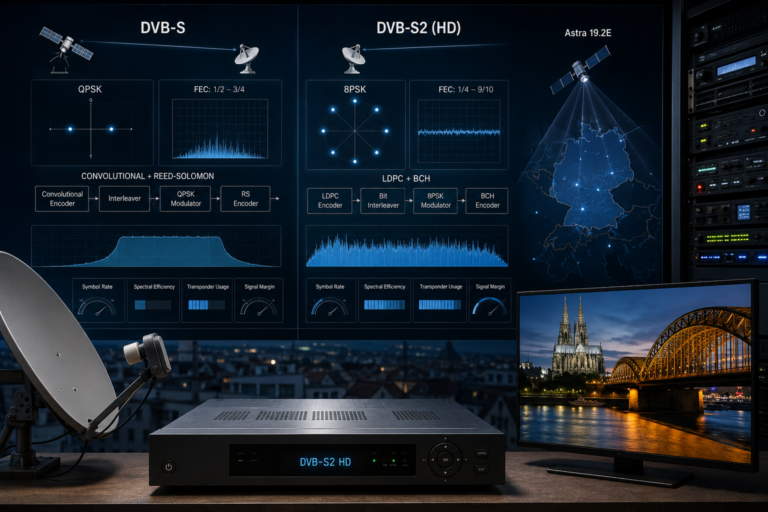
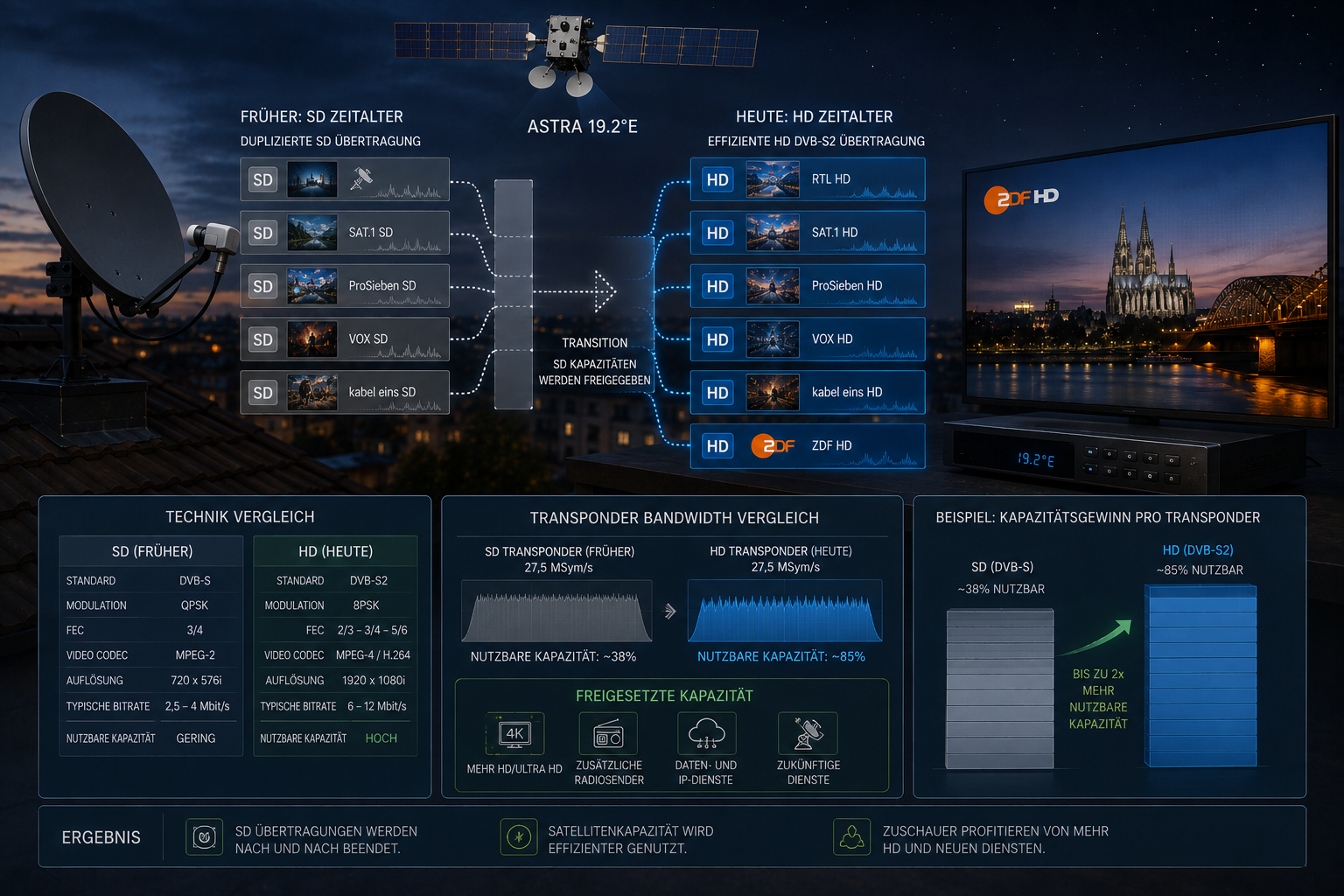
ZDF says its programmes were distributed simultaneously in SD and HD for around 15 years before the SD service ended. Astra reports that more than 90 percent of German satellite households now receive television in HD. The old ZDF SD satellite multiplex used DVB-S at 11.954 GHz with a symbol rate of 27.5 MS/s and FEC 3/4, while the current ZDF HD services use DVB-S2 and 8PSK. This illustrates how the transition also moves viewers away from an older satellite transmission generation. :contentReference[oaicite:1]{index=1}
- Why German Broadcasters Used SD and HD Together
- Why the SD Simulcast Became Less Necessary
- What Changed in Germany During 2025
- Why Two Versions Consume Extra Satellite Resources
- HD-Only Does Not Mean Satellite Is Disappearing
- How DVB-S2 Fits Into the Transition
- Why Video Compression Matters
- What Happened to the Old ZDF SD Transmission
- Why Old Receivers Can Stop Working
- Why a Channel Scan May Be Enough for Some Viewers
- What Changes Inside the Receiver
- Does HD Require a Stronger Satellite Signal?
- Why Dish Alignment Still Matters
- What MER and BER Have to Do With the Change
- Why Community Satellite Systems Need Attention
- How to Prepare a Satellite Installation for HD-Only TV
- Reality Check
- Final Verdict
- FAQ
Why German Broadcasters Used SD and HD Together
When HD satellite television was introduced, broadcasters could not simply switch off SD immediately.
Millions of households still owned televisions and satellite receivers designed around the older DVB-S and SD broadcasting environment. Replacing all of that equipment at once would have excluded viewers who had perfectly functional receivers.
Broadcasters therefore used simulcasting.
The same programme was distributed in an SD version for legacy equipment and an HD version for newer receivers.
This was a practical migration strategy. It allowed viewers to replace televisions and receivers gradually rather than forcing an immediate nationwide hardware transition.
The disadvantage was duplication. Broadcasters had to maintain satellite capacity and distribution infrastructure for two versions of substantially the same television programming.
Why the SD Simulcast Became Less Necessary
A transition system makes sense only while a significant number of viewers still depend on the old technology.
Over time, HD televisions became normal consumer equipment. Integrated DVB-S2 tuners became widespread, while external HD satellite receivers also became inexpensive and readily available.
The number of households depending exclusively on SD therefore declined.
ZDF stated that almost all households in Germany were already receiving television in HD and that SD reception was barely being used when it ended the duplicate satellite transmission. Astra separately reported that more than 90 percent of German satellite households receive television in HD. :contentReference[oaicite:2]{index=2}
Once the legacy audience becomes small enough, continuing a complete parallel broadcast chain for that group becomes increasingly inefficient.
What Changed in Germany During 2025
The German public broadcasting system passed two important satellite milestones during 2025.
On January 7, ARD ended the SD distribution of Das Erste and its regional television programmes. ARD explained that SD-only usage had been declining for years and that only a small proportion of German television households still depended exclusively on SD reception. :contentReference[oaicite:3]{index=3}
ZDF completed another major part of the transition on November 18. ZDF, ZDFneo, ZDFinfo, 3sat, and KiKA have since been distributed over satellite exclusively in HD. :contentReference[oaicite:4]{index=4}
This was not the first German SD shutdown. ZDF notes that ARTE and phoenix had already ended SD distribution in November 2022. :contentReference[oaicite:5]{index=5}
The important trend is clear. SD is no longer being treated as a permanent parallel satellite platform for major German public television services.
Why Two Versions Consume Extra Satellite Resources
A satellite transponder has finite bandwidth and finite usable data capacity.
If a broadcaster wants to distribute an SD and an HD version simultaneously, both encoded television services need transmission resources.
The SD service may use a lower bitrate than HD, but it is not free from an engineering perspective. It still occupies capacity in a multiplex and requires encoding, monitoring, distribution, service information, and operational support.
At a national scale, maintaining legacy transmission for years creates continuing costs.
ZDF explicitly identified lower programme-distribution costs as a reason for ending its approximately 15-year period of parallel SD and HD broadcasting. ARD also cited the economic use of broadcasting contributions when explaining its SD shutdown. :contentReference[oaicite:6]{index=6}
| Technical Element | Legacy SD Environment | Modern HD Environment |
|---|---|---|
| Picture format | Standard Definition | High Definition |
| Typical receiver generation | Older DVB-S capable equipment | HD capable DVB-S2 equipment |
| Satellite standard | DVB-S commonly used | DVB-S2 widely used |
| Modulation example | QPSK | 8PSK commonly used on German HD multiplexes |
| Video compression | MPEG-2 common on legacy services | More efficient codecs such as H.264 widely used |
| Simulcast requirement | Needed while legacy receivers remained important | Becomes unnecessary when the audience has migrated |
| Receiver requirement | Legacy hardware may be sufficient | Compatible HD and DVB-S2 hardware required for relevant services |
| Distribution efficiency | Legacy service consumes continuing capacity | Ending duplication reduces distribution overhead |
HD-Only Does Not Mean Satellite Is Disappearing
The end of SD should not be confused with the end of satellite broadcasting.
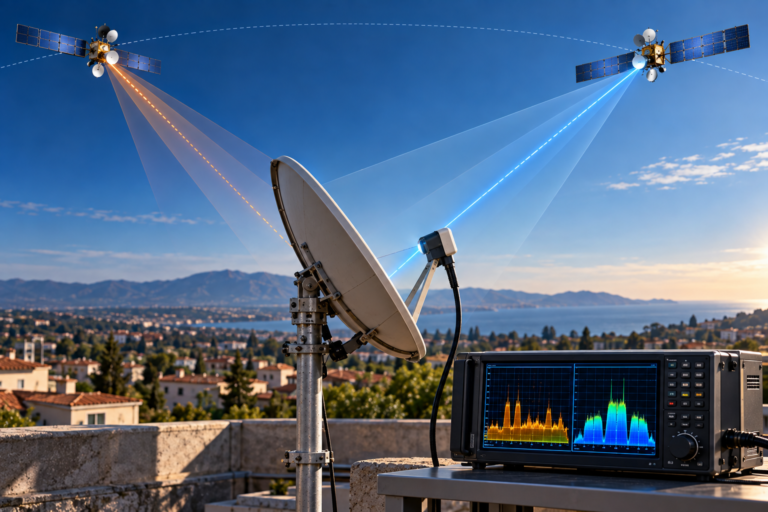
The transmission path remains satellite. The dish still points toward the relevant Astra orbital position, the LNB still converts Ku-band signals, and the receiver still demodulates a digital RF carrier.
What disappears is the redundant low-resolution version of the programme.
ZDF continues to distribute its HD services through Astra 19.2E. Its published current satellite parameters identify Astra 1P and DVB-S2 8PSK transmissions for the ZDF HD programme groups. :contentReference[oaicite:7]{index=7}
The infrastructure is therefore evolving rather than being abandoned.
How DVB-S2 Fits Into the Transition
DVB-S2 is one of the technologies that made modern HD satellite distribution more efficient.
The original DVB-S system was highly successful, but DVB-S2 introduced stronger Forward Error Correction and more flexible modulation and coding options.
This allows operators to choose a better balance between useful bitrate and reception robustness.
For example, ZDF currently lists its main HD satellite groups with DVB-S2, 8PSK, a symbol rate of 22 MS/s, and FEC 2/3. :contentReference[oaicite:8]{index=8}
This is significantly different from the former ZDF SD multiplex, which ZDF documented as DVB-S with a symbol rate of 27.5 MS/s, FEC 3/4, and horizontal polarization at 11.954 GHz. :contentReference[oaicite:9]{index=9}
The transition can therefore expose very old receivers that understand the former DVB-S carrier but cannot demodulate a modern DVB-S2 HD transmission.
Why Video Compression Matters
Satellite modulation is only one part of the efficiency improvement.
Video must also be compressed before it is inserted into the broadcast stream.
Older SD satellite services commonly relied on MPEG-2 video. Modern HD distribution can use more efficient compression such as H.264 AVC.
Better compression allows broadcasters to represent a much higher-resolution image without increasing the required bitrate in direct proportion to the number of pixels.
The physical transmission system and the video codec therefore solve different problems.
DVB-S2 carries the digital information through the RF link. The video codec reduces the amount of digital information needed to represent the pictures.
What Happened to the Old ZDF SD Transmission
The old ZDF SD platform provides a useful engineering example of what an HD-only transition actually removes.
Before shutdown, ZDF documented the SD services ZDF, ZDFneo, ZDFinfo, 3sat, and KiKA on Astra 1P at 11.954 GHz horizontal with a 27.5 MS/s symbol rate, FEC 3/4, and DVB-S modulation. ZDF explicitly marked that SD transmission as ending on November 18, 2025. :contentReference[oaicite:10]{index=10}
The current HD services use separate DVB-S2 carriers. ZDF HD and ZDFneo HD are listed at 11.362 GHz horizontal, while ZDFinfo HD, 3sat HD, and KiKA HD are listed at 11.347 GHz vertical. Both groups use 22 MS/s, FEC 2/3, and DVB-S2 8PSK. :contentReference[oaicite:11]{index=11}
An old receiver searching only for the former SD carrier cannot recover the programmes simply because the dish still receives Astra.
Why Old Receivers Can Stop Working
An old receiver can fail at several different technical stages.
The first limitation can be the tuner and demodulator. A DVB-S-only receiver does not contain the physical-layer capability required to decode DVB-S2 transmissions.
A second limitation can be modulation support. Modern satellite transmissions can use 8PSK rather than the QPSK environment associated with many older receivers.
A third limitation can appear after successful RF reception. The receiver’s video hardware must understand the codec used by the HD programme.
This explains why a receiver can display a strong signal indication but still be unable to show a modern German HD channel.
RF energy reaching the tuner is not the same as successful demodulation, and successful demodulation is not the same as successful video decoding.
Why a Channel Scan May Be Enough for Some Viewers
Not every household affected by an old SD channel entry needs new hardware.
Some televisions and receivers are already fully HD and DVB-S2 capable but still have obsolete SD services stored in their channel lists.
In that situation, a new channel scan can locate the existing HD service.
ZDF advises viewers who already have HDTV-capable satellite equipment to check for the HD-labelled programmes and perform a channel scan if necessary. It states that satellite viewers without suitable HDTV reception equipment need a television with an integrated DVB-S2 tuner or a separate DVB-S2 receiver. :contentReference[oaicite:12]{index=12}
This distinction prevents unnecessary hardware replacement.
What Changes Inside the Receiver
A modern German HD channel requires several processing stages before a picture reaches the screen.
The tuner first selects the intermediate frequency produced by the LNB.
The DVB-S2 demodulator then acquires the carrier and recovers symbol timing and phase information. With an 8PSK carrier, it must distinguish between eight modulation states.
The received data passes through LDPC and BCH Forward Error Correction. These stages repair errors caused by noise and other RF impairments.
The receiver then reconstructs the broadcast stream, identifies the selected television service, extracts its video and audio components, and passes them to the appropriate decoders.
An old receiver can fail before the transport stream is recovered or later because its media decoder does not support the required format.
Does HD Require a Stronger Satellite Signal?
HD resolution itself does not determine RF reception difficulty.
A satellite tuner does not know how many pixels are in the programme while it is trying to recover the RF carrier.
The decoding threshold is determined primarily by the physical transmission configuration, including modulation, coding, and received carrier quality.
A DVB-S2 8PSK transmission can have different reception requirements from an older DVB-S QPSK carrier, but this difference should not be simplified to “HD signals are weaker.”
A robustly configured HD carrier can outperform a marginal SD carrier under some conditions.
Why Dish Alignment Still Matters
Moving to HD-only transmission does not automatically require a new satellite dish if the existing installation already receives the required Astra HD carriers with sufficient margin.
However, marginal installations can become more obvious once the old SD fallback disappears.
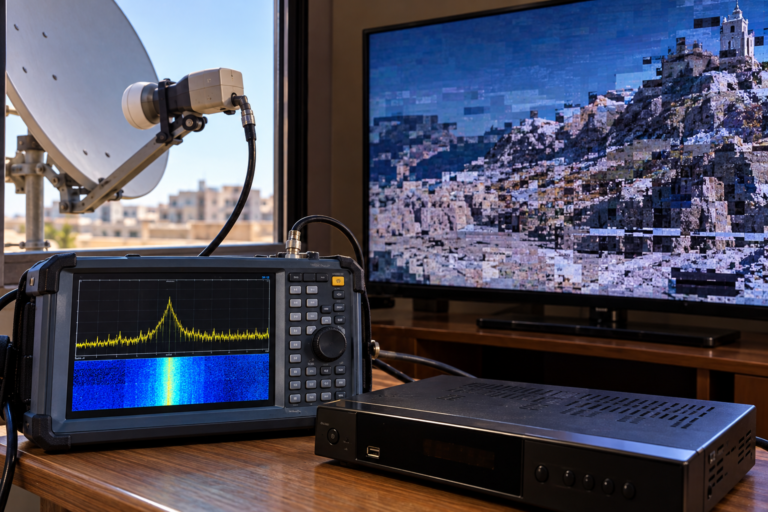
A slightly misaligned dish may still receive strong transponders while providing inadequate MER on others.
The correct solution is to optimize azimuth, elevation, and LNB skew using digital quality measurements rather than simply maximizing a strength bar.
A healthy installation should provide reserve above the decoding threshold so normal rain and environmental changes do not immediately interrupt reception.
What MER and BER Have to Do With the Change
MER describes the quality of the received modulation constellation.
A high MER means the receiver can clearly distinguish the transmitted symbol states. Poor alignment, interference, cross-polarization leakage, phase noise, and other impairments reduce MER.
BER describes how many bits are being recovered incorrectly.
As RF conditions deteriorate, raw errors increase. DVB-S2 Forward Error Correction repairs many of these errors while enough signal margin remains.
When the error rate exceeds the decoder’s correction capability, the picture begins to pixelate or freeze and eventually the receiver loses synchronization.
These measurements are more useful than raw strength when checking whether an existing satellite installation is genuinely ready for reliable HD-only reception.
Why Community Satellite Systems Need Attention
The transition also affects buildings that use shared satellite distribution systems.
A household may own a modern television but still receive signals through older communal equipment.
Multiswitches, headends, channel converters, filters, and other distribution components can determine which transponders actually reach individual apartments.
ZDF specifically identified households using both individual dishes and communal satellite installations among those potentially affected by the SD shutdown. It advises users of shared satellite systems to contact the responsible building management when reception questions remain. :contentReference[oaicite:13]{index=13}
Troubleshooting must therefore consider the complete distribution chain rather than assuming the television is the only relevant component.
How to Prepare a Satellite Installation for HD-Only TV
First confirm that the television or external receiver supports DVB-S2 and HD video decoding.
Next, scan for the current HD services instead of relying on old SD channel entries.
If the channels are found but reception is unstable, inspect the RF system. Check signal quality, MER, BER, dish alignment, LNB skew, cable condition, connectors, and switches.
If several channels on the same transponder fail together, suspect the common RF path. If the transponder locks reliably but one programme cannot be displayed, investigate receiver compatibility and service-level processing.
Do not replace the dish simply because SD has disappeared. A correctly installed Astra system that already provides sufficient quality on the relevant DVB-S2 carriers normally needs no fundamental antenna change just because a broadcaster has ended its SD simulcast.
Receiver compatibility becomes particularly important as these legacy transmissions disappear. Our guide to why older receivers cannot decode new German channels explains how DVB-S2, 8PSK, video codecs, tuner hardware, and decoder limitations can prevent an apparently healthy receiver from displaying modern services.
Germany’s move toward HD-only satellite television is not a mysterious change in the satellite signal and it does not mean satellite broadcasting is being abandoned.
Broadcasters are removing duplicate SD versions after years of transition because the overwhelming majority of satellite households now use HD-capable equipment. ARD ended major SD satellite services in January 2025, and ZDF ended its remaining SD satellite distribution in November 2025. :contentReference[oaicite:14]{index=14}
For most viewers already watching the HD versions, nothing fundamental changed at the dish. The households most affected are those still using legacy receivers, old stored channel entries, or distribution systems that do not correctly deliver the modern HD transponders.
Some German channels changed to HD only because maintaining SD and HD versions of the same programme had become an increasingly inefficient use of broadcast infrastructure.
Simulcasting was essential during the transition from older DVB-S and SD equipment, but that transition has largely matured. Astra reports that more than 90 percent of German satellite households receive television in HD, while ZDF says SD reception had become barely used before its shutdown. :contentReference[oaicite:15]{index=15}
The technical transition also reflects a newer receiving environment. Modern German HD satellite services commonly use DVB-S2, efficient modulation and Forward Error Correction, and modern video compression. Old DVB-S-only receivers can therefore become obsolete even though the dish itself remains perfectly usable.
HD-only satellite television is ultimately a consolidation of the broadcast chain. The same programming no longer needs to occupy resources in two generations of television distribution when almost the entire audience can receive the newer one.
| Question | Answer |
|---|---|
| Why are German satellite channels becoming HD only? | SD-only usage has fallen substantially, so maintaining separate SD and HD versions creates unnecessary distribution cost and technical duplication. |
| When did ZDF stop satellite SD broadcasting? | ZDF, ZDFneo, ZDFinfo, 3sat, and KiKA became satellite HD-only on November 18, 2025. :contentReference[oaicite:16]{index=16} |
| When did ARD end its major SD satellite services? | Das Erste and the ARD regional television services ended SD distribution on January 7, 2025. :contentReference[oaicite:17]{index=17} |
| Did ARTE and phoenix stop SD earlier? | Yes. ZDF states that ARTE and phoenix had already ended SD distribution in November 2022. :contentReference[oaicite:18]{index=18} |
| Does HD-only mean German satellite TV is ending? | No. The satellite transmission continues. The duplicate SD version is what has been removed. |
| Do I need a new dish for German HD channels? | Usually not if the existing Astra installation provides adequate quality on the current HD transponders. Receiver compatibility and channel tuning should be checked first. |
| What receiver does ZDF require for satellite HD? | ZDF states that viewers need a television with an integrated DVB-S2 tuner or a separate DVB-S2 receiver for its satellite HD services. :contentReference[oaicite:19]{index=19} |
| Why can an old receiver show signal but no HD channel? | It may detect RF energy but lack DVB-S2 demodulation, 8PSK support, or the video-decoding hardware required by the modern service. |
| Will a channel scan fix the problem? | It can if the receiver is already HD and DVB-S2 capable but still contains outdated SD channel entries. |
| Does HD inherently require a stronger RF signal than SD? | No. Reception requirements depend on modulation, FEC, carrier quality, and signal margin rather than picture resolution alone. |
| Why are MER and BER important after the SD shutdown? | They show whether the installation has enough digital signal quality and error margin for reliable reception of the current DVB-S2 carriers. |
| Are German public HD satellite channels free to receive? | ZDF states that its satellite HD programmes remain available without additional reception charges, and its published ZDF programme group is free and unencrypted. :contentReference[oaicite:20]{index=20} |