Sky Italia Streaming Lag Explained With Real Technical Causes
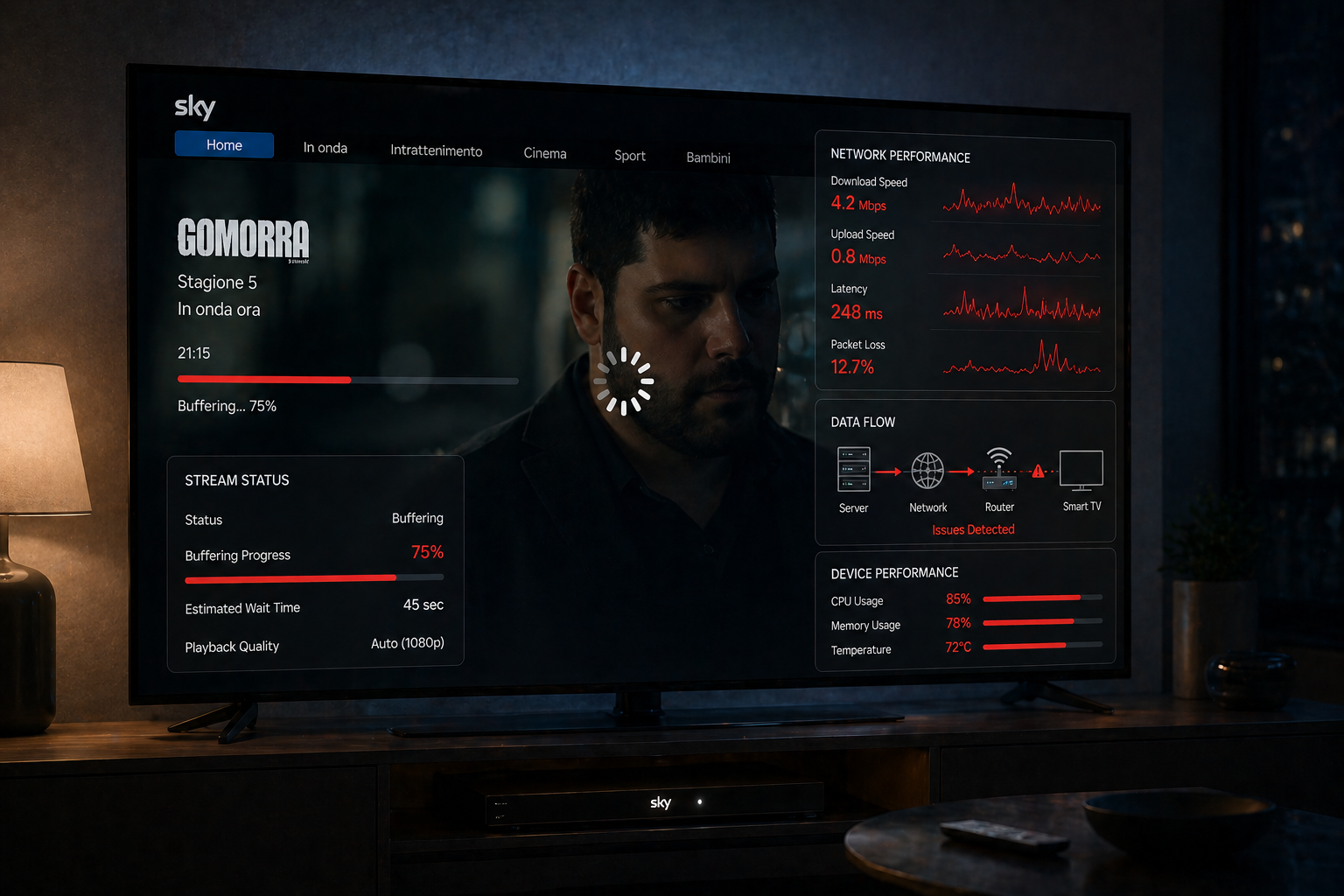
Estimated reading time: 11 to 13 minutes.
Streaming lag on Sky Italia is one of the most frustrating issues because it does not always follow a clear pattern. Sometimes the stream is smooth, and suddenly it becomes delayed or unresponsive. The reason is not a single problem. It is the result of multiple technical factors working together.
Lag happens when the timing between data delivery and playback becomes unstable. Even if the video continues playing, delays accumulate in the background. To understand this properly, we need to break down the real causes behind streaming lag instead of relying on simplified explanations.
Quick Context. Sky Italia lag is caused by latency, packet delay, congestion, buffering behavior, and device processing limits rather than just slow internet.
Table of Contents
What streaming lag actually means
Packet delay and delivery timing
Buffer behavior and delay accumulation
What streaming lag actually means
Streaming lag is not always buffering. It is a delay between when data is available and when it is displayed on your screen.
This delay can be small or large, but it is always caused by timing issues in the delivery process.
Lag can exist even when playback appears smooth.
Latency as the primary cause
Latency is the time it takes for data to travel from the server to your device. Every streaming session includes multiple steps such as encoding, processing, and delivery, each adding delay. :contentReference[oaicite:0]{index=0}
When latency increases, video segments arrive later than expected. This creates a gap between real time and playback.
Latency is the main reason why live streams are always slightly behind real events.
Packet delay and delivery timing
Streaming data is delivered in small packets. These packets must arrive in the correct order and at the right time.
If packets are delayed, playback timing becomes inconsistent.
Even if no data is lost, late arrival can still create lag.
This is a timing problem, not a speed problem.
Network congestion effects
When the network is busy, data packets must wait before being transmitted. This creates delays in delivery.
Congestion increases latency and reduces consistency.
Streaming systems must adapt to these conditions, often by lowering quality.
Lag becomes more noticeable during peak usage periods. :contentReference[oaicite:1]{index=1}
Buffer behavior and delay accumulation
The buffer stores video before playback. This protects against interruptions but also introduces delay.
If the buffer grows too large, it increases the time between live content and playback.
In some cases, network devices can create excessive buffering, which increases latency dramatically. :contentReference[oaicite:2]{index=2}
This effect is often invisible but has a major impact on lag.
Device processing limitations
Your device must decode and render video in real time. This requires processing power.
If the device is slow or overloaded, it introduces additional delay.
This delay is added on top of network latency.
Device performance is often overlooked when analyzing lag.
Distance and routing complexity
Data does not travel directly from the server to your device. It passes through multiple network nodes.
Each step adds a small delay. Over long distances, these delays accumulate.
The farther you are from the server, the higher the latency.
Routing changes can also affect how quickly data travels.
Real world scenario
During a live match, the video is captured, encoded, processed, and distributed through servers.
It then travels across networks to your device, where it is buffered and played.
Each stage adds delay. The total lag is the sum of all these steps.
For understanding how network load affects this process, see this guide Sky Italia Network Load Explained.
| Factor | Technical Cause | Effect | Result |
|---|---|---|---|
| Latency | Data travel time | Delayed segments | Playback lag |
| Packet delay | Late arrival | Timing mismatch | Unstable playback |
| Congestion | Network overload | Queue delays | Increased lag |
| Buffer size | Stored data | Delay accumulation | Late playback |
| Device limits | Processing delay | Slow rendering | Additional lag |
Reality Check
Streaming lag is not caused by a single issue. It is the result of multiple delays adding up across the entire delivery chain. Improving one factor alone does not eliminate lag completely.
Final Verdict
Sky Italia streaming lag is the result of latency, packet timing, congestion, buffering, and device processing working together. Each step adds a small delay, and these delays accumulate into noticeable lag. Understanding these layers helps explain why lag happens even on fast connections and why stability and timing are more important than raw speed.
FAQ
| Question | Answer |
|---|---|
| What causes streaming lag | Latency, packet delay, and buffering behavior |
| Is lag the same as buffering | No. Lag is delay, buffering is interruption |
| Can fast internet remove lag | No. Stability and latency matter more |
| Why is live streaming delayed | Because data must be processed and delivered before playback |
| Can lag be completely removed | No. It can be reduced but not eliminated |