Why Hot Bird Is Strong but Astra Is Weak on One Dish
Your dish receives Hot Bird 13°E without trouble. The channels are stable, the receiver locks quickly, and signal quality looks excellent. But switch to Astra 19.2°E and the picture becomes unreliable. Some Astra transponders show noticeably lower quality, while others freeze during minor changes in reception conditions. If both satellites use the same reflector, why is Astra performing so poorly?
In a monoblock or dual-feed installation, receiving one satellite reliably does not guarantee that the second receiving path is correctly positioned. The Astra feed may operate away from the reflector’s best focal geometry, or the entire dish may be aligned in a way that favors Hot Bird. Different satellite coverage and carrier requirements can also explain the imbalance. Before moving the reflector or buying a larger dish, establish whether Astra is losing antenna gain, operating with less link margin, or experiencing a separate configuration fault.
Hot Bird 13°E and Astra 19.2°E are neighboring geostationary orbital positions. They differ by approximately 6.2 degrees in orbital longitude, although their apparent angular separation from a receiving location is not necessarily exactly 6.2 degrees. A compatible monoblock or adjustable dual-feed arrangement can receive both positions with one reflector. However, feed geometry, satellite coverage, and individual transponder requirements determine how well each path performs.
Why Strong Hot Bird Reception Does Not Guarantee Strong Astra
A dual-satellite dish uses one reflector to collect signals arriving from two different directions.
These directions correspond to the orbital positions of Hot Bird 13°E and Astra 19.2°E.
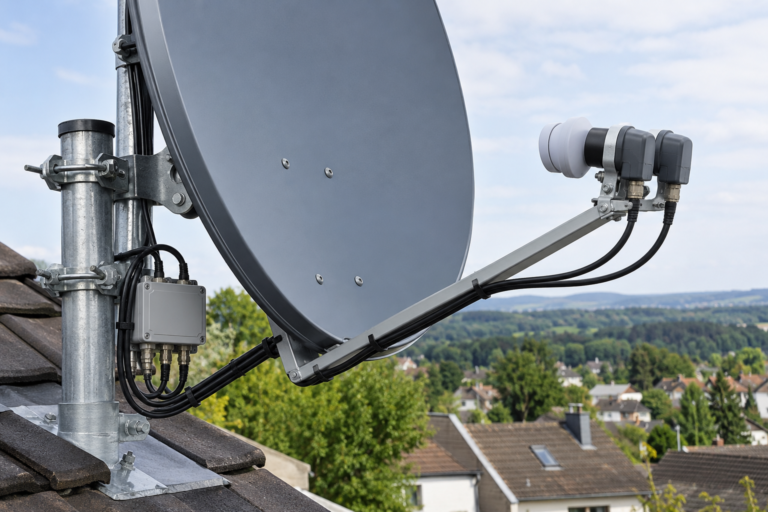
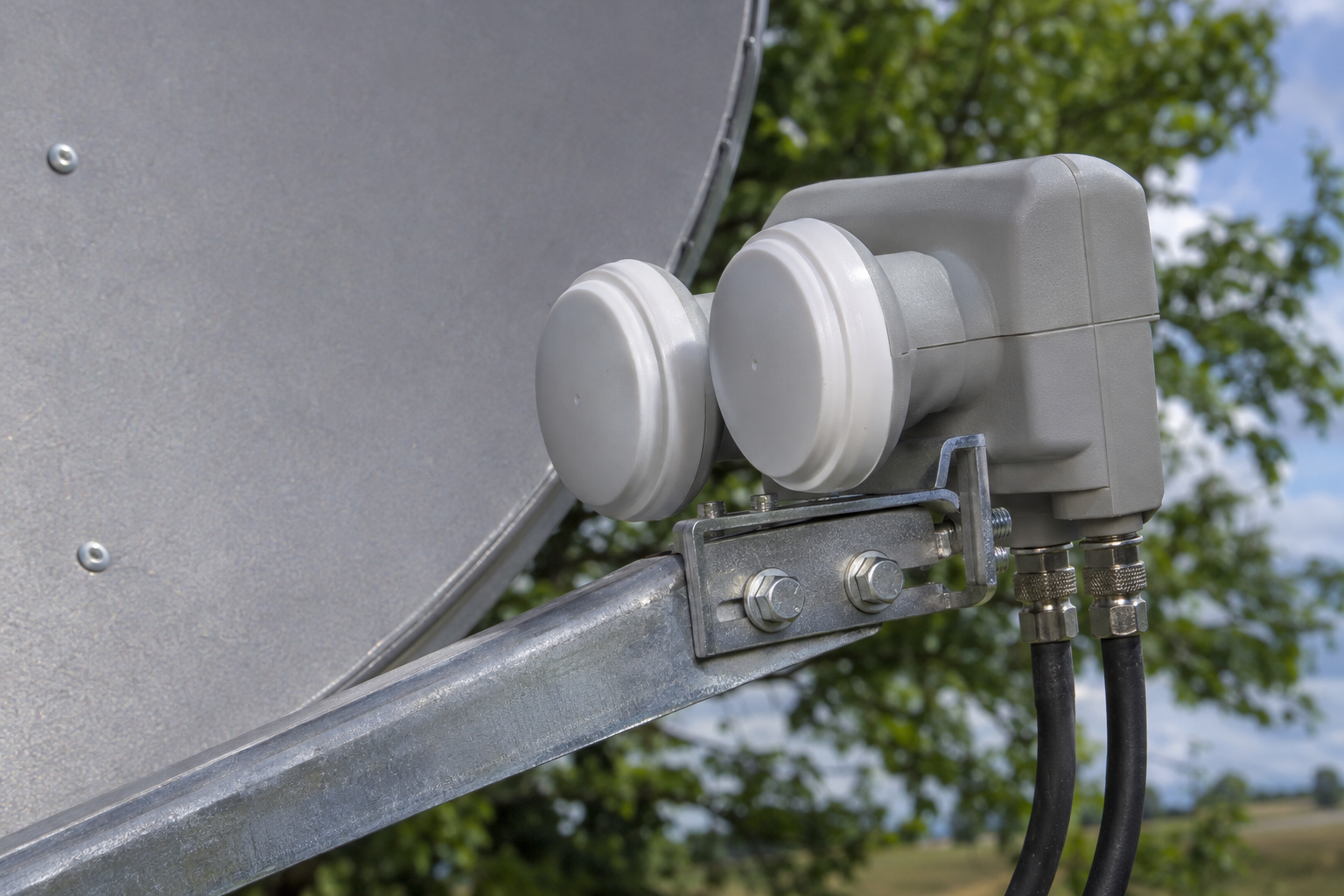
A compatible monoblock contains two feed assemblies positioned to receive the separate satellite signals. Alternatively, an adjustable multi-feed holder can support two independent LNBs.
Although both paths use the same reflector, they do not necessarily provide equal effective antenna gain.
One Reflector, Two Receiving Geometries
In a conventional single-satellite arrangement, the feed is positioned to take advantage of the reflector’s intended focal geometry.
For dual-satellite reception, a second feed may operate at an off-axis position.
This introduces additional geometric requirements.
Depending on the reflector and feed design, the secondary path can experience reduced gain, different illumination, or additional polarization-related impairments.
Why Receiver Percentages Are Misleading
Consumer satellite receivers commonly show signal quality as a percentage.
But those percentages are usually implementation-specific and are not standardized across different carriers or receivers.
A high Hot Bird quality reading and a lower Astra reading do not independently establish that the Astra antenna path has less gain.
The selected carriers may also have different modulation, coding, received power, or interference conditions.
Meaningful comparisons require suitable measurements and knowledge of each carrier’s operating requirements.
The Astra Offset-Feed Problem
One possible explanation for weak Astra reception is that the installation is optimized primarily for Hot Bird.
In this arrangement, the feed associated with Hot Bird may be positioned close to the intended mechanical reference, while Astra is received through the displaced feed.
This is a common installation scenario, but it is not universal. The correct configuration depends on the antenna and monoblock design.
How the Secondary Feed Receives Astra
The reflector redirects incoming signals toward different positions in its focal region according to their arrival directions.
The second feed must be located where the Astra signal is focused sufficiently well for reliable reception.
If the fixed feed spacing does not match the reflector’s geometry, the Astra path may collect less usable energy.
This loss can be especially noticeable on transponders operating with limited reception margin.
Why Hot Bird Can Stay Perfect While Astra Breaks Up
Imagine a system in which Hot Bird has comfortable margin across the required carriers.
The Astra feed, however, may be slightly displaced from its optimum position.
The resulting gain reduction may still allow some Astra transponders to lock while others become unreliable.
Hot Bird continues working because its receiving path remains adequately optimized.
This imbalance is not necessarily evidence of a defective Astra feed.
It may reflect how the existing reflector and monoblock work together.
Why Monoblock Geometry and F/D Ratio Matter
A monoblock is not simply two arbitrary LNBs connected inside one plastic housing.
The spacing between its feed assemblies is selected for particular receiving geometries.
Those geometries depend on more than the orbital separation of the satellites.
What F/D Ratio Means
The focal-length-to-diameter ratio, commonly written F/D, describes the relationship between the reflector’s focal length and effective aperture diameter.
It is one of the geometric parameters relevant to antenna and feed compatibility.
Two dishes with the same nominal diameter may have different focal ratios and different optical behavior.
Therefore, a monoblock that works well on one 80cm reflector may not perform identically on another.
Why Six-Degree Monoblocks Are Not Universal
A monoblock designed for Astra 19.2°E and Hot Bird 13°E is often described as a six-degree model.
That description does not mean the physical separation of its feeds will be correct for every reflector or receiving location.
For example, Inverto specifies a particular six-degree monoblock for an 80cm offset dish with F/D = 0.6.
This is a model-specific compatibility requirement, not a universal specification for every monoblock or 80cm dish.
Before changing the dish size, compare the exact monoblock specifications with the reflector’s geometry.
Why Increasing Dish Size Can Fail to Improve Astra
A larger reflector generally provides more theoretical gain at the same frequency and efficiency.
However, it also generally has a narrower main beam.
If the monoblock’s feed positions are poorly matched to the larger reflector, the expected gain improvement may not be realized on the secondary satellite.
A larger dish is therefore not automatically the correct remedy for weak Astra reception.
Orbital longitude separation, apparent angular separation in the sky, and physical feed spacing are three different quantities. A compatible monoblock design must account for the antenna’s receiving geometry rather than relying on orbital longitude alone.
What Happens When Dish Alignment Favors Hot Bird?
Dish pointing affects the receiving performance of both satellite paths.
In a dual-feed installation, the best practical setting often involves achieving adequate reception margins for both orbital positions rather than maximizing a single reference carrier.
Why Moving the Dish Toward Astra Is Not Always the Answer
A controlled pointing adjustment may improve a marginal Astra carrier.
However, it can also reduce the quality available on Hot Bird.
The result might be a better Astra reading but less reliable reception overall.
Before making any adjustment, record representative carrier measurements on both satellites.
Why the Best Position May Be a Compromise
A dual-feed arrangement is designed to receive two directions simultaneously.
Depending on the equipment, its mechanical design may establish a preferred mounting orientation and pointing procedure.
Where adjustment is possible, the installer should evaluate the weakest required carriers from each satellite.
A small sacrifice in excess Hot Bird margin may be acceptable if it substantially improves Astra while both paths remain reliable.
But this decision should be based on measured margins, not simply on equalizing receiver percentages.
Monoblock Tilt, Skew and Feed Position
The monoblock’s physical orientation influences how its two receiving feeds relate to the reflector and the incoming satellite directions.
Some mounting arrangements require a particular rotation or tilt to position the secondary feed correctly.
Why Rotation Can Affect Astra More Noticeably
If Hot Bird is already received with adequate margin, a small geometric error may be most visible on the Astra path.
Correcting the secondary feed’s position can improve Astra reception without necessarily changing the reflector’s main pointing direction.
However, the available adjustments depend on the monoblock model and its mounting arrangement.
Tilt and Polarization Skew Are Related but Distinct
Feed positioning affects where the satellite signals are collected.
Polarization alignment affects how well the feed receives the intended linearly polarized transmission while rejecting unwanted orthogonal components.
Rotating a monoblock can influence both aspects, so an adjustment should be evaluated across representative transponders and polarizations.
Do not assume that improving one horizontal carrier proves the entire installation is correctly aligned.
Why Mounting Depth Can Matter
The distance between the feed assembly and the reflector influences effective illumination and receiving efficiency.
Different LNB housings and feed designs may not share identical effective phase-center positions.
Therefore, a replacement monoblock seated at the same collar position may not necessarily reproduce the original receiving performance.
Where adjustment is supported, use the manufacturer’s intended mounting geometry as the starting point.
Could Astra Coverage Be Responsible for the Difference?
Astra 19.2°E and Hot Bird 13°E serve extensive European broadcasting markets, but their satellite coverage patterns are not identical.
The received power available at a particular location depends on the relevant satellite, beam, and transponder.
This makes coverage an important part of diagnosing an apparent satellite-to-satellite imbalance.
Why Two Carriers Cannot Be Compared by Name Alone
A channel broadcasting from Hot Bird may have generous reception margin at the installation.
A selected Astra carrier may operate closer to its required decoding threshold.
That situation can occur even when both feeds are correctly positioned.
Differences in required C/N, modulation, coding, downlink power, and interference all contribute to the result.
Why Geographic Location Matters
Satellite EIRP varies across coverage patterns.
An installation in one location may experience stronger conditions for selected Astra beams than another installation elsewhere.
Likewise, local obstructions and satellite elevation angles can influence reception.
Before attributing weak Astra reception to monoblock geometry, consider the actual beam and carrier requirements at the receiving location.
Why Only Certain Astra Transponders May Be Weak
Different Astra transponders can have different link budgets and operating requirements.
A receiving system that provides adequate margin for some carriers may leave others close to their decoding thresholds.
The Difference Between Lock and Reliable Reception
A receiver may successfully acquire an Astra transponder yet produce intermittent picture breakup when the available margin is low.
Other carriers may remain stable because they operate farther above their required thresholds.
This is why an apparently working Astra feed can still deliver incomplete or unreliable channel reception.
Check Frequency and Polarization Patterns
If weak reception is concentrated in a particular frequency range, investigate frequency-dependent losses, feed performance, and receiver configuration.
If the problem affects one polarization disproportionately, examine polarization alignment and the applicable control path.
These patterns are more informative than treating every weak Astra channel as an independent fault.
When the Real Problem Is DiSEqC Rather Than Weak Astra Reception
Before making mechanical adjustments, confirm that the receiver is actually selecting the Astra feed.
Many monoblock LNBs incorporate satellite switching controlled through DiSEqC commands.
The assignment of satellite positions to ports A and B depends on the exact product.
Why Port Mapping Cannot Be Assumed
For example, one Inverto monoblock specifies Hot Bird as Satellite A and Astra as Satellite B.
A Megasat Diavolo installation guide provides an example with Astra on A and Hot Bird on B.
These are model-specific arrangements, not universal rules.
Copying another installation’s settings without checking the product documentation may select the wrong feed.
No Lock Is Different From Low Reception Margin
If Astra carriers lock but show inadequate quality, the problem may involve alignment, feed geometry, or available margin.
If verified Astra carriers never lock, first confirm the correct feed path and tuning configuration.
A receiver can show RF strength even when the selected satellite signal is not present.
Changing the dish position cannot fix an incorrect DiSEqC assignment.
How to Compare Hot Bird and Astra Reception Correctly
A useful comparison should be based on selected carriers and meaningful reception measurements.
Do not attempt to make two arbitrary signal-quality percentages identical.
Select Verified Reference Carriers
Choose currently active transponders from Hot Bird 13°E and Astra 19.2°E.
Verify their frequency, polarization, symbol rate, and transmission mode.
Where possible, include carriers from different frequency ranges and both polarizations.
Measure C/N and MER
Professional satellite analyzers can provide carrier-to-noise ratio and modulation error ratio measurements.
These readings help characterize the quality available to the receiver.
However, different modulation and coding configurations have different operating requirements.
The useful comparison is the available margin relative to each carrier’s requirements, not simply the highest measured MER.
Check Whether the Imbalance Is Constant
Record the same Astra reference carriers at different times under comparable conditions.
If Astra is consistently weaker while Hot Bird remains stable, feed geometry, coverage, or a persistent path fault may deserve attention.
If the quality varies significantly during the day, investigate temperature-sensitive equipment, mechanical movement, and possible interference.
Our related guide, Why Hot Bird Quality Changes During the Day, explains how repeated measurements can help distinguish environmental variation from LNB instability and other time-dependent reception problems. The same diagnostic principles can be applied to a changing Astra signal.
Step-by-Step: Improve Astra Without Losing Hot Bird
Step 1: Confirm Both Satellites
Verify that the receiver is correctly identifying Hot Bird 13°E and Astra 19.2°E.
Use current reference transponders and suitable service-identification information where available.
Do not rely only on the satellite labels in the receiver menu.
Step 2: Identify the Feed Arrangement
Determine whether the antenna uses an integrated monoblock or two independent LNBs.
Confirm which physical feed is intended for Astra and how the receiver selects that path.
Step 3: Verify Monoblock Compatibility
Check the manufacturer’s recommended dish size, F/D ratio, satellite separation, mounting orientation, and output configuration.
An incompatible monoblock may produce poor reception even with a correctly aligned reflector.
Step 4: Record the Baseline
Before changing anything, measure several reference carriers on both satellites.
Record lock status, C/N, MER, and relevant error measurements where suitable equipment is available.
Preserve the current mechanical position as a reference.
Step 5: Inspect Feed Position and Mounting
Check the monoblock’s seating, orientation, and mechanical stability.
Look for loose clamps, inappropriate adapters, or evidence of a mismatched reflector geometry.
Use the manufacturer’s installation instructions rather than assuming that every monoblock has the same positioning requirements.
Step 6: Optimize the Two-Satellite Balance
If the configuration and hardware are correct, a qualified installer can make small controlled adjustments while monitoring both satellite paths.
Prioritize the weakest required Astra carriers without reducing Hot Bird below acceptable reception margins.
Do not use a single strong Hot Bird transponder as the only alignment reference.
Step 7: Verify Results After Tightening
Secure the reflector and feed mounting hardware according to the manufacturer’s specifications.
Recheck carrier quality after tightening because small mechanical changes can affect the final result.
Confirm satellite identity → Verify DiSEqC mapping → Check monoblock compatibility → Measure both paths → Inspect feed geometry → Optimize alignment → Recheck margins.
The goal is stable reception on both satellites, not equal signal-strength percentages.
What Different Astra Reception Patterns Reveal
| Observed Pattern | Possible Explanation | Recommended Check |
|---|---|---|
| Hot Bird stable, Astra locks with low quality | Offset-feed loss, pointing bias, or limited margin | Compare measured Astra carrier quality |
| Hot Bird stable, no Astra carriers lock | Wrong feed selection, tuning settings, or complete path fault | Verify DiSEqC and satellite identity |
| Astra improves when the dish moves but Hot Bird worsens | Dual-feed alignment compromise | Evaluate both satellites’ required margins |
| Only some Astra frequencies are weak | Carrier-specific margin or frequency-dependent impairment | Check verified transponder parameters and quality |
| Only one Astra polarization fails | Skew, switching, or distribution problem | Check polarization selection and feed orientation separately |
| Astra changes with temperature while Hot Bird remains stable | Possible temperature-sensitive hardware or mechanical behavior | Record repeatable time-dependent measurements |
| Problem began after fitting a new monoblock | Mounting geometry, compatibility, or equipment difference | Compare the original and new configurations |
| Astra services appear under the Hot Bird satellite name | Incorrect port mapping or database assignment | Identify the physical satellite path |
These patterns help prioritize troubleshooting but do not establish a specific cause without supporting measurements.
When to Adjust the Monoblock, Change the Dish or Use Separate LNBs
The correct solution depends on whether the limitation is geometric, electrical, or related to the available satellite link margin.
Correct an Installation or Configuration Error First
If the monoblock is incorrectly mounted or the receiver selects the wrong satellite feed, correct those problems before replacing hardware.
Where the dish and monoblock are compatible, proper alignment may recover useful Astra reception margin.
Use a Compatible Monoblock
If the existing monoblock’s fixed feed spacing does not suit the reflector, a compatible model may improve performance.
Check the product’s intended dish dimensions, mounting specifications, and satellite assignments.
Consider Two Adjustable LNBs
Separate LNBs on a suitable multi-feed holder can offer more flexibility when fixed monoblock geometry is unsuitable.
Each feed can be positioned within the holder’s supported adjustment range.
However, the reflector still has off-axis performance limitations, and a compatible switching arrangement is required.
Do Not Upgrade Dish Size Blindly
A larger dish can improve received gain when antenna aperture is the limiting factor.
But it cannot correct wrong DiSEqC settings, outdated tuning parameters, or an incompatible feed geometry.
Evaluate the measured system margin before deciding whether a larger reflector is justified.
Reality Check: Strong Hot Bird Does Not Prove Astra Is Weak Everywhere
Astra 19.2°E is not universally weaker than Hot Bird 13°E.
The actual comparison depends on satellite beams, receiving location, transponder characteristics, and the geometry of the shared antenna system.
A weak Astra reading may result from an offset-feed mismatch, insufficient link margin, or another local fault.
Before adjusting the dish, confirm that Astra is genuinely being received and identify whether the problem is low usable quality or complete failure to select the correct feed.
Final Verdict
Hot Bird 13°E can provide excellent reception while Astra 19.2°E remains weak on the same dish because a dual-satellite installation does not necessarily deliver identical antenna performance or link margin to both orbital positions.
The Astra offset feed may be poorly positioned, the reflector may favor Hot Bird, or the monoblock geometry may not match the antenna.
Different carrier requirements and local coverage conditions can also contribute to the imbalance.
The most reliable diagnosis is to confirm the correct satellite paths, verify hardware compatibility, measure representative carriers, and make controlled alignment adjustments only when the evidence supports them.
The best installation is one that provides adequate usable margin on the required Astra and Hot Bird services, rather than simply maximizing one satellite’s signal-strength display.
Frequently Asked Questions
Why does Hot Bird work better than Astra on one dish?
The Astra receiving path may have less usable margin because of offset-feed positioning, dish alignment, hardware compatibility, or different carrier and coverage conditions. The result does not establish that Astra is universally weaker.
Can I improve Astra without moving the whole dish?
Possibly. An adjustable multi-feed arrangement may allow feed-position corrections. A fixed monoblock offers less flexibility, and any permitted adjustment should follow its manufacturer’s installation instructions.
Does a six-degree monoblock work with every 80cm dish?
No. Monoblock compatibility depends on the reflector geometry, intended focal ratio, feed spacing, and installation arrangement. Nominal dish diameter alone is not sufficient.
Can tilting the monoblock improve Astra reception?
Controlled orientation adjustments may improve the secondary feed’s position or polarization alignment, depending on the design. However, incorrect rotation can also reduce reception quality on either satellite.
Why are some Astra channels weaker than others?
Individual transponders can differ in received power, modulation requirements, interference conditions, and available reception margin. A marginal antenna path may affect selected carriers before others.
Can wrong DiSEqC settings cause weak Astra reception?
Incorrect switching can select the wrong satellite feed. This usually creates a satellite-identification or lock problem rather than a straightforward reduction in the desired Astra carrier’s margin. Confirm the model-specific assignments first.
Should I buy a larger dish if Hot Bird is strong but Astra is weak?
Not before checking feed geometry, pointing, switching, and actual carrier margin. A larger reflector may help when insufficient antenna gain is the limitation, but it will not fix every dual-satellite installation fault.
When are two separate LNBs better than a monoblock?
Separate LNBs with an appropriate adjustable holder may be preferable when fixed monoblock spacing is incompatible with the reflector or cannot provide satisfactory margins for both satellites.