Why Eutelsat 16E Channels Suddenly Turn Into Blocks
Estimated reading time: 18 minutes.
This article explains:
- Why channels suddenly turn into blocks.
- The difference between pixelation and complete signal loss.
- BER errors and transport stream corruption.
- Signal quality vs signal strength.
- Dish alignment margin problems.
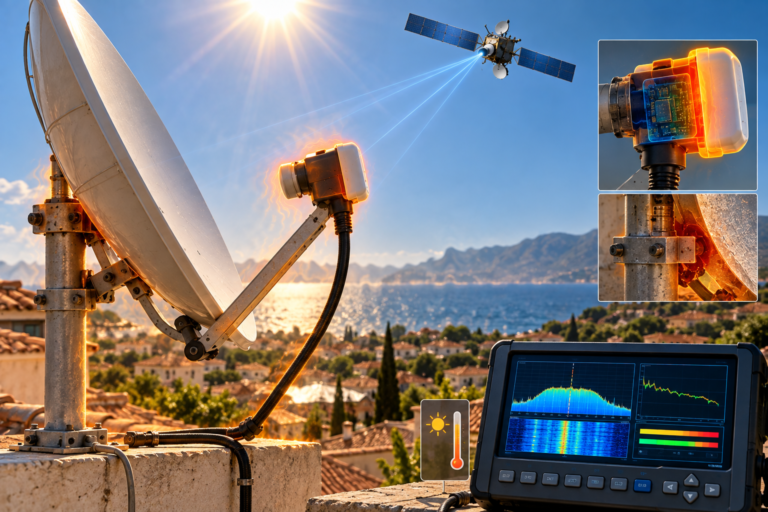
- LNB instability and thermal drift.
- Why HD channels show blocking first.
- Real technical solutions for stable Eutelsat 16E reception.
- What Digital Blocking Actually Means
- BER Errors and Corrupted Data
- Signal Quality vs Signal Strength
- Signal Margin and Threshold Failure
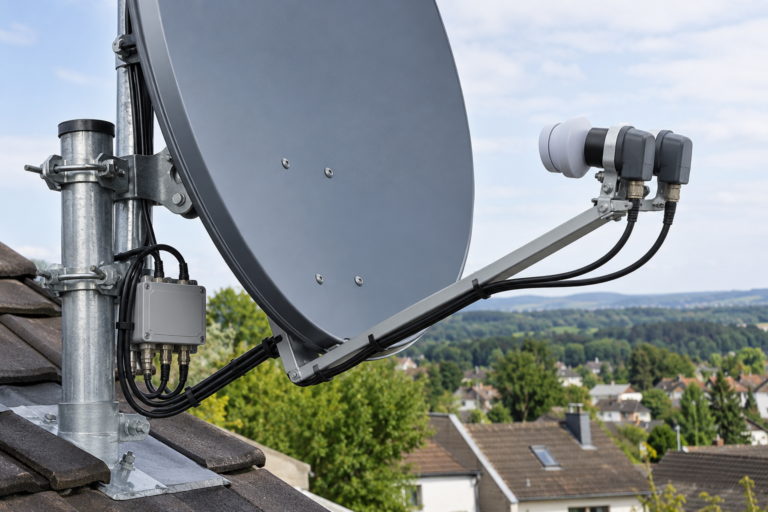
- Dish Alignment Problems
- LNB Instability and Frequency Drift
- Why HD Channels Show Blocks First
- Weather and Environmental Effects
- Receiver Decoding Behavior
- Technical Comparison Table
- Real Technical Fixes
- Reality Check
- Final Verdict
- FAQ
What Digital Blocking Actually Means
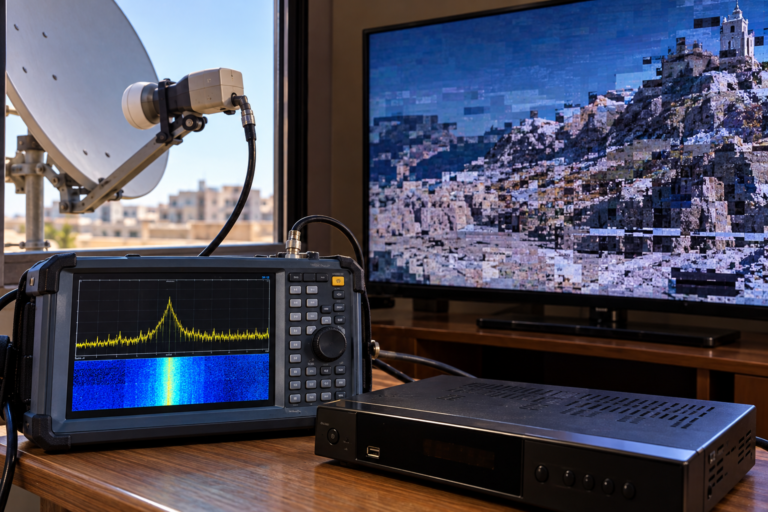
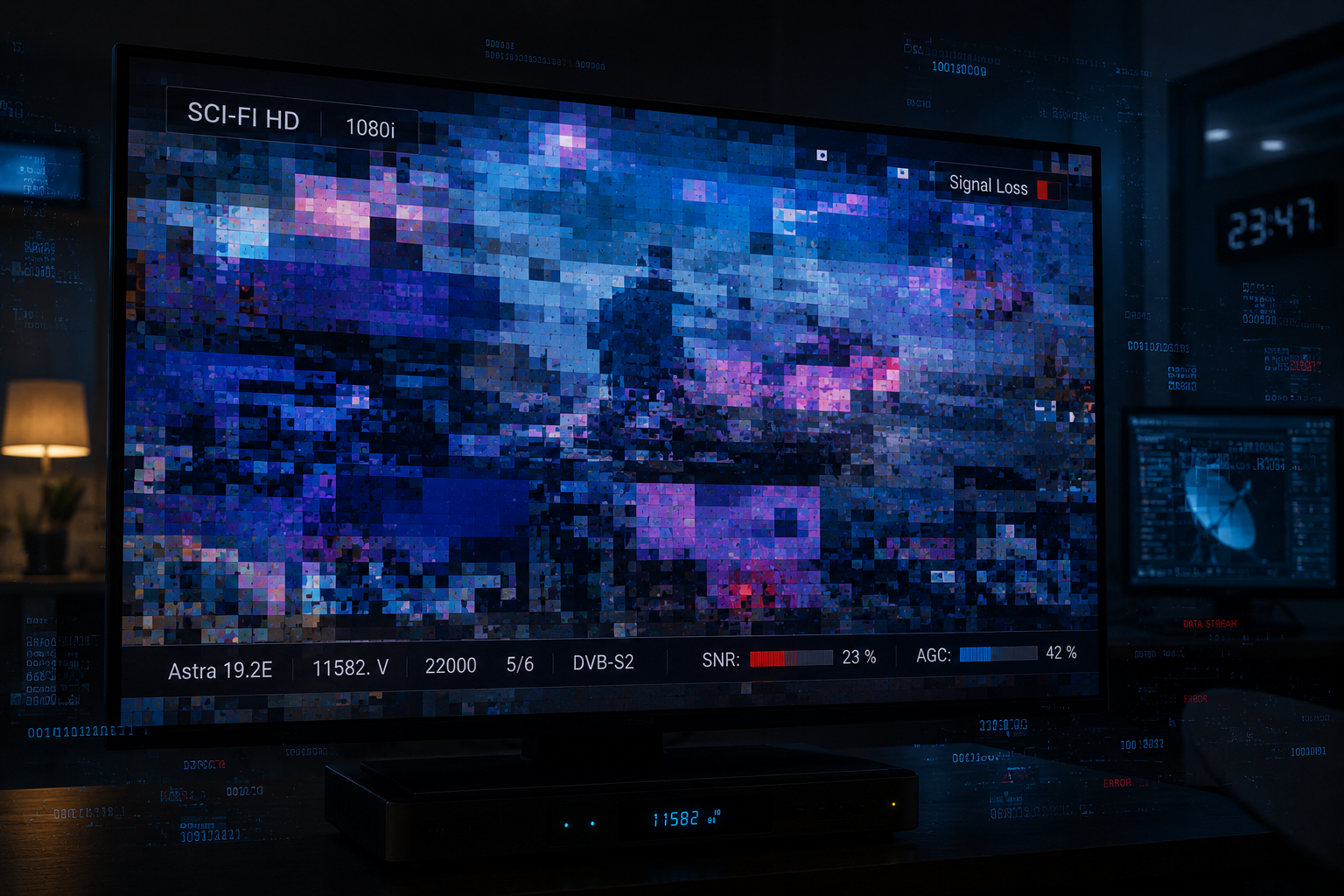
When a channel turns into digital blocks, the receiver is no longer receiving enough clean data to rebuild the image correctly.
Modern satellite television works by transmitting compressed digital video streams.
The receiver continuously reconstructs these streams using packets of incoming data.
When packets arrive damaged or corrupted, the receiver attempts to repair them using error correction systems.
As long as enough valid information remains available, the image stays stable.
Once packet corruption becomes too severe, the receiver begins losing visual information.
The missing data appears as pixel blocks, frozen image areas, or broken screen segments.
This is usually the first visible warning before complete signal collapse occurs.
BER Errors and Corrupted Data
BER stands for Bit Error Rate.
It measures how many digital bits arrive incorrectly during transmission.
Every satellite system experiences some level of transmission error.
Modern receivers constantly repair these errors automatically.
Problems begin when BER increases beyond correction capacity.
At that point, corrupted packets start reaching the video decoder.
The receiver can no longer reconstruct certain image areas accurately.
Large visual blocks appear because portions of the compressed image stream are missing.
This is why pixelation often appears suddenly.
The signal itself may still exist, but the data integrity has already collapsed.
Signal Quality vs Signal Strength
Many users become confused because blocking can appear even when signal strength still looks high.
This happens because signal strength and signal quality measure different things.
Signal strength measures RF energy reaching the tuner.
Signal quality measures how clean and decodable the signal actually remains.
A receiver may display 85 percent strength while quality becomes unstable.
BER can still increase rapidly under those conditions.
The result is channel blocking despite apparently healthy signal readings.
This is one reason why Eutelsat 16E troubleshooting should always focus on quality and stability rather than strength alone.
Signal Margin and Threshold Failure
Signal margin is the safety reserve above the minimum decoding threshold.
A strong installation contains enough reserve to survive environmental changes.
Weak systems operate dangerously close to failure.
Under clear conditions they appear stable.
Then a small increase in noise or attenuation removes the remaining reserve.
The receiver suddenly begins losing packets.
Blocking appears first.
If conditions worsen slightly more, the receiver loses synchronization completely.
This explains why channels often freeze into blocks before disappearing entirely.
Dish Alignment Problems
Weak dish alignment is one of the most common causes of pixelation on Eutelsat 16E.
Many installations are aligned well enough to lock channels but not well enough to maximize signal margin.
Small alignment errors reduce quality reserve significantly.
The system may survive under ideal weather conditions.
Then humidity, interference, or temperature changes expose the weakness.
BER rises rapidly and channels begin showing blocks.
Fine-tuning the dish often improves stability dramatically even when signal strength barely changes.
Quality reserve usually matters far more than raw signal level.
LNB Instability and Frequency Drift
The LNB converts satellite frequencies into lower frequencies that the receiver can process.
This process depends on highly stable oscillator performance.
Aging or low-quality LNB units may drift under heat stress.
Modern DVB-S2 transponders require extremely accurate synchronization.
Small frequency drift increases BER instability.
As decoding becomes less reliable, channel blocking begins appearing more frequently.
Many users replace receivers repeatedly while the actual problem comes from LNB instability.
Replacing an aging LNB often restores stability immediately on difficult Eutelsat 16E frequencies.
Why HD Channels Show Blocks First
HD channels usually react more aggressively to weak signal conditions.
Most HD transponders use DVB-S2 with higher-order modulation systems such as 8PSK.
These systems provide excellent efficiency but require cleaner signal quality.
As BER rises, HD decoding becomes unstable much faster than older SD channels.
This is why users often see HD channels turning into blocks while some SD services continue functioning.
The HD transponder is not necessarily weaker.
It simply operates with stricter decoding requirements.
Small quality losses create visible damage much sooner.
Weather and Environmental Effects
Weather plays a major role in channel blocking behavior.
Rain fade increases attenuation and removes signal margin.
Humidity changes can also weaken already marginal systems.
Temperature shifts affect LNB stability and cable performance.
Environmental stress does not automatically destroy strong installations.
The real problem appears when a weak system already operates near the decoding threshold.
Then even moderate weather changes become enough to trigger blocking and signal instability.
This is why some users experience pixelation during light rain while others remain unaffected.
Receiver Decoding Behavior
Receivers are active digital processing systems.
They continuously rebuild transport streams while correcting transmission errors.
Higher-quality tuners usually handle difficult conditions better.
Some receivers maintain synchronization longer during BER spikes.
Others begin displaying blocks immediately once correction pressure increases.
Firmware quality matters as well.
Different receivers may behave differently even on the same dish installation.
Still, the receiver often reveals deeper signal quality problems rather than creating them directly.
Technical Comparison Table
| Condition | Stable Channel | Channel Showing Blocks |
|---|---|---|
| Signal quality | Stable reserve margin | Near threshold |
| BER level | Low and controlled | Rapid error spikes |
| Receiver correction load | Normal operation | Overloaded correction system |
| HD transponder behavior | Stable decoding | Visible pixelation first |
| LNB stability | Accurate frequency lock | Possible drift problems |
| Weather resistance | Strong signal margin | Highly vulnerable |
Real Technical Fixes
The first step is maximizing signal quality instead of chasing higher strength percentages.
Fine dish alignment often reduces BER dramatically.
LNB skew optimization is also important because polarization errors increase transponder instability.
Replace aging LNB units if frequency drift is suspected.
Inspect coaxial cable condition carefully.
Water damage, weak shielding, and oxidized connectors often increase noise and packet corruption.
Check multiple transponders during testing because some frequencies expose weaknesses more clearly than others.
Receiver firmware updates may improve decoding stability on difficult DVB-S2 streams.
For deeper analysis of evening instability and signal quality behavior, read The Strange Reason Eutelsat 16E Signals Drop Every Evening.
When Eutelsat 16E channels suddenly turn into blocks, the receiver is usually warning that signal quality has already become unstable. Pixelation is rarely the root problem itself. It is often the visible symptom of deeper BER errors, weak signal margin, poor alignment, or environmental stress affecting the decoding process.
Channel blocking on Eutelsat 16E is usually caused by corrupted digital data rather than complete signal disappearance. BER instability, weak quality reserve, LNB drift, alignment errors, and weather-related attenuation all contribute to pixelation. Improving signal margin through precise alignment, stable hardware, and stronger overall reception quality remains the most effective long-term solution.
FAQ
| Question | Answer |
|---|---|
| Why do channels turn into blocks before disappearing? | Because the receiver starts losing packet integrity before complete decoding failure occurs. |
| What causes pixelation on Eutelsat 16E? | Usually BER spikes, weak signal quality, or decoding instability. |
| Can strong signal strength still produce blocks? | Yes. High strength does not guarantee stable signal quality. |
| Why do HD channels show blocking first? | HD transponders require cleaner signal quality and stricter synchronization. |
| Can an old LNB cause pixelation? | Yes. Frequency drift and instability often increase BER errors. |
| What is the best fix for channel blocking? | Improving signal quality margin through alignment, stable hardware, and proper system optimization. |