The Strange Reason Eutelsat 16E Signals Drop Every Evening
Estimated reading time: 17 minutes.
This article explains:
- Why Eutelsat 16E signals often drop every evening.
- The difference between signal strength and quality.
- How temperature affects LNB stability.
- Why evening humidity changes signal behavior.
- How weak dish alignment creates evening failures.
- Receiver decoding and BER instability.
- Why HD channels collapse first.
- Real troubleshooting methods that improve stability.
- Signal Quality vs Signal Strength
- Why Evening Hours Cause Problems
- Thermal Drift Inside the LNB
- Atmospheric Moisture and Humidity Effects
- Dish Alignment Margin Problems
- Receiver Decoding and BER Errors
- Why HD Channels Fail Earlier
- Electrical Noise and Evening Interference
- Technical Comparison Table
- Real Technical Fixes
- Reality Check
- Final Verdict
- FAQ
Signal Quality vs Signal Strength
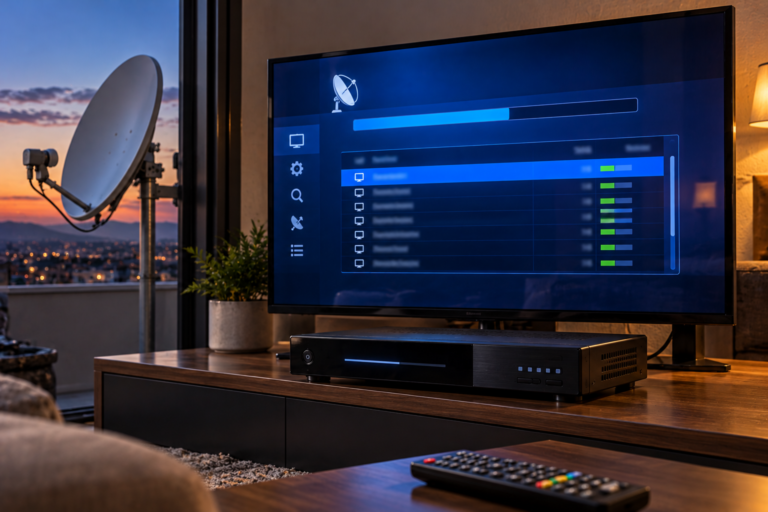
One of the biggest reasons users become confused during evening signal drops is the signal meter itself. Many receivers still display strong signal percentages even while channels freeze or disappear.
This happens because signal strength and signal quality are completely different measurements.
Signal strength simply measures RF energy reaching the tuner. Signal quality measures how clean and decodable the transport stream actually is.
A system may still receive strong RF energy while noise, timing instability, BER errors, or modulation distortion destroy decoding quality.
This is extremely common on Eutelsat 16E installations that operate close to minimum reception thresholds.
During the evening, even small environmental changes reduce quality enough to push the signal below the receiver’s decoding limit.
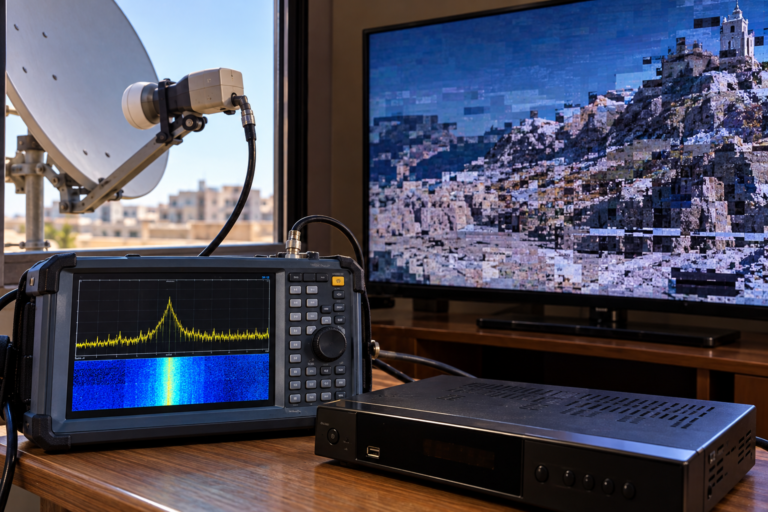
The result is freezing, pixelation, audio loss, or complete channel disappearance despite healthy-looking strength readings.
Why Evening Hours Cause Problems
Evening conditions are often the most difficult period for weak satellite systems.
During the day, the atmosphere may remain relatively stable. But in the evening, multiple environmental transitions begin happening at the same time.
Temperature gradients change rapidly. Humidity levels rise in many regions. Rooftop surfaces release stored heat. Electrical activity inside buildings increases dramatically.
All these changes create additional stress on already weak reception systems.
Satellite reception does not suddenly collapse because the satellite itself becomes weak every evening. Instead, the local installation loses enough quality margin that decoding becomes unstable.
A properly aligned system with strong reserve margin usually survives these environmental changes without visible problems.
Borderline systems fail because they no longer have enough correction headroom.
Thermal Drift Inside the LNB
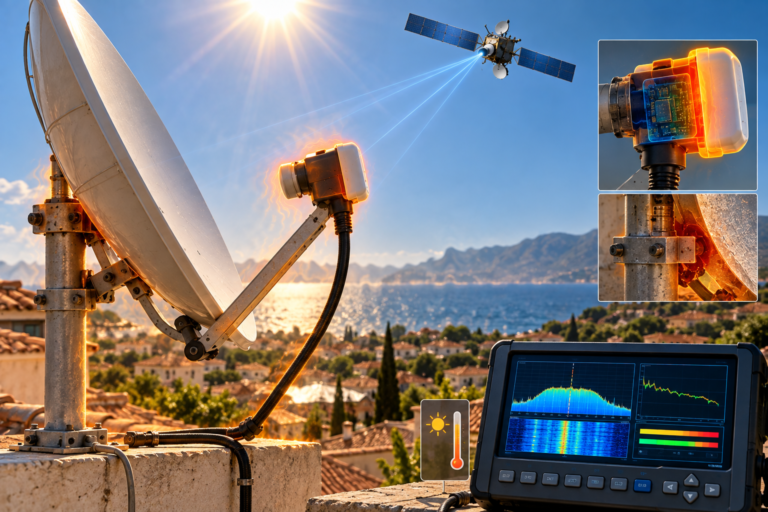
The LNB is one of the most temperature-sensitive parts of any satellite system.
As evening heat accumulates on rooftops and metal surfaces, the internal oscillator inside the LNB may become unstable.
This creates small frequency drift errors.
Modern DVB-S2 transponders, especially HD channels using 8PSK modulation, require extremely accurate frequency synchronization.
Even small drift can reduce lock stability and increase BER errors.
Low-quality or aging LNBs often become much worse during warm evening conditions.
This is why some Eutelsat 16E channels disappear only during certain hours.
After midnight, temperatures drop. The LNB cools down. Oscillator stability improves. The receiver suddenly regains lock again.
Many users incorrectly assume the broadcaster changed transmission power overnight, when the real problem actually exists inside the local receiving equipment.
Atmospheric Moisture and Humidity Effects
Humidity changes are another major cause of evening instability.
As temperatures fall after sunset, moisture behavior in the atmosphere changes. In some areas, humidity layers become denser during the evening.
Satellite frequencies used by Eutelsat 16E can become slightly more vulnerable under these conditions.
A strong installation usually ignores these small atmospheric losses. Weak installations cannot.
This explains why some users only experience problems during certain weather patterns.
Humidity itself may not destroy the signal directly. Instead, it removes the last remaining stability margin from an already weak system.
Rain fade works similarly but more aggressively.
Even small atmospheric attenuation becomes dangerous when dish alignment, LNB condition, or cable quality are already poor.
Dish Alignment Margin Problems
Many dishes are technically aligned but not optimized.
There is a major difference between achieving signal lock and maximizing signal margin.
Installers often stop adjusting once channels appear stable. But tiny alignment errors may still remain.
These small errors become highly visible during difficult evening conditions.
A dish slightly off-axis may lose critical quality reserve even though channels still appear normal during the day.
Then every evening, environmental stress pushes the signal below decoding stability.
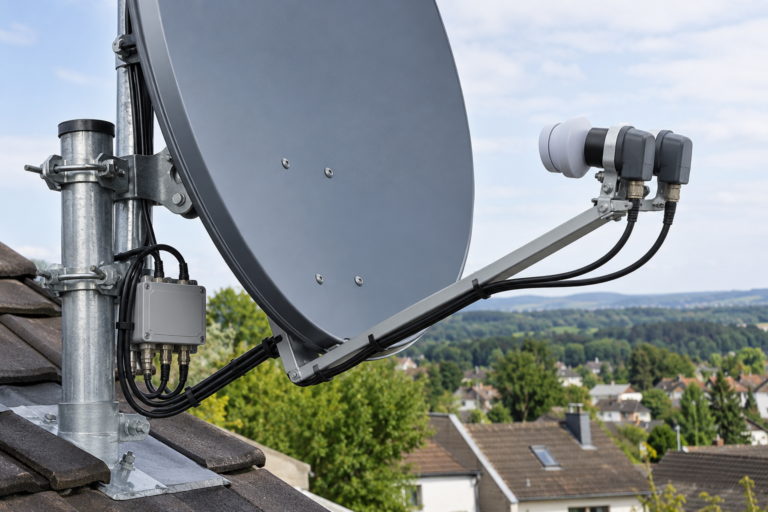
Fine-tuning dish elevation, azimuth, and especially LNB skew angle often creates huge improvements.
Signal quality should always be prioritized over raw signal strength during alignment.
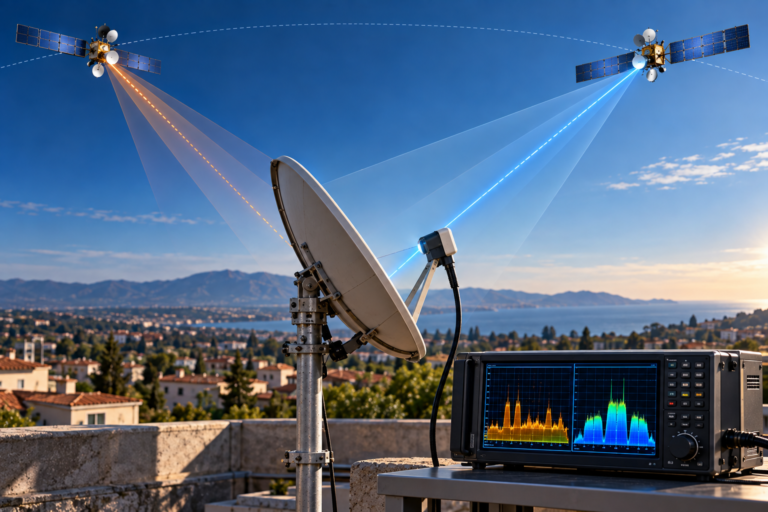
Professional alignment tools usually reveal how narrow the true quality peak actually is.
Receiver Decoding and BER Errors
Receivers do much more than simply display signal.
They actively reconstruct compressed digital transport streams while correcting transmission errors in real time.
When signal quality falls, BER increases rapidly.
Once the receiver can no longer correct enough packet errors, decoding collapses.
Different receivers behave differently under weak conditions.
Cheap tuners often fail earlier because they contain weaker demodulators and less stable correction algorithms.
Some receivers recover quickly after temporary packet loss. Others freeze completely for several seconds.
Firmware quality matters too.
A newer receiver may appear more stable on the same dish because it handles difficult DVB-S2 streams more efficiently.
Still, the receiver is often only exposing deeper signal quality problems already present in the installation.
Why HD Channels Fail Earlier
Many users notice that HD channels disappear first during evening instability.
This is completely normal.
HD transponders usually use denser modulation systems and higher compression efficiency.
These systems require cleaner signal quality and lower BER levels.
SD channels may continue functioning because they tolerate slightly weaker reception conditions.
HD streams operate much closer to the edge.
Once evening conditions reduce quality slightly, HD decoding collapses first.
This does not necessarily mean the HD transponder itself is weak.
It usually means the receiving system lacks enough reserve margin to support higher-quality modulation under changing conditions.
Electrical Noise and Evening Interference
Evening hours also increase electrical activity inside residential areas.
More LED lighting systems become active. More routers, switching power supplies, televisions, and networking equipment operate simultaneously.
Poorly shielded coaxial systems may become vulnerable to local interference.
Cheap splitters and damaged connectors increase this risk further.
Urban environments are especially sensitive because many RF sources operate close together.
Although satellite systems normally resist local interference well, weak installations can become unstable when the noise floor rises slightly.
This is another reason why Eutelsat 16E signals may collapse every evening yet recover later at night when local electrical activity decreases.
Technical Comparison Table
| Condition | Daytime Behavior | Evening Behavior |
|---|---|---|
| LNB stability | More stable frequency lock | Possible thermal drift |
| Atmospheric conditions | More stable air layers | Higher humidity changes |
| Signal quality margin | Usually acceptable | Closer to decoding failure |
| Electrical interference | Lower residential activity | Higher urban RF noise |
| HD transponder stability | Mostly stable | Fails earlier |
| Weak dish alignment impact | Less visible | Much more visible |
Real Technical Fixes
The most effective fix is usually improving overall signal margin.
Start with proper dish realignment using signal quality measurements instead of strength readings alone.
Tiny alignment improvements often create major stability gains.
Check LNB skew carefully because incorrect polarization alignment reduces quality significantly on some Eutelsat 16E transponders.
Replace old or low-quality coaxial cable if heat exposure or moisture damage exists.
Connector oxidation should also be inspected carefully.
Upgrading the LNB often solves evening instability immediately, especially when the old unit suffers thermal drift.
Receiver firmware updates may improve decoding behavior too.
Avoid unnecessary splitters and poor-quality switches while troubleshooting.
In difficult environments, better cable shielding and grounding may help reduce local interference.
For more satellite troubleshooting and signal analysis, visit Satellite TV News.
Evening signal drops on Eutelsat 16E are usually not caused by the satellite becoming weaker at night. In most cases, the installation itself lacks enough signal quality reserve. Temperature changes, humidity, interference, and thermal drift simply expose weaknesses that already existed inside the system.
The strange evening signal drop behavior on Eutelsat 16E is typically the result of weak quality margin combined with environmental stress. Systems operating near the decoding threshold become unstable once evening heat, humidity, interference, or LNB drift appear. Proper alignment, stable LNB performance, high-quality cabling, and stronger signal reserve are the real solutions. Waiting for the signal to recover later at night only hides the deeper problem temporarily.
FAQ
| Question | Answer |
|---|---|
| Why do Eutelsat 16E signals drop every evening? | Usually because environmental changes expose weak signal margin inside the installation. |
| Can temperature affect the LNB? | Yes. Heat can cause oscillator drift and lower decoding stability. |
| Why do HD channels fail first? | HD transponders require cleaner signal quality and lower BER levels. |
| Does humidity affect satellite reception? | Yes. Humidity can slightly weaken marginal signals during evening conditions. |
| Can a better receiver fix the issue? | Sometimes partially, but alignment and LNB quality are usually more important. |
| What is the best long-term fix? | Improving overall signal quality margin through alignment, LNB replacement, and cable optimization. |