Why Eutelsat 16E Channels Freeze Even With Strong Signal
Estimated reading time: 18 minutes.
- Why strong signal does not guarantee stable channels.
- Signal strength versus signal quality.
- BER and digital decoding errors.
- DVB-S2 synchronization requirements.
- LNB stability and frequency drift.
- Signal margin limitations.
- Receiver lock behavior.
- How to eliminate freezing channels.
- Strong Signal Does Not Mean Clean Signal
- Signal Quality Is The Real Priority
- BER Is Often The Hidden Cause
- Why DVB-S2 Channels Freeze More Easily
- Signal Margin Explains Intermittent Freezing
- How LNB Problems Create Freezing Channels
- Receiver Synchronization And Buffer Recovery
- Environmental Conditions And Freezing
- Technical Comparison Table
- How To Stop Eutelsat 16E Channel Freezing
- Reality Check
- Final Verdict
- FAQ
Strong Signal Does Not Mean Clean Signal
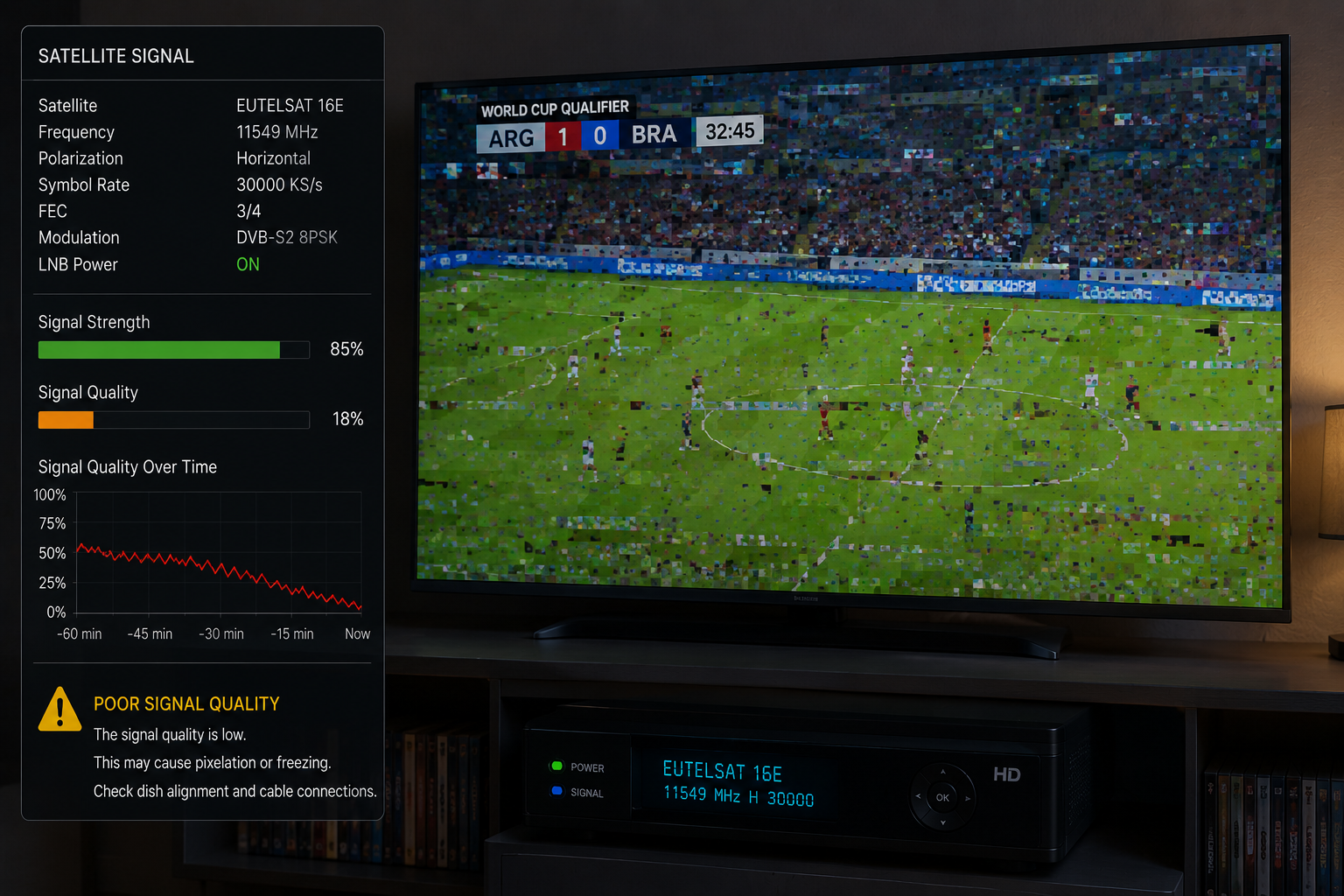
Many satellite users focus on the signal strength indicator because it is usually the first number displayed by the receiver.
However, signal strength simply measures how much RF energy reaches the tuner.
It does not measure whether the signal is accurate, stable, or easy to decode.
A receiver can show eighty or ninety percent signal strength while still receiving a noisy or unstable digital stream.
This explains why freezing can occur despite apparently excellent signal levels.
The receiver sees plenty of signal power.
The digital information inside that signal is the real problem.
Signal Quality Is The Real Priority
Signal quality reflects how accurately the receiver can reconstruct the incoming digital transmission.
Unlike strength, quality directly affects channel stability.
Small reductions in quality often create visible freezing before any noticeable change appears in strength readings.
This is why professional installers prioritize quality measurements during dish alignment.
A system with moderate strength and excellent quality usually performs better than a system with high strength and poor quality.
When channels freeze, quality should always be investigated before strength.
BER Is Often The Hidden Cause
BER stands for Bit Error Rate.
It measures how many digital errors are reaching the receiver.
Modern receivers automatically repair small numbers of errors using forward error correction systems.
As BER rises, those correction systems become overloaded.
The receiver starts losing information.
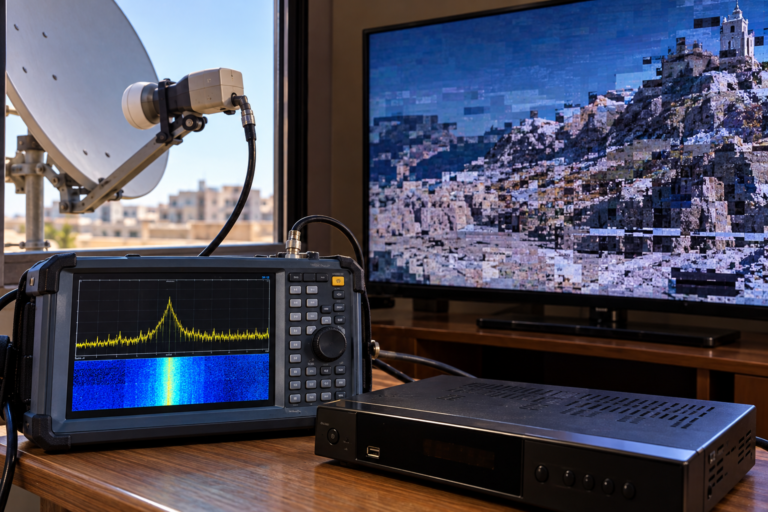
Video frames become incomplete.
Audio interruptions appear.
Eventually the picture freezes while the receiver attempts to rebuild the stream.
Most freezing problems can be traced back to excessive BER rather than weak signal strength.
Why DVB-S2 Channels Freeze More Easily
Many Eutelsat 16E HD channels use DVB-S2 transmission technology.
DVB-S2 provides better efficiency than older DVB-S systems.
The tradeoff is greater sensitivity.
DVB-S2 channels require cleaner synchronization and lower BER.
A small quality loss that has little effect on older channels may create noticeable freezing on HD services.
This often causes viewers to believe specific channels are faulty.
In reality, those channels simply reveal weaknesses already present in the reception system.
Signal Margin Explains Intermittent Freezing
Signal margin is the reserve between current reception quality and the minimum decoding threshold.
A healthy installation maintains sufficient reserve.
A marginal installation operates too close to the edge.
When small fluctuations occur, the receiver temporarily falls below the required decoding level.
Channels freeze.
Quality recovers.
Channels return.
This cycle often repeats throughout the day.
The problem is not the signal itself but the lack of reserve available to absorb normal variations.
How LNB Problems Create Freezing Channels
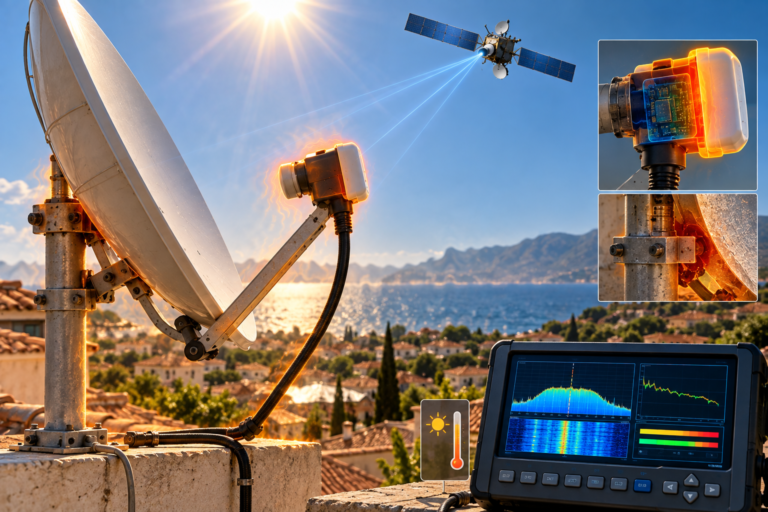
The LNB converts satellite frequencies into a range that the receiver can process.
As the LNB ages, oscillator stability may decline.
Frequency drift becomes more common.
Noise levels may increase.
These changes often affect quality much more than strength.
The receiver continues detecting a strong signal while struggling to maintain stable synchronization.
Freezing becomes one of the earliest warning signs of LNB deterioration.
Receiver Synchronization And Buffer Recovery
Receivers continuously synchronize themselves with incoming data streams.
When synchronization is stable, playback remains smooth.
When errors increase, the receiver must repeatedly rebuild portions of the transport stream.
This recovery process often appears as short freezes.
The signal never completely disappears.
The receiver simply struggles to maintain continuous decoding.
Once synchronization recovers, playback resumes normally.
Environmental Conditions And Freezing
Rain, humidity, temperature changes, and atmospheric attenuation all influence signal quality.
Even small environmental effects can become visible when signal margin is limited.
A system operating near its threshold may freeze during weather conditions that stronger installations handle easily.
This is why freezing often appears only at certain times or during specific weather patterns.
The environmental change is simply exposing an existing weakness.
Technical Comparison Table
| Factor | Stable Reception | Freezing Channels |
|---|---|---|
| Signal quality | High and stable | Fluctuating |
| BER | Low | Elevated |
| Signal margin | Comfortable reserve | Near threshold |
| LNB stability | Consistent | Possible drift |
| DVB-S2 decoding | Reliable | Frequently interrupted |
| Viewer experience | Smooth playback | Freezes and pixelation |
How To Stop Eutelsat 16E Channel Freezing
Begin by monitoring signal quality rather than strength.
Fine-tune dish alignment using quality readings.
Inspect connectors and cables for corrosion or moisture.
Evaluate LNB stability if problems appear worse during temperature changes.
Check BER readings whenever possible.
Improving signal margin by only a few percentage points often eliminates freezing completely.
The goal is not simply to increase signal strength.
The goal is to create cleaner, more reliable decoding conditions.
For additional insight into temporary channel behavior on the satellite, read Why Eutelsat 16E Sports Feeds Suddenly Disappear.
Most channel freezing problems occur even when signal strength looks healthy. The real causes are usually poor signal quality, increased BER, weak signal margin, synchronization instability, or LNB performance issues. Strength readings alone rarely tell the full story.
Eutelsat 16E channels freeze with strong signal because digital television depends far more on signal quality than signal power. BER spikes, weak signal margin, DVB-S2 sensitivity, and synchronization problems can all interrupt decoding while strength remains high. Improving signal quality and reducing error rates is the most effective way to achieve stable reception.
FAQ
| Question | Answer |
|---|---|
| Can channels freeze with high signal strength? | Yes. High strength does not guarantee good signal quality. |
| What causes freezing most often? | BER spikes, poor signal quality, and low signal margin. |
| Why do HD channels freeze first? | DVB-S2 HD channels require cleaner decoding conditions. |
| Can an LNB create freezing problems? | Yes. Frequency drift and increased noise can affect synchronization. |
| Does weather affect freezing? | Yes. Weather can reduce signal margin and increase decoding errors. |
| What should I monitor during troubleshooting? | Signal quality and BER are usually more useful than strength alone. |