How to Align Dish for Astra 19.2 and 28.2
Estimated reading time: 18 minutes.
Aligning a satellite dish for Astra 19.2E and Astra 28.2E is not just about pointing the dish roughly in the right direction. It is a precise process where small angle adjustments can completely change signal quality. Many users struggle because they focus only on signal strength instead of proper alignment logic.
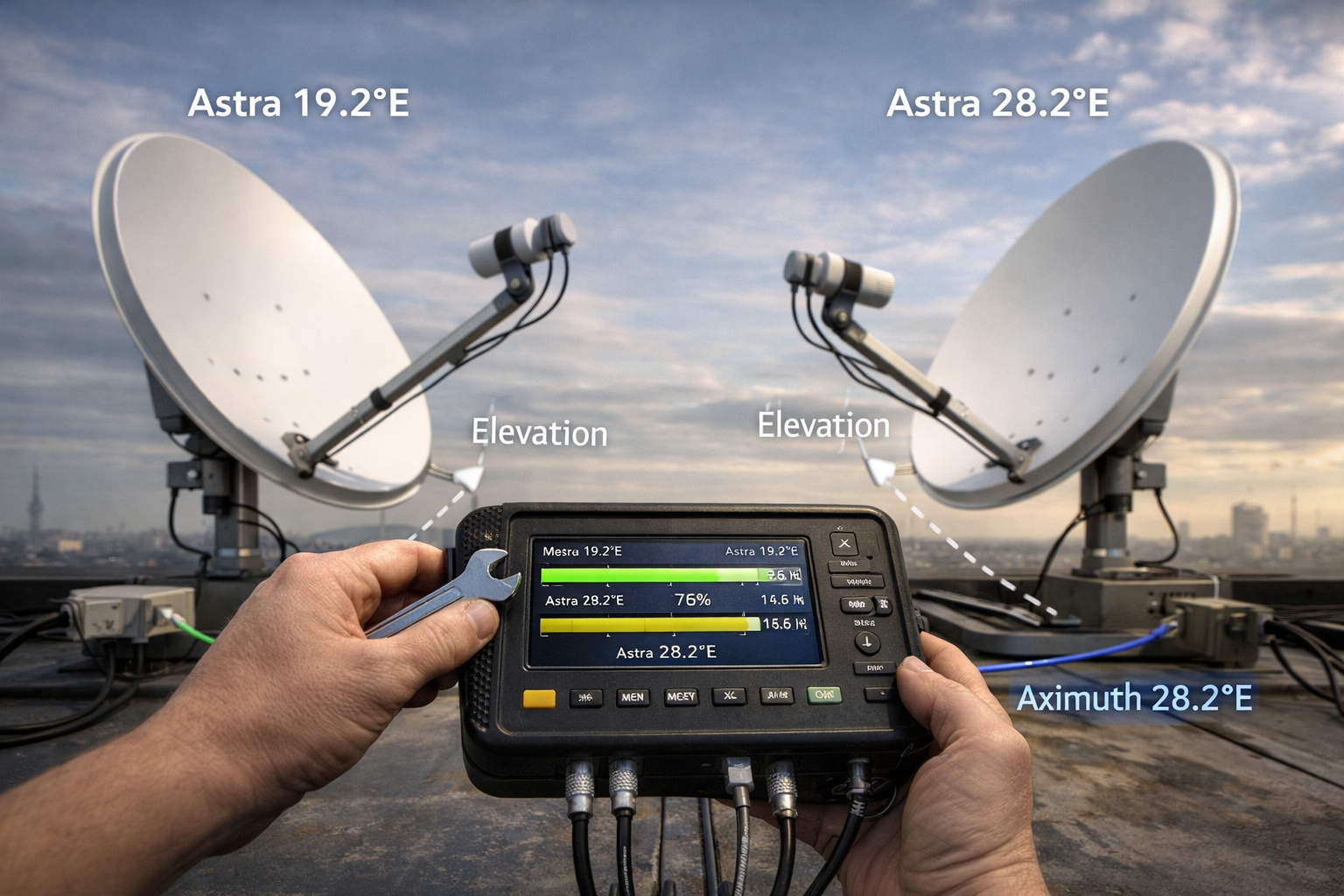
When working with two satellites, the challenge becomes even greater. You are not aligning for a single position but trying to balance between two orbital points. This requires understanding azimuth, elevation, LNB positioning, and how signal quality behaves during adjustment.
Proper dish alignment requires correct azimuth, elevation, and LNB skew. Astra 19.2E is easier to align, while Astra 28.2E requires more precise adjustment especially outside the UK.
Understanding alignment fundamentals
Satellite alignment depends on three main angles. Azimuth controls horizontal direction. Elevation controls vertical angle. LNB skew adjusts polarization.
All three must be correct for stable signal reception. Focusing on only one parameter will not give optimal results.
Signal quality should always be the main reference, not signal strength.
Tools needed for alignment
To align a dish correctly, you need a signal meter or a receiver with signal quality display.
Basic tools include a compass for azimuth, a wrench for adjustments, and access to signal readings on your receiver.
Professional meters provide faster and more accurate alignment, but basic tools can still achieve good results.
Aligning dish for Astra 19.2E first
Start with Astra 19.2E because it has a wider beam and is easier to receive.
Point the dish roughly toward the satellite using azimuth and elevation values for your location.
Slowly adjust the dish left and right while monitoring signal quality. Then adjust elevation for maximum quality.
Lock the dish in position once you achieve stable signal.
Adding Astra 28.2E with second LNB
After aligning Astra 19.2E, install a second LNB for Astra 28.2E.
Position the second LNB slightly offset depending on dish orientation. This offset corresponds to the orbital difference between the satellites.
Adjust the LNB position horizontally and vertically until signal quality improves.
This process requires patience because Astra 28.2E signals are more sensitive.
Adjusting azimuth and elevation
Fine tuning azimuth and elevation is critical when receiving both satellites.
Make very small adjustments and observe signal quality changes. Even a small movement can significantly affect reception.
The goal is to find the best compromise where both satellites have acceptable signal quality.
LNB position and skew adjustment
LNB position affects how the signal is captured from the dish focal point.
Adjusting skew improves polarization alignment. This helps separate horizontal and vertical signals.
Incorrect skew reduces signal quality and affects specific transponders.
Using signal quality for tuning
Signal quality is the most important metric during alignment.
Strength only shows that signal is present, but quality shows whether it can be decoded.
Always adjust the dish based on quality readings, not strength.
Common alignment mistakes
One common mistake is adjusting the dish too quickly. This makes it difficult to detect the correct position.
Another mistake is focusing only on Astra 19.2E and ignoring Astra 28.2E sensitivity.
Incorrect LNB skew and loose mounting also cause poor results.
Analytical alignment steps table
| Step | Action | Goal | Result |
|---|---|---|---|
| 1 | Align Astra 19.2E | Stable base signal | Strong reception |
| 2 | Add second LNB | Receive Astra 28.2E | Dual satellite setup |
| 3 | Fine tune azimuth | Improve signal quality | Better alignment |
| 4 | Adjust elevation | Maximize signal | Stable reception |
| 5 | Set LNB skew | Optimize polarization | Clean signal |
FAQ
| Question | Answer |
|---|---|
| Which satellite should I align first | Start with Astra 19.2E because it is easier to receive. |
| Why is Astra 28.2E harder to align | Because it uses focused beams and is more sensitive. |
| Should I use signal strength or quality | Always use signal quality. |
| Can I align both satellites perfectly | You need a compromise between both positions. |
| Do I need a special LNB | Dual LNB or monoblock is recommended. |
Dish alignment is a precise process. Small adjustments have a big impact, especially when working with multiple satellites.
Aligning a dish for Astra 19.2E and 28.2E requires careful adjustment and understanding of signal behavior. Start with Astra 19.2E, then add Astra 28.2E, and fine tune for the best balance between both satellites.