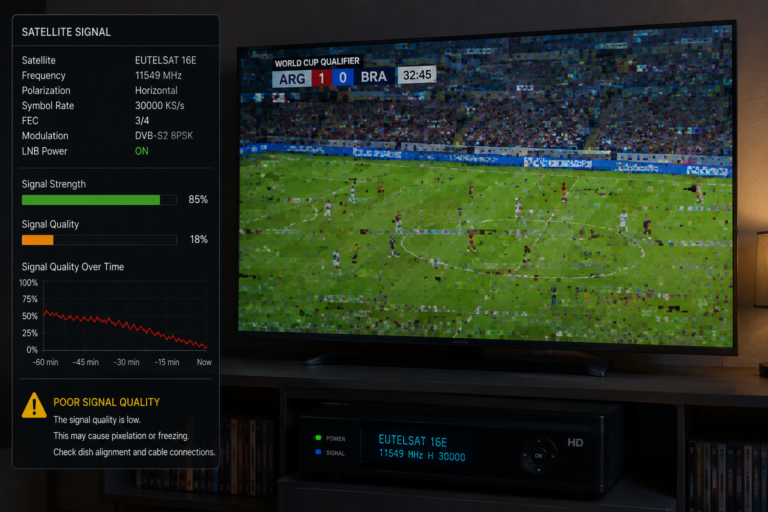
How to Receive German TV on Astra 19.2
Estimated reading time: 15 minutes.
Receiving German television through the Astra satellite at 19.2 degrees east has become a standard setup for millions of households across Europe. From Germany to Austria Switzerland and many neighboring countries viewers rely on this satellite position to access national broadcasters entertainment channels and public television networks.
Although satellite reception might appear technical at first the basic process is actually simple. With the correct dish alignment receiver configuration and signal scanning most households can receive dozens of German television channels without needing cable infrastructure or terrestrial broadcast networks.
Quick Context
This guide explains how viewers receive German television channels from Astra 19.2 satellite including dish positioning receiver scanning and signal stability considerations for home installations.
- Why Astra 19.2 is used for German television
- Equipment needed for satellite reception
- Satellite dish positioning
- Understanding the LNB component
- Satellite receiver configuration
- Channel scanning process
- Signal coverage across Europe
- Typical home satellite setup
- Reality Check
- Final Verdict
- Frequently Asked Questions
Why Astra 19.2 is used for German television
The Astra satellite group located at 19.2 degrees east is the primary broadcast platform for German television. This orbital position provides wide coverage across Europe allowing millions of viewers to receive German programming with a single satellite dish.
Both public broadcasters and commercial television networks distribute their signals through Astra because it offers reliable signal quality and large geographic reach. As a result Astra 19.2 has become one of the most important satellite positions for German language media.
For viewers this means that aligning a dish to this orbital position often unlocks access to dozens of free to air television channels.
Equipment needed for satellite reception
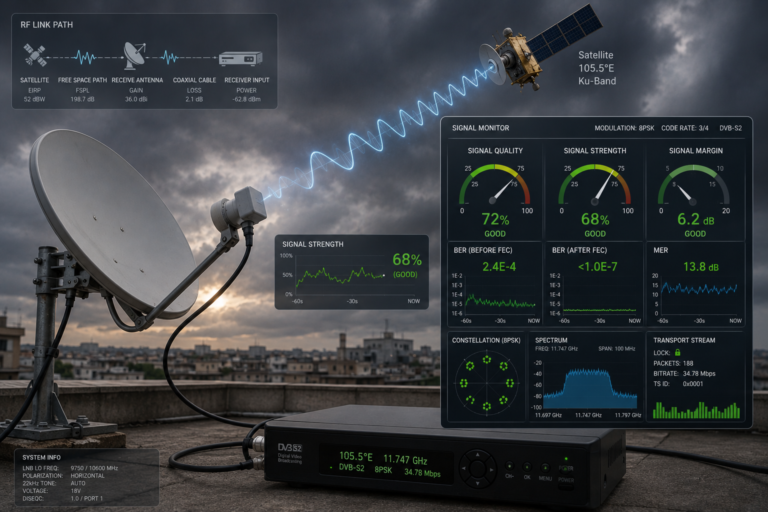
Receiving satellite television requires a few essential components. The first and most visible element is the satellite dish itself which captures signals transmitted from orbiting satellites.
Attached to the front of the dish is the LNB also known as the low noise block converter. This device collects the reflected satellite signal and converts it into a frequency that can travel through a coaxial cable.
Inside the home a satellite receiver processes the incoming signal and converts it into video that can be displayed on a television screen.
When these components work together properly viewers can receive a wide range of channels without relying on terrestrial broadcasting infrastructure.
Satellite dish positioning
Correct dish alignment is one of the most important steps in receiving satellite signals. The dish must be pointed precisely toward the Astra satellite position in the sky.
Even small alignment errors can reduce signal quality or prevent the receiver from detecting certain transponders during scanning.
Installers typically adjust two angles when positioning the dish. The first is the horizontal direction also known as azimuth. The second is the vertical angle called elevation.
When both angles are adjusted correctly the dish focuses the satellite signal directly toward the LNB mounted at the front of the reflector.
Understanding the LNB component
The LNB plays a critical role in satellite reception. Its main function is to collect the signal reflected by the dish and convert it into a frequency that can travel through the cable to the receiver.
Satellite signals are transmitted at extremely high frequencies that cannot travel efficiently through standard coaxial cables. The LNB converts these signals into a lower frequency range suitable for home electronics.
The device also helps reduce signal noise ensuring that the receiver receives a clear digital transmission.
Satellite receiver configuration
Once the dish and LNB are correctly installed the receiver becomes responsible for decoding the incoming signal. The receiver stores a list of satellite frequencies used by broadcasters.
When the user begins a channel scan the receiver searches through each frequency and attempts to detect active transponders. Each detected transponder contains multiple television channels grouped together inside a digital stream.
The receiver extracts the channel information and builds a viewing list that can be accessed through the remote control.
Modern receivers complete this process automatically and typically require only a few minutes to finish scanning the satellite.
Channel scanning process
During a scan the receiver checks each frequency assigned to the Astra satellite. If a valid signal is detected the receiver downloads the service information table transmitted by the satellite.
This table contains the channel names technical identifiers and additional broadcast parameters required for playback.
After the scan completes the receiver stores the channel list and viewers can begin browsing through available programming.
Occasionally broadcasters change frequencies or add new channels. Running a fresh scan allows the receiver to update its internal list.
Signal coverage across Europe
Astra satellites provide wide coverage across most of Europe. This allows viewers outside Germany to receive German television channels as long as their satellite dish is correctly aligned.
Countries such as Austria Switzerland Belgium the Netherlands and parts of Eastern Europe commonly receive Astra signals without difficulty.
In areas farther from the satellite coverage center slightly larger dishes may be required to maintain strong signal levels.
Typical home satellite setup
| Component | Purpose | Function |
|---|---|---|
| Satellite dish | Signal collection | Reflects satellite signal toward the LNB |
| LNB unit | Signal conversion | Converts high frequency signal to cable frequency |
| Coaxial cable | Signal transmission | Transfers signal from dish to receiver |
| Satellite receiver | Signal decoding | Processes channels and displays them on TV |
Reality Check
Most households receiving German television through Astra rely on simple dish installations combined with automatic receiver scanning. Reception issues are usually related to alignment errors rather than satellite transmission problems.
Final Verdict
Final Verdict
Receiving German television channels through Astra 19.2 satellite remains one of the most reliable viewing methods across Europe. With correct dish alignment stable equipment and updated receiver scanning viewers can access a large selection of German programming through a single satellite position.
Frequently Asked Questions
| Question | Answer |
|---|---|
| What satellite is used for German television | Astra located at 19.2 degrees east is the primary satellite used to broadcast German television channels. |
| Do I need cable TV to watch German channels | No satellite reception allows viewers to receive channels directly from the Astra satellite without cable networks. |
| Why are some channels missing after scanning | Missing channels usually occur when the receiver frequency list is outdated or the dish alignment is slightly incorrect. |
| Can Astra signals be received outside Germany | Yes Astra satellites cover most of Europe allowing many countries to receive German television channels. |