Why DirecTV New Sports Package Changes Live TV Delivery
Estimated reading time: 17 minutes.
The introduction of a cheaper sports-only package by DirecTV is not just a pricing decision. It reflects a deeper change in how live television is structured and delivered. Instead of sending large channel bundles, providers are now focusing on targeted content delivery that matches how people actually watch TV today.
This shift becomes more important when comparing satellite broadcast systems with streaming platforms like YouTube TV. Both are moving toward similar package models, but the underlying delivery technology remains completely different. This difference is what truly changes how live TV behaves.
DirecTV new sports package reduces channel load and focuses bandwidth on sports content, while streaming platforms use adaptive delivery based on user demand and network conditions.
Shift in live TV delivery model
Traditional TV delivery relied on large channel bundles transmitted continuously. This model ensured full coverage but wasted bandwidth on channels that many users never watched.
The new sports package changes this approach. By focusing only on sports channels, the system reduces unnecessary load and allows better allocation of transmission resources.
This is not only about cost reduction. It is about improving efficiency in how signals are distributed and consumed.
How signal delivery actually works
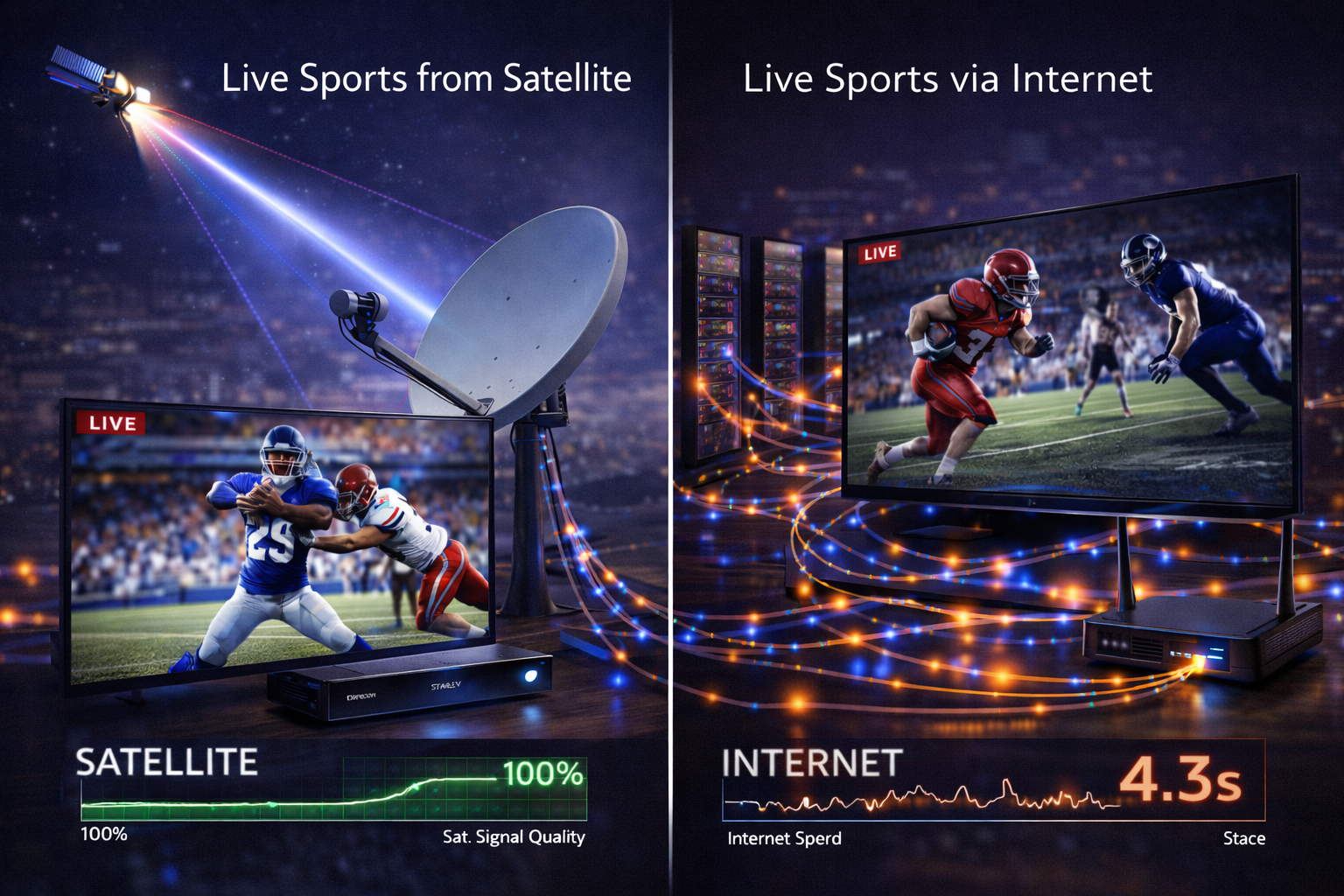
In satellite systems like DirecTV, the signal is broadcast from a ground station to a satellite and then distributed to all users simultaneously.
This creates a fixed signal path where every viewer receives the same transmission at the same time.
Streaming platforms work differently. Each user receives an individual stream from servers through the internet, which means delivery depends on network conditions.
Bandwidth allocation differences
Satellite systems allocate bandwidth per transponder. Each transponder carries a group of channels with fixed capacity.
By reducing channel count in a sports package, more bandwidth can be focused on fewer channels, improving quality consistency.
Streaming platforms allocate bandwidth dynamically. Video quality changes depending on available internet speed.
Impact on latency and live events
Latency is one of the most important factors in live sports.
Satellite broadcasting provides stable latency because the signal path is direct and consistent.
Streaming introduces additional delay due to encoding, buffering, and network routing.
Even with optimized systems, streaming latency is usually higher than satellite broadcast.
Broadcast vs streaming behavior
Broadcast systems send one signal to all users. This makes them highly efficient and stable under load.
Streaming systems send individual streams to each user. This allows flexibility but increases system complexity.
The new sports package highlights this difference because it focuses on high-demand live content.
System behavior under high demand
Satellite systems handle high demand easily because the signal is transmitted once regardless of audience size.
Streaming platforms must scale server capacity for each additional user. During major sports events, this can create network congestion.
Modern content delivery networks reduce this issue, but it still depends on infrastructure quality.
Technical impact on user experience
For users, the change is noticeable in how content is delivered and how stable it feels.
Satellite systems provide consistent quality and predictable performance.
Streaming systems provide flexibility and device compatibility but introduce variability in performance.
The new package structure emphasizes these differences rather than removing them.
Technical comparison table
| Factor | DirecTV Satellite | YouTube TV Streaming |
|---|---|---|
| Delivery type | Broadcast signal | Internet streaming |
| Latency | Stable | Variable |
| Bandwidth usage | Fixed per transponder | Dynamic per user |
| Load handling | Efficient | Server dependent |
| Signal stability | Consistent | Network dependent |
The new sports package does not change the core technology. It changes how efficiently that technology is used.
DirecTV sports package reflects a shift toward targeted content delivery. While satellite remains stable and efficient, streaming platforms offer flexibility with more complex performance behavior. The difference between them is not just content, but how the signal is engineered and delivered.
FAQ
| Question | Answer |
|---|---|
| Does this package change signal technology | No it changes content structure not core technology |
| Why is satellite more stable | Because it uses broadcast transmission instead of individual streams |
| Is streaming less reliable | It depends on network quality and server performance |
| Does fewer channels improve quality | Yes it allows better bandwidth allocation |
| Which is better for sports | Satellite offers stability while streaming offers flexibility |