How CDN Networks Affect Live Sports Streaming Performance
Estimated reading time: 19 minutes.
When you watch live sports online, you are not just receiving a video stream from one server. Behind the scenes, a complex system called a Content Delivery Network is responsible for delivering that stream to millions of users at the same time. This system is one of the most important factors that determines whether your stream is smooth or constantly buffering.
CDN networks are designed to solve the biggest challenges in streaming. Distance, traffic load, and latency. However, even with advanced CDN infrastructure, performance can still vary depending on how the system is configured and how network conditions behave during live events.
CDNs improve streaming by distributing content across multiple servers close to users, reducing latency and handling traffic spikes efficiently. :contentReference[oaicite:0]{index=0}
What CDN actually does in streaming
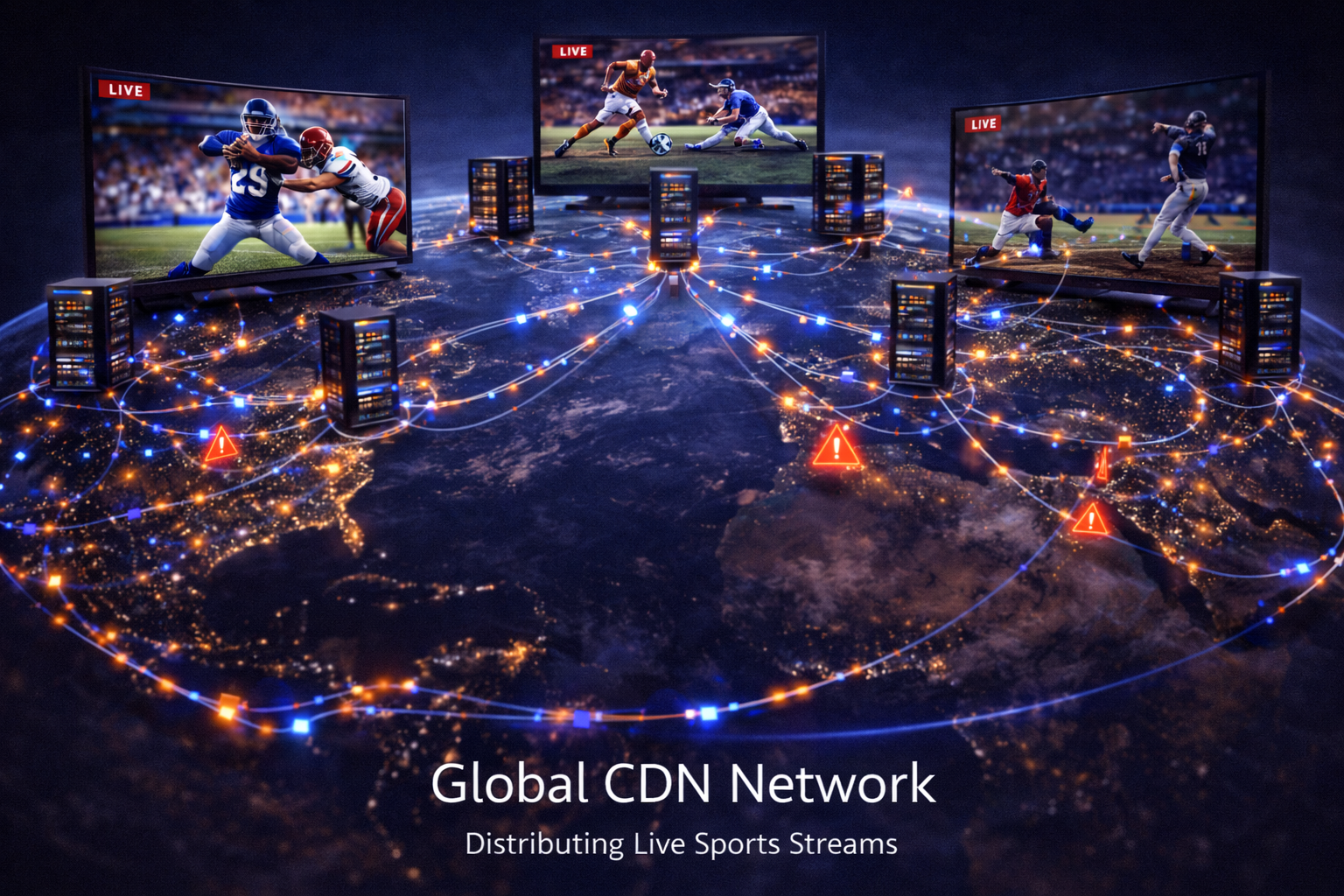
A CDN is a network of distributed servers that deliver content from locations close to users instead of a single central server.
Instead of every viewer connecting to one source, the CDN spreads the load across many servers. :contentReference[oaicite:1]{index=1}
This is essential for live sports where millions of users watch at the same time.
Distance and latency reduction
One of the biggest advantages of CDN is reducing physical distance between the user and the server.
The closer the server is, the faster data arrives, reducing latency and improving playback speed. :contentReference[oaicite:2]{index=2}
Without CDN, data would travel longer distances, increasing delay and buffering risk.
Traffic load distribution
During live sports events, millions of users request the same stream.
A CDN distributes this load across multiple servers, preventing overload on a single source.
This allows the system to scale efficiently and maintain performance under high demand. :contentReference[oaicite:3]{index=3}
How CDN affects buffering
Buffering occurs when data does not arrive fast enough to maintain playback.
CDNs reduce buffering by serving content from nearby servers and maintaining steady data flow.
However, buffering can still happen if other parts of the system fail, such as network congestion or packet loss.
Role of edge servers
Edge servers are the core of CDN performance.
They store or cache video segments and deliver them to users quickly.
When a user starts a stream, the system connects them to the nearest edge server instead of the main origin server.
This reduces delay and improves reliability.
Real time streaming challenges
Live sports streaming is more complex than video on demand.
Data is generated in real time and must be distributed instantly.
Modern systems combine CDN with advanced protocols to handle millions of viewers at scale. :contentReference[oaicite:4]{index=4}
Even with this, maintaining low latency and stability is still a challenge.
Where CDN systems still fail
CDNs are powerful but not perfect.
Performance depends on the entire delivery chain. If one part fails, the whole system is affected.
Issues can occur in encoding, server routing, or network infrastructure. :contentReference[oaicite:5]{index=5}
This is why some streams still buffer even with strong CDN systems.
CDN performance breakdown
| Factor | CDN Impact | Result |
|---|---|---|
| Distance | Reduced | Lower latency |
| Traffic load | Distributed | Stable performance |
| Server availability | Redundant | High reliability |
| Data flow | Optimized | Less buffering |
| System complexity | High | Multiple failure points |
Real world streaming behavior
In real scenarios, CDN performance depends on both infrastructure and external conditions.
Users close to strong CDN nodes experience smooth playback.
Users in weaker network areas may still experience buffering even with CDN support.
This explains why streaming performance varies between users.
For deeper understanding of how delivery models are evolving, you can explore this technical breakdown: Why DirecTV new sports package changes live TV delivery
CDN improves streaming performance significantly, but it cannot eliminate all problems because performance depends on the entire delivery chain.
CDN networks are essential for modern live sports streaming. They reduce latency, distribute load, and improve reliability. However, final performance still depends on network stability, server efficiency, and system design. CDN solves many problems, but not all of them.
FAQ
| Question | Answer |
|---|---|
| What is a CDN in streaming | A network of servers that deliver content closer to users |
| Does CDN reduce buffering | Yes but it depends on overall system performance |
| Why do streams still lag with CDN | Because other factors like network and latency still affect performance |
| Are CDNs used for all streaming | Yes almost all modern streaming platforms use CDNs |
| Is CDN enough for perfect streaming | No it improves performance but does not guarantee perfection |