How Astra 19.2 Signal Changes During the Day
Estimated reading time: 14 minutes.
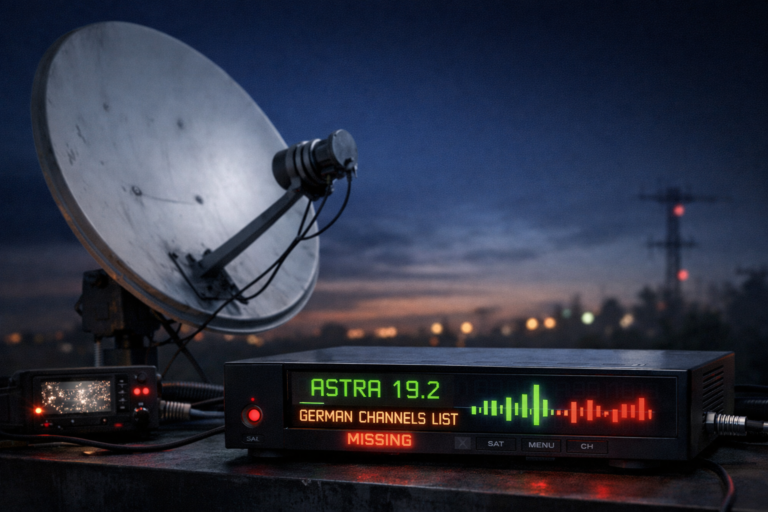
Many users notice that German channels on Astra 19.2 behave differently at different times of the day. In the morning, everything may work perfectly. In the afternoon, some channels become unstable. At night, the signal may improve again or drop depending on conditions. This behavior is not random and it is not caused by the satellite moving. It is the result of how environmental and hardware factors change over time.
Satellite signals travel a long distance and depend on precise alignment and stable hardware conditions. Small changes in temperature, noise, and signal path can affect reception quality. Understanding how the signal changes during the day helps you diagnose time based problems without guessing.
Astra 19.2 signal variation during the day is mainly caused by temperature changes, LNB drift, atmospheric conditions, and installation sensitivity. These factors affect signal quality more than signal strength.
- Why satellite signal changes during the day
- Temperature effects on dish and LNB
- LNB frequency drift and stability
- Atmospheric and environmental changes
- Alignment sensitivity under changing conditions
- Impact on signal quality and decoding
- Common daily signal patterns
- Analytical daily variation table
- How to stabilize signal during the day
- FAQ
Why satellite signal changes during the day
The satellite position remains stable relative to the Earth, but the conditions around your receiving system do not. Temperature, humidity, and hardware behavior change continuously throughout the day.
These changes affect how the signal is received and processed. Even small variations can reduce signal quality enough to create noticeable differences in channel performance.
This is why signal problems often appear at specific times rather than randomly.
Temperature effects on dish and LNB
Temperature changes can slightly alter the physical shape of the dish and the position of the LNB. Metal expands when heated and contracts when cooled.
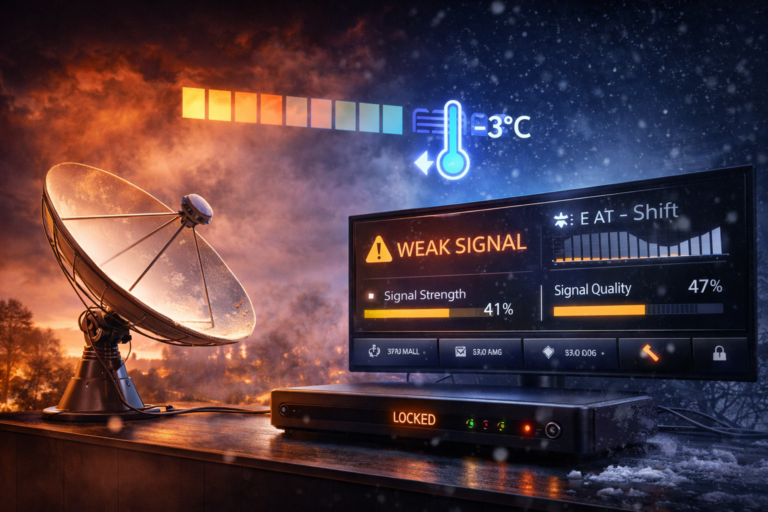
During hot daytime conditions, the dish may lose perfect alignment. This reduces signal focus and lowers quality. At night, cooler temperatures may restore better alignment.
These changes are small but significant enough to affect weak transponders.
LNB frequency drift and stability
The LNB uses an internal oscillator to convert frequencies. This oscillator can drift with temperature changes.
When drift occurs, the receiver may struggle to lock onto the signal correctly. This affects decoding performance and may cause channels to become unstable.
High quality LNBs are more stable and less affected by temperature variations.
Atmospheric and environmental changes
Atmospheric conditions change throughout the day. Heat, humidity, and air density can affect signal propagation.
Although these effects are usually small, they can impact weak signals. Combined with other factors, they may reduce signal quality enough to cause problems.
Cloud formation and moisture levels also vary during the day, affecting signal strength and stability.
Alignment sensitivity under changing conditions
A perfectly aligned dish provides strong and stable reception. However, a slightly misaligned dish becomes more sensitive to environmental changes.
During the day, heat related expansion may worsen alignment errors. At night, cooler conditions may improve them.
This is why some users experience time dependent signal problems.
Impact on signal quality and decoding
Daily variations mainly affect signal quality rather than strength. The receiver may still detect the signal but struggle to decode it.
This leads to freezing, pixelation, or temporary signal loss. Channels with lower signal margins are affected first.
Understanding this helps explain why problems appear at specific times.
Common daily signal patterns
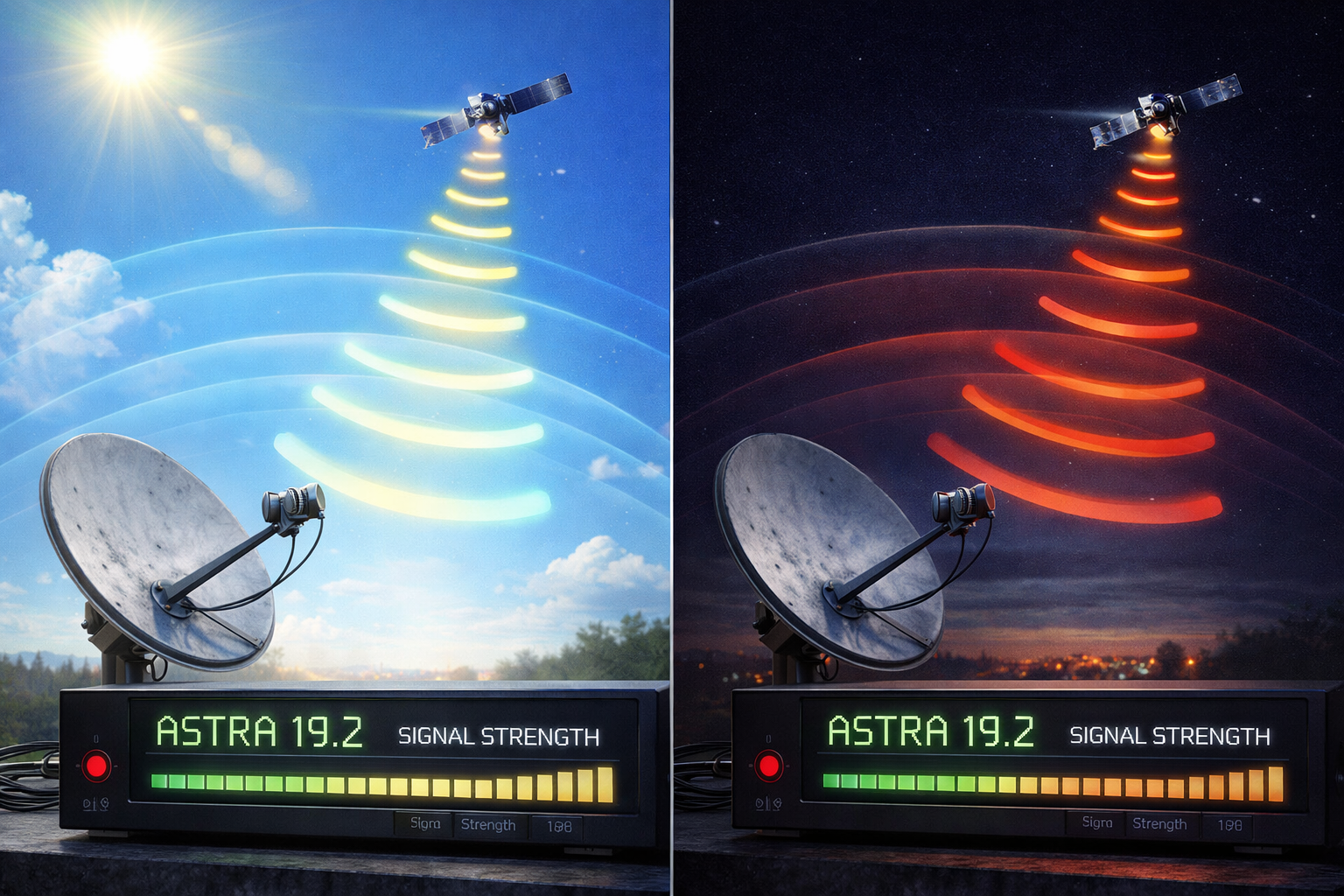
Many users report stable signals in the morning, weaker performance in the afternoon, and recovery in the evening.
Others experience the opposite depending on installation conditions and local environment.
These patterns are linked to temperature cycles and hardware behavior rather than satellite movement.
Analytical daily variation table
| Time of Day | Condition | Signal Effect | Result |
|---|---|---|---|
| Morning | Cool temperature | Stable alignment | Good reception |
| Afternoon | High heat | Alignment shift | Weak signal or freezing |
| Evening | Cooling | Improved alignment | Better reception |
| Night | Low temperature | Stable hardware | Strong signal |
How to stabilize signal during the day
Start by improving dish alignment. Ensure it is perfectly aligned to reduce sensitivity to changes.
Use a high quality LNB with stable frequency performance.
Secure the dish mount to prevent movement or distortion.
Check cables and connectors to minimize signal loss.
Remove obstacles that may affect signal path.
Daily signal variation is normal in satellite systems. It becomes noticeable only when the installation has low signal margin or minor alignment issues.
Astra 19.2 signal changes during the day due to environmental and hardware factors. By improving alignment, using stable components, and understanding signal behavior, you can maintain consistent reception at all times.
FAQ
| Question | Answer |
|---|---|
| Why does signal change during the day | Because of temperature, hardware drift, and environmental changes. |
| Does the satellite move during the day | No. The satellite position remains stable. |
| Can heat affect signal reception | Yes. It can change dish alignment and LNB performance. |
| Why are channels worse in the afternoon | Because heat can reduce signal quality. |
| How can I fix time based signal problems | Improve alignment and use stable hardware. |