Astra Dish Alignment Problems Explained
Estimated reading time: 18 minutes.
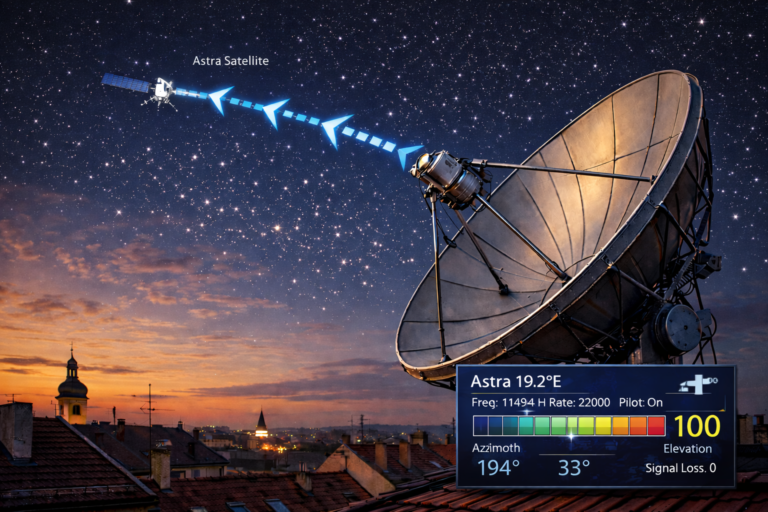
Satellite reception from Astra 19.2 depends heavily on accurate dish alignment. Even small positioning errors can cause signal instability, missing channels, or a complete loss of reception. While modern satellite receivers provide signal meters, the underlying alignment process still requires precise adjustments.
Many reception issues that appear to be technical failures are actually caused by dish direction errors or installation movement. Understanding how alignment works helps households maintain stable satellite reception and prevent repeated signal interruptions.
Quick Context
This guide explains common Astra satellite dish alignment problems, how they affect signal quality, and what installation factors influence long term reception stability.
Why satellite alignment must be precise
Satellite signals originate from objects positioned thousands of kilometers above Earth. From the perspective of a dish installed on a house, the signal appears to arrive from a very narrow direction in the sky.
Because of this geometry the dish must be pointed extremely accurately toward the satellite orbital position. Even a deviation of a few degrees may weaken the signal significantly.
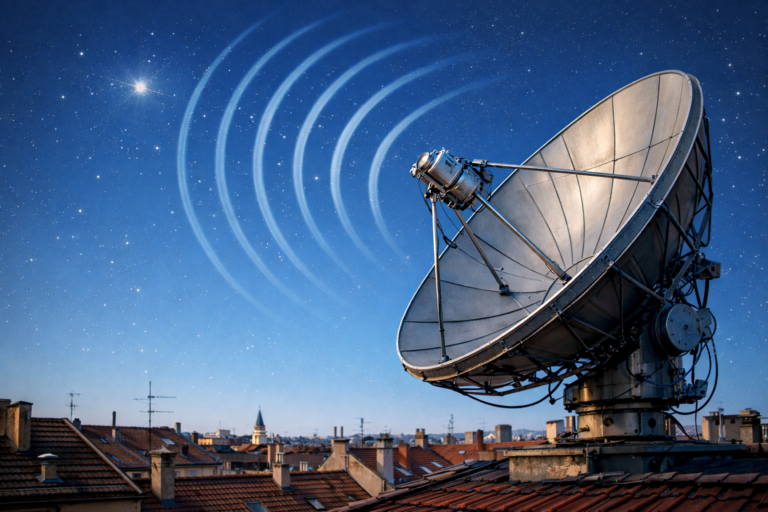
A properly aligned dish focuses the signal toward the LNB placed at the focal point of the reflector. When alignment shifts, the reflected signal may partially miss the LNB.
The result is reduced signal quality and unstable channel reception.
Horizontal direction errors
Azimuth refers to the horizontal direction of the dish. When the dish rotates too far left or right it may point away from the Astra orbital position.
In Central Europe the Astra satellite appears in the southern sky. Installations that accidentally face southwest or southeast instead of the correct direction often suffer from weak signals.
Azimuth errors frequently occur during installation when the initial direction is estimated incorrectly.
Using a receiver signal meter while adjusting the dish slowly helps identify the correct direction.
Elevation angle mistakes
Elevation determines how high the dish points above the horizon. If the elevation angle is too high or too low the signal may not reach the LNB efficiently.
Elevation angles vary depending on geographic location. For example viewers in northern Europe typically require slightly lower elevation angles than those located further south.
Many dish brackets include elevation scales to assist installers during setup.
Fine adjustments are usually required to reach maximum signal quality.
Incorrect LNB skew positioning
The LNB must also be rotated slightly to match the polarization of the satellite signal. This rotation is called skew.
If skew is incorrect the receiver may struggle to decode certain transponders.
Incorrect skew often leads to partial reception problems where some channels work correctly while others show weak signal warnings.
Adjusting the LNB angle according to the satellite polarization improves signal quality across all channels.
Mounting instability and structural movement
Even perfectly aligned dishes can lose signal if the mounting structure is unstable.
Strong wind vibrations or loose mounting bolts may cause the dish to move slightly over time.
This movement changes the dish direction enough to reduce signal quality.
Stable mounting brackets and rigid support structures help maintain alignment accuracy over long periods.
How to diagnose alignment problems
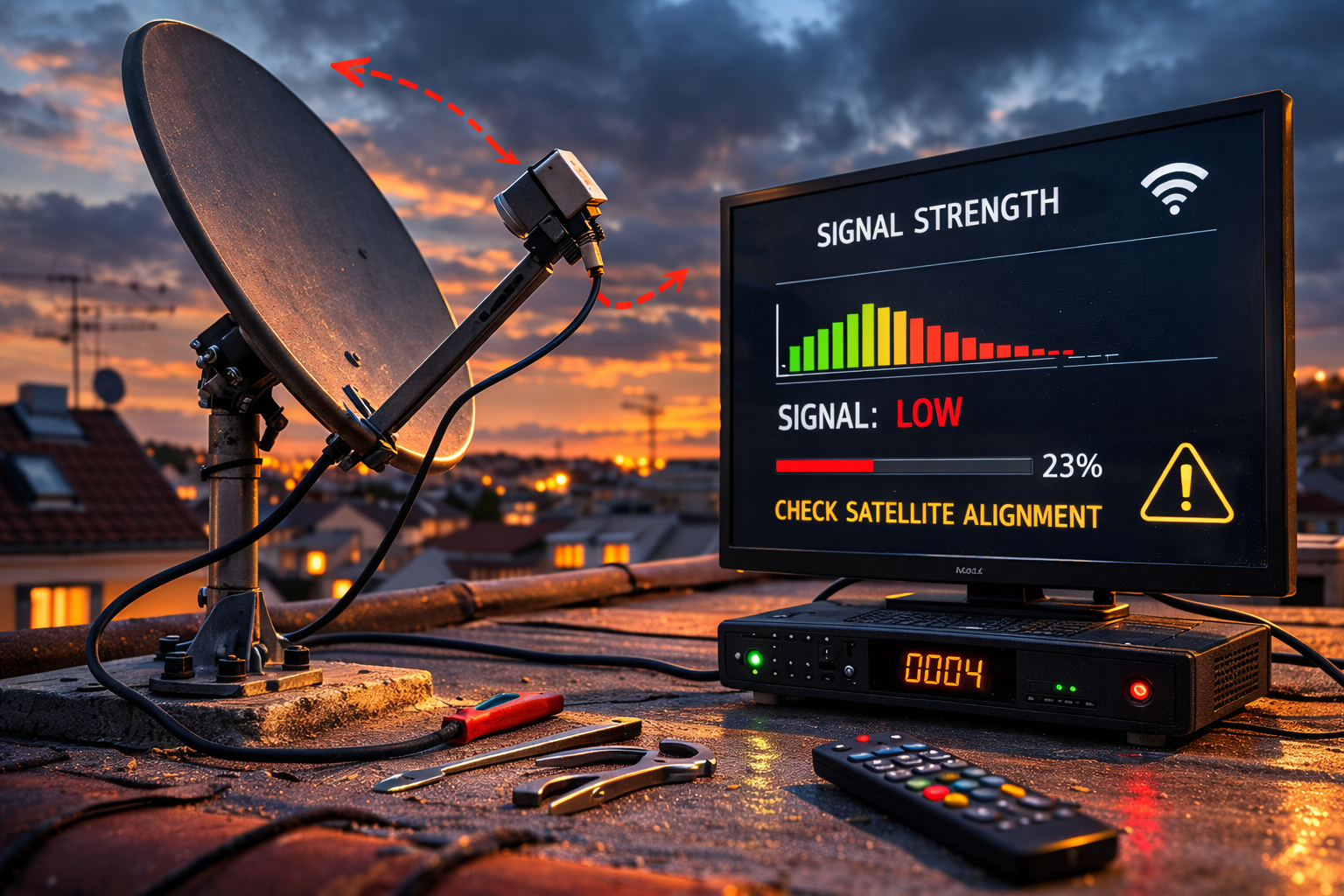
Satellite receivers typically include signal monitoring indicators that display both signal strength and signal quality.
When diagnosing alignment issues installers watch these indicators while adjusting the dish position gradually.
A sudden increase in signal strength usually indicates the dish is approaching the correct direction.
Once the strongest signal is achieved the mounting bracket should be tightened carefully to prevent further movement.
Repeating this process ensures the dish remains locked in the optimal position for Astra reception.
Typical alignment error symptoms
| Symptom | Likely cause | Viewer experience |
|---|---|---|
| Signal fluctuates | Dish slightly misaligned | Picture freezing |
| Some channels missing | Incorrect LNB skew | Partial reception |
| Signal lost after storm | Mounting movement | No signal message |
| Low signal on all channels | Incorrect elevation angle | Weak reception |
Reality Check
Most satellite reception issues attributed to equipment failures are actually caused by small dish alignment errors that develop gradually over time.
Final Verdict
Final Verdict
Astra dish alignment is one of the most critical factors affecting satellite television stability. Proper adjustment of azimuth elevation and LNB skew ensures consistent reception and prevents common signal problems experienced by many households.
Frequently Asked Questions
| Question | Answer |
|---|---|
| How precise must dish alignment be | Satellite dishes must be aligned within a few degrees of the satellite position to maintain stable signal reception. |
| Why do channels disappear after wind storms | Strong winds may slightly shift the dish direction causing signal loss. |
| Can LNB rotation affect reception | Yes incorrect skew may reduce signal quality and prevent certain channels from being decoded. |
| Do satellite dishes need realignment over time | Occasionally yes especially if the mounting structure loosens or environmental conditions change. |