Why Astra 19.2°E Is Critical for Live Sports Broadcasting
Estimated reading time. 8 to 10 minutes.
Live sports broadcasting leaves no room for hesitation. When millions of viewers tune in at the same moment, the delivery system must work perfectly. There is no pause button, no second chance, and no tolerance for failure. Across Europe, Astra 19.2°E plays a quiet but critical role in making sure live sports reach screens without interruption.
For viewers, a live match feels simple. The channel opens, the picture appears, and the game begins. Behind that simplicity is a complex distribution chain built to handle extreme pressure. Sports broadcasting is one of the most demanding tasks in television, and the infrastructure supporting it must be designed for reliability above all else.
- Why live sports put extreme pressure on broadcast systems
- Why reliability matters more than speed
- The specific role of Astra 19.2°E in sports distribution
- Serving multiple countries at the same time
- Satellite as part of broadcast backup strategies
- High demand events and peak traffic moments
- What viewers expect during live sports
- Reality Check
- Final Verdict
- FAQ
Why live sports put extreme pressure on broadcast systems
Live sports differ from almost every other form of television content. There is no buffer, no delayed playback, and no opportunity to fix mistakes after the fact. The signal must arrive on time, in sequence, and without degradation.
When a major match begins, audience numbers rise sharply within seconds. Millions of households may switch to the same channel at once. That sudden concentration creates a stress test for every part of the distribution chain, from signal ingestion to final delivery.
Unlike on demand content, live sports cannot rely on caching or delayed distribution. Every viewer is watching the same moment at the same time. This makes stability more important than raw speed.
Why reliability matters more than speed
In sports broadcasting, reliability is often more valuable than the lowest possible latency. A delay of a few seconds is acceptable. A frozen picture or lost signal is not.
Broadcasters design sports distribution systems with a conservative mindset. The goal is not to be the fastest path, but the most dependable one. Satellite distribution fits well into this philosophy because it delivers a steady signal that is largely unaffected by ground-level congestion.
While fiber and IP networks offer impressive capacity, they are still vulnerable to localized failures. Satellite provides a separate path that does not share those vulnerabilities.
The specific role of Astra 19.2°E in sports distribution
Astra 19.2°E functions as a central distribution point for many European sports channels. Its role is not to create content, but to carry it reliably from production centers to platforms across multiple markets.
Over time, broadcasters have built workflows around this orbital position. Encoding profiles, uplink facilities, and monitoring systems are aligned to ensure predictable behavior during live events.
This long-term alignment reduces operational risk. Engineers know what to expect. Operators know how to respond if something looks unusual. That familiarity is especially valuable when time pressure is high.
Serving multiple countries at the same time
Major sports events rarely belong to a single country. Football tournaments, international competitions, and continental leagues are watched across borders.
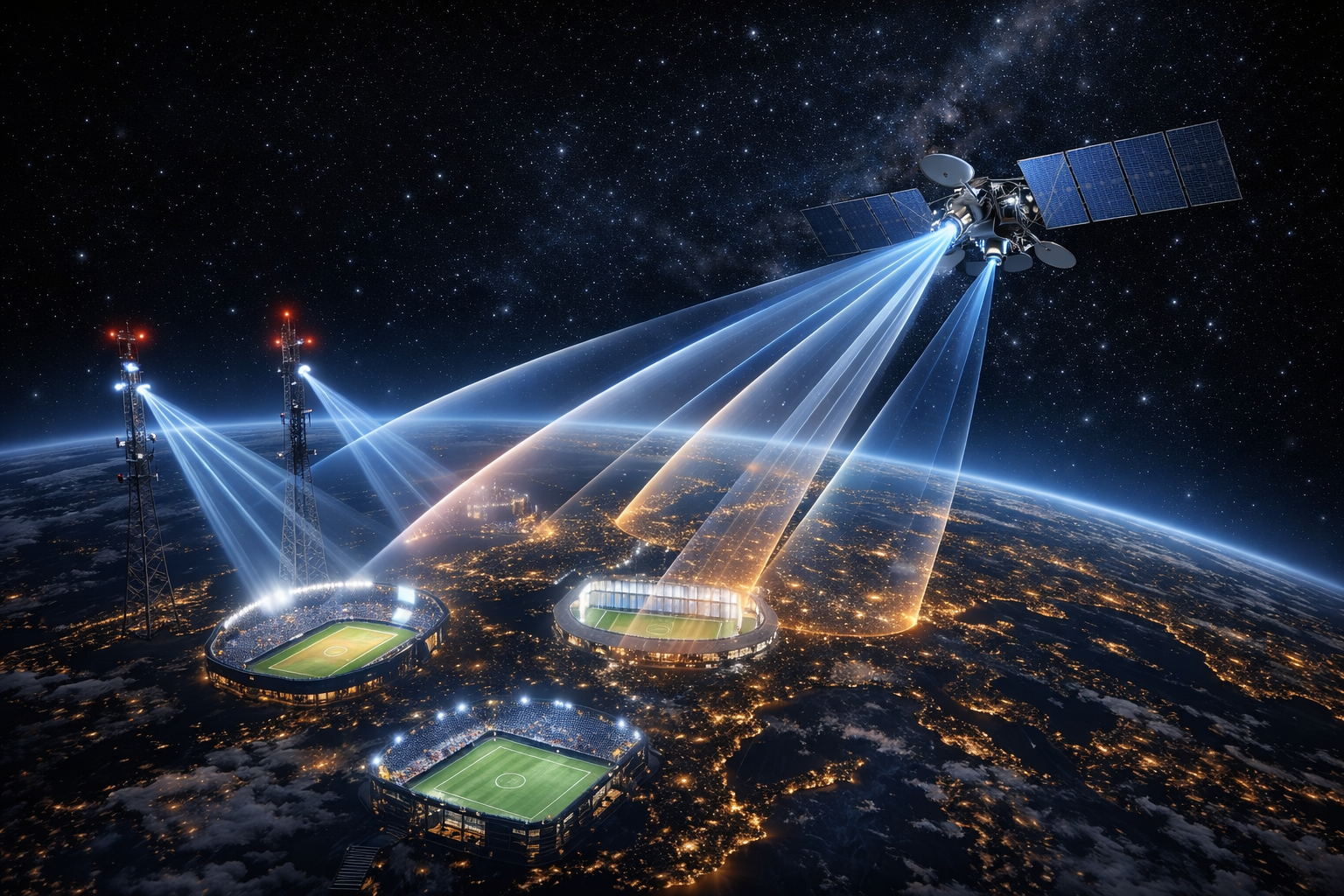
Satellite distribution allows one feed to reach many markets simultaneously. Platforms in different countries can ingest the same signal and deliver it locally without building separate long-haul connections for each one.
This one-to-many model is efficient and predictable. It reduces complexity while ensuring consistent quality across regions.
Satellite as part of broadcast backup strategies
No professional broadcaster relies on a single delivery path. Redundancy is a core principle of sports broadcasting.
Satellite is often used as a backup path, even when fiber is the primary route. If a terrestrial connection fails, the satellite feed can maintain continuity.
This layered approach protects against unexpected outages and ensures that viewers experience fewer disruptions during critical moments.
High demand events and peak traffic moments
Live sports create traffic patterns that are difficult to predict precisely. A dramatic match can attract viewers who were not planning to watch.
Distribution systems must handle these spikes without degradation. Satellite excels here because its broadcast nature does not change with audience size.
Whether ten thousand or ten million viewers are watching, the satellite signal remains the same.
What viewers expect during live sports
Viewers expect live sports to feel immediate and uninterrupted. They may tolerate slight delays, but not instability.
A stable picture, synchronized audio, and consistent availability matter more than technical perfection.
When distribution works as intended, viewers never think about how the signal arrived. That invisibility is a sign of success.
Reality Check
Satellite distribution does not eliminate the need for other delivery systems. It works best as part of a hybrid strategy that includes fiber and IP networks.
Weather conditions and local reception quality can still influence performance, especially at the final reception point.
Final Verdict
Astra 19.2°E is critical for live sports broadcasting because it delivers stability under pressure. It supports one-to-many distribution, cross-border reach, and resilient backup strategies.
In an environment where failure is immediately visible, Astra 19.2°E continues to provide a dependable backbone for European live sports coverage.
FAQ
Is Astra 19.2°E used for live sports only?
No. Live sports are one of its most demanding use cases, but the satellite supports many types of television content.
Does satellite broadcasting replace fiber networks?
No. Most broadcasters use a hybrid approach where satellite complements terrestrial delivery.
Why is satellite reliable during peak events?
Because the signal is broadcast equally regardless of how many people are watching.
Do viewers need satellite dishes to watch?
Not necessarily. Many platforms receive satellite feeds and redistribute them through cable or IPTV.
Will satellite remain important for sports in the future?
Yes. As long as live events require stable, large-scale delivery, satellite will remain a key part of the infrastructure.